
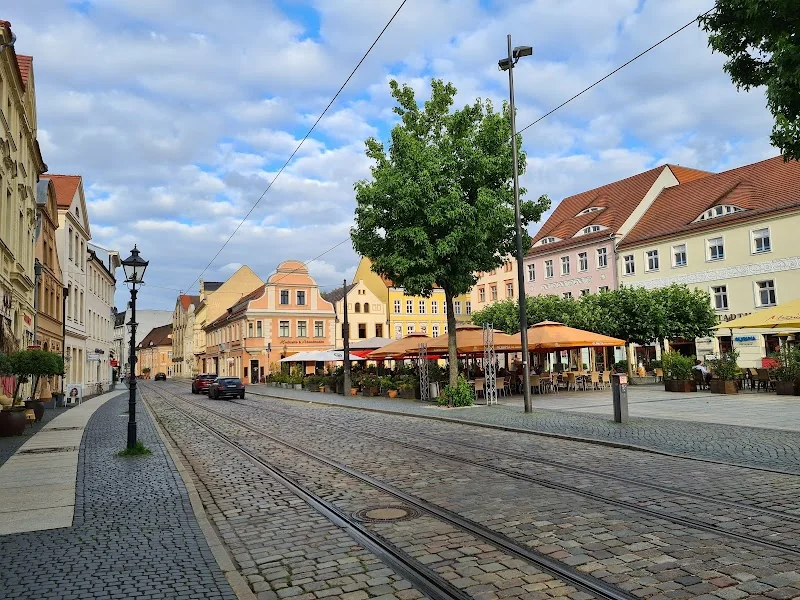
Cottbus
03 Cottbus, Deutschland
Cottbus | Tickets & Events
Cottbus/Chóśebuz is not an anonymous stop on the map, but a city with a very clear profile: It is the second largest city in Brandenburg, the largest city in Lower Lusatia, and a place where history, park landscapes, sports, and events are closely interconnected. Officially, the city refers to its founding in 1156, its location on historic trade routes, and its development from an industrial to a green city. This very mix makes Cottbus exciting for visitors who are looking for more than just a single destination. Here, one can stroll through the old town in the morning, relax in the park in the afternoon, attend a concert, a play, or a football match in the evening, and discover new perspectives on the city in between. Cottbus is also a central hub in Brandenburg, which is reflected in the diversity of infrastructure, cultural offerings, and leisure activities. For SEO searches related to tickets, stadium, Baltic Sea, attractions, parking, and city festivals, Cottbus is therefore a place with a wide thematic range and many concrete points of connection. ([cottbus.de](https://cottbus.de/geschichte-und-traditionen/?utm_source=openai))
Current Events, Tickets, and City Festival in Cottbus
Those looking for Cottbus tickets, Cottbus news, or Cottbus game today quickly find a very broad mix of events. The official event calendar of the city shows that Cottbus not only has a single stage but offers large and small formats throughout the year: markets, tours, concerts, musicals, operas, sports events, and traditional celebrations. Particularly important for external perception are the large city festivals and the ongoing cultural offerings around the city center. The calendar is intentionally presented as a selection and is regularly updated, allowing visitors to filter dates, locations, and categories specifically. For 2025, the city festival has been announced with a three-day program around Altmarkt, Stadthallenvorplatz, Spremberger Straße, Platz am Stadtbrunnen, Puschkinpark, Postparkplatz, and Oberkirche; additionally, over 80 vendors and restaurateurs as well as rides and a laser show have been mentioned. For 2026, therefore, less a rigid date is important than looking at the official calendar, as the city continuously publishes new dates. Those searching for tickets will find not only classic advance sales points in Cottbus but also connections to tourist and municipal service offerings. This is particularly relevant for SEO planning, as the search intentions range from program, tickets, and event location to travel and parking. ([cottbus-tourismus.de](https://cottbus-tourismus.de/de/winter/cottbus-erleben/veranstaltungskalender.html?utm_source=openai))
FC Energie Cottbus, Stadium of Friendship, and Football Experience
A central keyword cluster around Cottbus is football, especially FC Energie Cottbus, Cottbus stadium, and Cottbus energy. According to tourism and city information, the club is considered a sporting landmark and a source of pride for the region. Its home games take place at the Stadium of Friendship, which remains present as the historical name of the stadium and is explicitly associated with the club in the official city presentation. This connection is important for many search queries because fans are not only looking for the club itself but also for tickets, match dates, directions, stadium names, and the supporting program on match day. The tourism site also points out that home games can also be accessed via CottbusService, which clearly illustrates the local service chain between the city, tourism, and the club. For visitors, this means: A game in Cottbus is not just a sporting event but often a complete outing with a city center visit, gastronomy, and further cultural programs. The stadium environment is also structured by municipal safety and order regulations, highlighting the significance of the location for large events. Therefore, communication should not only mention the club but also the stadium, the atmosphere, and the regional importance. Anyone writing about Cottbus without mentioning FC Energie misses one of the strongest identity anchors of the city. ([cottbus-tourismus.de](https://cottbus-tourismus.de/de/winter/cottbus-besonders/winter-in-cottbus/sehenswuerdigkeiten-in-cottbus/artikel-fc-energie-cottbus.html?utm_source=openai))
Cottbuser Baltic Sea, Observation Tower, and Leisure by the Water
The Cottbuser Baltic Sea is one of the most prominent themes when searching for Cottbus maps, Cottbus attractions, or Cottbus weather in a leisure context, as it represents the transformation of the city from a coal to a landscape and leisure region. According to official tourism information, the lake is emerging from the former open-pit mining area Cottbus-Nord; since April 2019, it has been flooded, and the water mainly comes from the Spree. The Baltic Sea is located directly on the outskirts of the city and is described as a future large recreational area. Particularly striking is the 31-meter-high observation tower near Cottbus-Merzdorf, which offers a wide view of the emerging body of water via 173 steps. Parking spaces for cars and buses are available directly at the tower, and the location is now also accessible via bus line 12. This is important for visitors because the Baltic Sea is not just a concept but already a concretely experienceable destination. The city and tourism partners also offer orientation plans and round tours that structure the area for cyclists, hikers, and day visitors. So, if you are looking for a modern, scenically exciting destination in Cottbus, you will find here an example of how the city transforms a former industrial area into a leisure profile with an observation tower, hiking trails, accessibility, and regional storytelling. This contrast between past and future makes the Cottbuser Baltic Sea a strong SEO topic. ([cottbus-tourismus.de](https://cottbus-tourismus.de/de/cottbus-besonders/der-cottbuser-ostsee.html?utm_source=openai))
Attractions in Cottbus: Branitzer Park, Old Town, and Oberkirche
When visitors search for attractions in Cottbus, several places stand out clearly, foremost the Branitzer Park and the Oberkirche St. Nikolai. The Branitzer Park was designed between 1845 and 1871 by Hermann Prince of Pückler-Muskau and is considered an artistic landscape of hills, valleys, and waters that condenses towards the central pleasure ground. Its two earth pyramids, including the lake pyramid as Pückler's burial site, make it one of the most notable garden art works in the region. In addition, the city refers to the Spreeauenpark, which was established in 1995 in the context of the Federal Garden Show on 55 hectares and connects the city center with the Branitz landscape park. For families, the Cottbus Zoo is also important: with 25 hectares, it is the largest zoo in the state of Brandenburg and houses more than 1300 animals. In the old town itself, the Oberkirche St. Nikolai offers another anchor point. It is a late Gothic, three-nave hall church from the 15th century, considered the largest church in Lower Lusatia and offers a wide view over the green city with its 55-meter-high tower. Additionally, there are the city museum, city center, historical squares, and cultural use of the church for concerts and special events. This combination of garden art, animal experiences, sacred architecture, and urban old town makes Cottbus equally attractive for day visitors and weekend travelers. ([cottbus.de](https://cottbus.de/kultur-und-tourismus/parke/parklandschaften-branitz-und-zatonie/park-branitz/?utm_source=openai))
Directions, Parking, and Maps: How to Move Around in Cottbus
Those searching for Cottbus maps, Cottbus traffic, or parking need clear orientation between the city center, event locations, and excursion destinations. The city works with parking space management, parking zones, and digital information; additionally, the parking guidance system has been modernized to make orientation for visitors and locals clearer and less stressful. For central areas like Oberkirche or Friedrich-Ludwig-Jahn-Straße, there are regulated parking spaces that may be closed or managed differently during events. The city has also pointed out that certain parking ticket machines may only be usable cashless. This is important for visitors because especially during city festivals, weekly markets, or match days, short-term changes can occur. For the Cottbuser Baltic Sea, there is also a separate orientation plan with tour suggestions, accessibility by bicycle, on foot, by public buses, and motorized transport, as well as connections for navigation via map applications. Bus line 12 connects the Baltic Sea observation tower with the city promenade and Kolkwitz, making travel without a car easier. Those wanting to experience Cottbus efficiently should therefore not plan the route in isolation but understand it as part of the experience: city center, park, stadium, and Baltic Sea are located in a network of footpaths, public transport, parking areas, and tourist signage. This practical, service-oriented structure is a strong argument for visitors who appreciate short distances and good accessibility. ([cottbus.de](https://cottbus.de/wp-content/uploads/2025/05/.files_oparl_file_82b1db00-fb01-472c-bc6d-494904ba7574_vorlage_6644_Dokument_3.pdf.pdf?utm_source=openai))
History, City Profile, and Why Cottbus is So Special
Cottbus is not just a place for individual attractions but a city with historical depth and a very clear self-understanding. The official city history points out that Cottbus was founded in 1156 and was located at the intersection of important trade routes. From this origin, a city developed that over time was both industrially shaped and culturally and scenically upgraded. Today, Cottbus describes itself as a green city, as a location for education and sports, and as a central hub in Brandenburg. For the current population statistics, it is particularly relevant that on March 31, 2026, the city counted 100,112 residents with primary residence. Thus, Cottbus is not only the second largest city in the state of Brandenburg but also the largest city in Lower Lusatia. This size explains why the city serves so many different thematic fields simultaneously: historical architecture, modern events, football, landscape parks, science, and economy. The city marketing explicitly pursues the goal of making Cottbus visible as an attractive location for residents, visitors, businesses, and investors. This is precisely where the SEO value of the city arises: Cottbus is a place where search intentions do not only go in one direction but branch out between culture, sports, tourism, events, parking, news, weather, and regional identity. Therefore, anyone writing about Cottbus should always consider the overall character: a city that convincingly connects tradition and change, city center and nature, football and garden art, everyday life and large events. ([cottbus.de](https://cottbus.de/geschichte-und-traditionen/?utm_source=openai))
Sources:
- City Cottbus/Chóśebuz – Attractions and City Tours ([cottbus.de](https://cottbus.de/kultur-und-tourismus/sehenswuerdigkeiten/?utm_source=openai))
- City Cottbus/Chóśebuz – History of the City, Founded in 1156 and Development into a Green City ([cottbus.de](https://cottbus.de/geschichte-und-traditionen/?utm_source=openai))
- FC Energie Cottbus and Stadium of Friendship ([cottbus-tourismus.de](https://cottbus-tourismus.de/de/winter/cottbus-besonders/winter-in-cottbus/sehenswuerdigkeiten-in-cottbus/artikel-fc-energie-cottbus.html?utm_source=openai))
- Cottbuser Baltic Sea, Observation Tower, and Mobility ([cottbus-tourismus.de](https://cottbus-tourismus.de/de/cottbus-besonders/der-cottbuser-ostsee.html?utm_source=openai))
- City Festival, Parking, and City Center Service ([cottbus-tourismus.de](https://cottbus-tourismus.de/de/winter/cottbus-erleben/veranstaltungskalender/artikel-32_stadtfest_cottbus.html?utm_source=openai))
Mehr anzeigenWeniger anzeigen
Cottbus | Tickets & Events
Cottbus/Chóśebuz is not an anonymous stop on the map, but a city with a very clear profile: It is the second largest city in Brandenburg, the largest city in Lower Lusatia, and a place where history, park landscapes, sports, and events are closely interconnected. Officially, the city refers to its founding in 1156, its location on historic trade routes, and its development from an industrial to a green city. This very mix makes Cottbus exciting for visitors who are looking for more than just a single destination. Here, one can stroll through the old town in the morning, relax in the park in the afternoon, attend a concert, a play, or a football match in the evening, and discover new perspectives on the city in between. Cottbus is also a central hub in Brandenburg, which is reflected in the diversity of infrastructure, cultural offerings, and leisure activities. For SEO searches related to tickets, stadium, Baltic Sea, attractions, parking, and city festivals, Cottbus is therefore a place with a wide thematic range and many concrete points of connection. ([cottbus.de](https://cottbus.de/geschichte-und-traditionen/?utm_source=openai))
Current Events, Tickets, and City Festival in Cottbus
Those looking for Cottbus tickets, Cottbus news, or Cottbus game today quickly find a very broad mix of events. The official event calendar of the city shows that Cottbus not only has a single stage but offers large and small formats throughout the year: markets, tours, concerts, musicals, operas, sports events, and traditional celebrations. Particularly important for external perception are the large city festivals and the ongoing cultural offerings around the city center. The calendar is intentionally presented as a selection and is regularly updated, allowing visitors to filter dates, locations, and categories specifically. For 2025, the city festival has been announced with a three-day program around Altmarkt, Stadthallenvorplatz, Spremberger Straße, Platz am Stadtbrunnen, Puschkinpark, Postparkplatz, and Oberkirche; additionally, over 80 vendors and restaurateurs as well as rides and a laser show have been mentioned. For 2026, therefore, less a rigid date is important than looking at the official calendar, as the city continuously publishes new dates. Those searching for tickets will find not only classic advance sales points in Cottbus but also connections to tourist and municipal service offerings. This is particularly relevant for SEO planning, as the search intentions range from program, tickets, and event location to travel and parking. ([cottbus-tourismus.de](https://cottbus-tourismus.de/de/winter/cottbus-erleben/veranstaltungskalender.html?utm_source=openai))
FC Energie Cottbus, Stadium of Friendship, and Football Experience
A central keyword cluster around Cottbus is football, especially FC Energie Cottbus, Cottbus stadium, and Cottbus energy. According to tourism and city information, the club is considered a sporting landmark and a source of pride for the region. Its home games take place at the Stadium of Friendship, which remains present as the historical name of the stadium and is explicitly associated with the club in the official city presentation. This connection is important for many search queries because fans are not only looking for the club itself but also for tickets, match dates, directions, stadium names, and the supporting program on match day. The tourism site also points out that home games can also be accessed via CottbusService, which clearly illustrates the local service chain between the city, tourism, and the club. For visitors, this means: A game in Cottbus is not just a sporting event but often a complete outing with a city center visit, gastronomy, and further cultural programs. The stadium environment is also structured by municipal safety and order regulations, highlighting the significance of the location for large events. Therefore, communication should not only mention the club but also the stadium, the atmosphere, and the regional importance. Anyone writing about Cottbus without mentioning FC Energie misses one of the strongest identity anchors of the city. ([cottbus-tourismus.de](https://cottbus-tourismus.de/de/winter/cottbus-besonders/winter-in-cottbus/sehenswuerdigkeiten-in-cottbus/artikel-fc-energie-cottbus.html?utm_source=openai))
Cottbuser Baltic Sea, Observation Tower, and Leisure by the Water
The Cottbuser Baltic Sea is one of the most prominent themes when searching for Cottbus maps, Cottbus attractions, or Cottbus weather in a leisure context, as it represents the transformation of the city from a coal to a landscape and leisure region. According to official tourism information, the lake is emerging from the former open-pit mining area Cottbus-Nord; since April 2019, it has been flooded, and the water mainly comes from the Spree. The Baltic Sea is located directly on the outskirts of the city and is described as a future large recreational area. Particularly striking is the 31-meter-high observation tower near Cottbus-Merzdorf, which offers a wide view of the emerging body of water via 173 steps. Parking spaces for cars and buses are available directly at the tower, and the location is now also accessible via bus line 12. This is important for visitors because the Baltic Sea is not just a concept but already a concretely experienceable destination. The city and tourism partners also offer orientation plans and round tours that structure the area for cyclists, hikers, and day visitors. So, if you are looking for a modern, scenically exciting destination in Cottbus, you will find here an example of how the city transforms a former industrial area into a leisure profile with an observation tower, hiking trails, accessibility, and regional storytelling. This contrast between past and future makes the Cottbuser Baltic Sea a strong SEO topic. ([cottbus-tourismus.de](https://cottbus-tourismus.de/de/cottbus-besonders/der-cottbuser-ostsee.html?utm_source=openai))
Attractions in Cottbus: Branitzer Park, Old Town, and Oberkirche
When visitors search for attractions in Cottbus, several places stand out clearly, foremost the Branitzer Park and the Oberkirche St. Nikolai. The Branitzer Park was designed between 1845 and 1871 by Hermann Prince of Pückler-Muskau and is considered an artistic landscape of hills, valleys, and waters that condenses towards the central pleasure ground. Its two earth pyramids, including the lake pyramid as Pückler's burial site, make it one of the most notable garden art works in the region. In addition, the city refers to the Spreeauenpark, which was established in 1995 in the context of the Federal Garden Show on 55 hectares and connects the city center with the Branitz landscape park. For families, the Cottbus Zoo is also important: with 25 hectares, it is the largest zoo in the state of Brandenburg and houses more than 1300 animals. In the old town itself, the Oberkirche St. Nikolai offers another anchor point. It is a late Gothic, three-nave hall church from the 15th century, considered the largest church in Lower Lusatia and offers a wide view over the green city with its 55-meter-high tower. Additionally, there are the city museum, city center, historical squares, and cultural use of the church for concerts and special events. This combination of garden art, animal experiences, sacred architecture, and urban old town makes Cottbus equally attractive for day visitors and weekend travelers. ([cottbus.de](https://cottbus.de/kultur-und-tourismus/parke/parklandschaften-branitz-und-zatonie/park-branitz/?utm_source=openai))
Directions, Parking, and Maps: How to Move Around in Cottbus
Those searching for Cottbus maps, Cottbus traffic, or parking need clear orientation between the city center, event locations, and excursion destinations. The city works with parking space management, parking zones, and digital information; additionally, the parking guidance system has been modernized to make orientation for visitors and locals clearer and less stressful. For central areas like Oberkirche or Friedrich-Ludwig-Jahn-Straße, there are regulated parking spaces that may be closed or managed differently during events. The city has also pointed out that certain parking ticket machines may only be usable cashless. This is important for visitors because especially during city festivals, weekly markets, or match days, short-term changes can occur. For the Cottbuser Baltic Sea, there is also a separate orientation plan with tour suggestions, accessibility by bicycle, on foot, by public buses, and motorized transport, as well as connections for navigation via map applications. Bus line 12 connects the Baltic Sea observation tower with the city promenade and Kolkwitz, making travel without a car easier. Those wanting to experience Cottbus efficiently should therefore not plan the route in isolation but understand it as part of the experience: city center, park, stadium, and Baltic Sea are located in a network of footpaths, public transport, parking areas, and tourist signage. This practical, service-oriented structure is a strong argument for visitors who appreciate short distances and good accessibility. ([cottbus.de](https://cottbus.de/wp-content/uploads/2025/05/.files_oparl_file_82b1db00-fb01-472c-bc6d-494904ba7574_vorlage_6644_Dokument_3.pdf.pdf?utm_source=openai))
History, City Profile, and Why Cottbus is So Special
Cottbus is not just a place for individual attractions but a city with historical depth and a very clear self-understanding. The official city history points out that Cottbus was founded in 1156 and was located at the intersection of important trade routes. From this origin, a city developed that over time was both industrially shaped and culturally and scenically upgraded. Today, Cottbus describes itself as a green city, as a location for education and sports, and as a central hub in Brandenburg. For the current population statistics, it is particularly relevant that on March 31, 2026, the city counted 100,112 residents with primary residence. Thus, Cottbus is not only the second largest city in the state of Brandenburg but also the largest city in Lower Lusatia. This size explains why the city serves so many different thematic fields simultaneously: historical architecture, modern events, football, landscape parks, science, and economy. The city marketing explicitly pursues the goal of making Cottbus visible as an attractive location for residents, visitors, businesses, and investors. This is precisely where the SEO value of the city arises: Cottbus is a place where search intentions do not only go in one direction but branch out between culture, sports, tourism, events, parking, news, weather, and regional identity. Therefore, anyone writing about Cottbus should always consider the overall character: a city that convincingly connects tradition and change, city center and nature, football and garden art, everyday life and large events. ([cottbus.de](https://cottbus.de/geschichte-und-traditionen/?utm_source=openai))
Sources:
- City Cottbus/Chóśebuz – Attractions and City Tours ([cottbus.de](https://cottbus.de/kultur-und-tourismus/sehenswuerdigkeiten/?utm_source=openai))
- City Cottbus/Chóśebuz – History of the City, Founded in 1156 and Development into a Green City ([cottbus.de](https://cottbus.de/geschichte-und-traditionen/?utm_source=openai))
- FC Energie Cottbus and Stadium of Friendship ([cottbus-tourismus.de](https://cottbus-tourismus.de/de/winter/cottbus-besonders/winter-in-cottbus/sehenswuerdigkeiten-in-cottbus/artikel-fc-energie-cottbus.html?utm_source=openai))
- Cottbuser Baltic Sea, Observation Tower, and Mobility ([cottbus-tourismus.de](https://cottbus-tourismus.de/de/cottbus-besonders/der-cottbuser-ostsee.html?utm_source=openai))
- City Festival, Parking, and City Center Service ([cottbus-tourismus.de](https://cottbus-tourismus.de/de/winter/cottbus-erleben/veranstaltungskalender/artikel-32_stadtfest_cottbus.html?utm_source=openai))
Cottbus | Tickets & Events
Cottbus/Chóśebuz is not an anonymous stop on the map, but a city with a very clear profile: It is the second largest city in Brandenburg, the largest city in Lower Lusatia, and a place where history, park landscapes, sports, and events are closely interconnected. Officially, the city refers to its founding in 1156, its location on historic trade routes, and its development from an industrial to a green city. This very mix makes Cottbus exciting for visitors who are looking for more than just a single destination. Here, one can stroll through the old town in the morning, relax in the park in the afternoon, attend a concert, a play, or a football match in the evening, and discover new perspectives on the city in between. Cottbus is also a central hub in Brandenburg, which is reflected in the diversity of infrastructure, cultural offerings, and leisure activities. For SEO searches related to tickets, stadium, Baltic Sea, attractions, parking, and city festivals, Cottbus is therefore a place with a wide thematic range and many concrete points of connection. ([cottbus.de](https://cottbus.de/geschichte-und-traditionen/?utm_source=openai))
Current Events, Tickets, and City Festival in Cottbus
Those looking for Cottbus tickets, Cottbus news, or Cottbus game today quickly find a very broad mix of events. The official event calendar of the city shows that Cottbus not only has a single stage but offers large and small formats throughout the year: markets, tours, concerts, musicals, operas, sports events, and traditional celebrations. Particularly important for external perception are the large city festivals and the ongoing cultural offerings around the city center. The calendar is intentionally presented as a selection and is regularly updated, allowing visitors to filter dates, locations, and categories specifically. For 2025, the city festival has been announced with a three-day program around Altmarkt, Stadthallenvorplatz, Spremberger Straße, Platz am Stadtbrunnen, Puschkinpark, Postparkplatz, and Oberkirche; additionally, over 80 vendors and restaurateurs as well as rides and a laser show have been mentioned. For 2026, therefore, less a rigid date is important than looking at the official calendar, as the city continuously publishes new dates. Those searching for tickets will find not only classic advance sales points in Cottbus but also connections to tourist and municipal service offerings. This is particularly relevant for SEO planning, as the search intentions range from program, tickets, and event location to travel and parking. ([cottbus-tourismus.de](https://cottbus-tourismus.de/de/winter/cottbus-erleben/veranstaltungskalender.html?utm_source=openai))
FC Energie Cottbus, Stadium of Friendship, and Football Experience
A central keyword cluster around Cottbus is football, especially FC Energie Cottbus, Cottbus stadium, and Cottbus energy. According to tourism and city information, the club is considered a sporting landmark and a source of pride for the region. Its home games take place at the Stadium of Friendship, which remains present as the historical name of the stadium and is explicitly associated with the club in the official city presentation. This connection is important for many search queries because fans are not only looking for the club itself but also for tickets, match dates, directions, stadium names, and the supporting program on match day. The tourism site also points out that home games can also be accessed via CottbusService, which clearly illustrates the local service chain between the city, tourism, and the club. For visitors, this means: A game in Cottbus is not just a sporting event but often a complete outing with a city center visit, gastronomy, and further cultural programs. The stadium environment is also structured by municipal safety and order regulations, highlighting the significance of the location for large events. Therefore, communication should not only mention the club but also the stadium, the atmosphere, and the regional importance. Anyone writing about Cottbus without mentioning FC Energie misses one of the strongest identity anchors of the city. ([cottbus-tourismus.de](https://cottbus-tourismus.de/de/winter/cottbus-besonders/winter-in-cottbus/sehenswuerdigkeiten-in-cottbus/artikel-fc-energie-cottbus.html?utm_source=openai))
Cottbuser Baltic Sea, Observation Tower, and Leisure by the Water
The Cottbuser Baltic Sea is one of the most prominent themes when searching for Cottbus maps, Cottbus attractions, or Cottbus weather in a leisure context, as it represents the transformation of the city from a coal to a landscape and leisure region. According to official tourism information, the lake is emerging from the former open-pit mining area Cottbus-Nord; since April 2019, it has been flooded, and the water mainly comes from the Spree. The Baltic Sea is located directly on the outskirts of the city and is described as a future large recreational area. Particularly striking is the 31-meter-high observation tower near Cottbus-Merzdorf, which offers a wide view of the emerging body of water via 173 steps. Parking spaces for cars and buses are available directly at the tower, and the location is now also accessible via bus line 12. This is important for visitors because the Baltic Sea is not just a concept but already a concretely experienceable destination. The city and tourism partners also offer orientation plans and round tours that structure the area for cyclists, hikers, and day visitors. So, if you are looking for a modern, scenically exciting destination in Cottbus, you will find here an example of how the city transforms a former industrial area into a leisure profile with an observation tower, hiking trails, accessibility, and regional storytelling. This contrast between past and future makes the Cottbuser Baltic Sea a strong SEO topic. ([cottbus-tourismus.de](https://cottbus-tourismus.de/de/cottbus-besonders/der-cottbuser-ostsee.html?utm_source=openai))
Attractions in Cottbus: Branitzer Park, Old Town, and Oberkirche
When visitors search for attractions in Cottbus, several places stand out clearly, foremost the Branitzer Park and the Oberkirche St. Nikolai. The Branitzer Park was designed between 1845 and 1871 by Hermann Prince of Pückler-Muskau and is considered an artistic landscape of hills, valleys, and waters that condenses towards the central pleasure ground. Its two earth pyramids, including the lake pyramid as Pückler's burial site, make it one of the most notable garden art works in the region. In addition, the city refers to the Spreeauenpark, which was established in 1995 in the context of the Federal Garden Show on 55 hectares and connects the city center with the Branitz landscape park. For families, the Cottbus Zoo is also important: with 25 hectares, it is the largest zoo in the state of Brandenburg and houses more than 1300 animals. In the old town itself, the Oberkirche St. Nikolai offers another anchor point. It is a late Gothic, three-nave hall church from the 15th century, considered the largest church in Lower Lusatia and offers a wide view over the green city with its 55-meter-high tower. Additionally, there are the city museum, city center, historical squares, and cultural use of the church for concerts and special events. This combination of garden art, animal experiences, sacred architecture, and urban old town makes Cottbus equally attractive for day visitors and weekend travelers. ([cottbus.de](https://cottbus.de/kultur-und-tourismus/parke/parklandschaften-branitz-und-zatonie/park-branitz/?utm_source=openai))
Directions, Parking, and Maps: How to Move Around in Cottbus
Those searching for Cottbus maps, Cottbus traffic, or parking need clear orientation between the city center, event locations, and excursion destinations. The city works with parking space management, parking zones, and digital information; additionally, the parking guidance system has been modernized to make orientation for visitors and locals clearer and less stressful. For central areas like Oberkirche or Friedrich-Ludwig-Jahn-Straße, there are regulated parking spaces that may be closed or managed differently during events. The city has also pointed out that certain parking ticket machines may only be usable cashless. This is important for visitors because especially during city festivals, weekly markets, or match days, short-term changes can occur. For the Cottbuser Baltic Sea, there is also a separate orientation plan with tour suggestions, accessibility by bicycle, on foot, by public buses, and motorized transport, as well as connections for navigation via map applications. Bus line 12 connects the Baltic Sea observation tower with the city promenade and Kolkwitz, making travel without a car easier. Those wanting to experience Cottbus efficiently should therefore not plan the route in isolation but understand it as part of the experience: city center, park, stadium, and Baltic Sea are located in a network of footpaths, public transport, parking areas, and tourist signage. This practical, service-oriented structure is a strong argument for visitors who appreciate short distances and good accessibility. ([cottbus.de](https://cottbus.de/wp-content/uploads/2025/05/.files_oparl_file_82b1db00-fb01-472c-bc6d-494904ba7574_vorlage_6644_Dokument_3.pdf.pdf?utm_source=openai))
History, City Profile, and Why Cottbus is So Special
Cottbus is not just a place for individual attractions but a city with historical depth and a very clear self-understanding. The official city history points out that Cottbus was founded in 1156 and was located at the intersection of important trade routes. From this origin, a city developed that over time was both industrially shaped and culturally and scenically upgraded. Today, Cottbus describes itself as a green city, as a location for education and sports, and as a central hub in Brandenburg. For the current population statistics, it is particularly relevant that on March 31, 2026, the city counted 100,112 residents with primary residence. Thus, Cottbus is not only the second largest city in the state of Brandenburg but also the largest city in Lower Lusatia. This size explains why the city serves so many different thematic fields simultaneously: historical architecture, modern events, football, landscape parks, science, and economy. The city marketing explicitly pursues the goal of making Cottbus visible as an attractive location for residents, visitors, businesses, and investors. This is precisely where the SEO value of the city arises: Cottbus is a place where search intentions do not only go in one direction but branch out between culture, sports, tourism, events, parking, news, weather, and regional identity. Therefore, anyone writing about Cottbus should always consider the overall character: a city that convincingly connects tradition and change, city center and nature, football and garden art, everyday life and large events. ([cottbus.de](https://cottbus.de/geschichte-und-traditionen/?utm_source=openai))
Sources:
- City Cottbus/Chóśebuz – Attractions and City Tours ([cottbus.de](https://cottbus.de/kultur-und-tourismus/sehenswuerdigkeiten/?utm_source=openai))
- City Cottbus/Chóśebuz – History of the City, Founded in 1156 and Development into a Green City ([cottbus.de](https://cottbus.de/geschichte-und-traditionen/?utm_source=openai))
- FC Energie Cottbus and Stadium of Friendship ([cottbus-tourismus.de](https://cottbus-tourismus.de/de/winter/cottbus-besonders/winter-in-cottbus/sehenswuerdigkeiten-in-cottbus/artikel-fc-energie-cottbus.html?utm_source=openai))
- Cottbuser Baltic Sea, Observation Tower, and Mobility ([cottbus-tourismus.de](https://cottbus-tourismus.de/de/cottbus-besonders/der-cottbuser-ostsee.html?utm_source=openai))
- City Festival, Parking, and City Center Service ([cottbus-tourismus.de](https://cottbus-tourismus.de/de/winter/cottbus-erleben/veranstaltungskalender/artikel-32_stadtfest_cottbus.html?utm_source=openai))
Upcoming Events
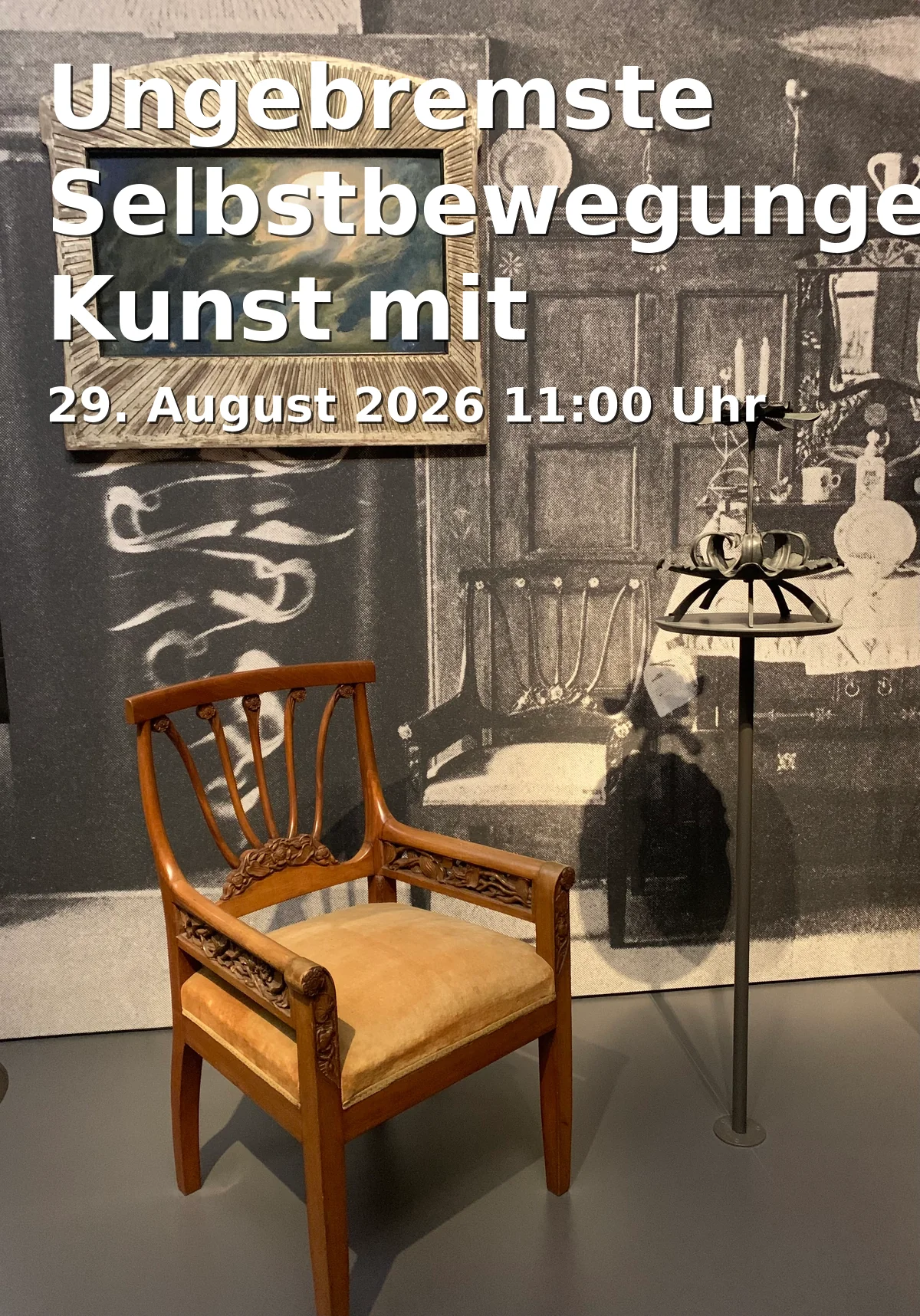
Unconstrained Self-Movements. Art with Photography in the GDR
Experience exciting GDR photo art in Cottbus: Unconstrained Self-Movements showcases experimental images full of courage, energy, and boundary-pushing. #Art
Unbraked Self-Movements – Art with Photography in the GDR
Photography as a Starting Point: In the Diesel Power Plant Cottbus, GDR art becomes newly experienceable. Experimental, intelligently curated, and full of visual power. #Cottbus #Art

Lausitz Festival: Jonathas de Andrade: The Bright Glare of the Edges
Jonathas de Andrade presents in Cottbus an exhibition full of tension, connection to nature, and social depth. Experience art live now! #LausitzFestival

Denis Galloway – Woblica from a Forgotten House / Faces of an Era
Historical glass negatives, Sorbian costumes, and silent faces of an era: This exhibition makes memory tangible. Free admission. #Cottbus #Exhibition
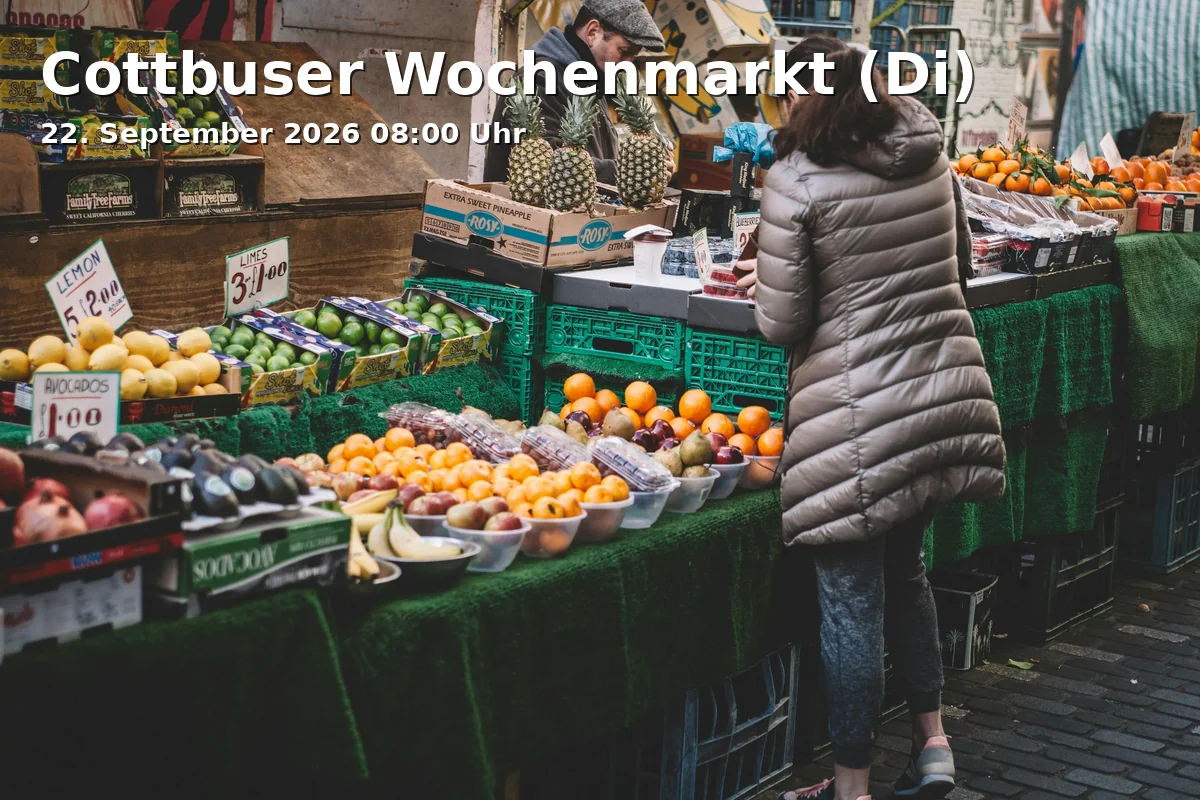
Cottbus Weekly Market (Tue)
Tuesday is market day in Cottbus: Fresh products, regional variety, and real Lusatian market culture await at Oberkirchplatz. 22.09.2026, free entry. #WeeklyMarket
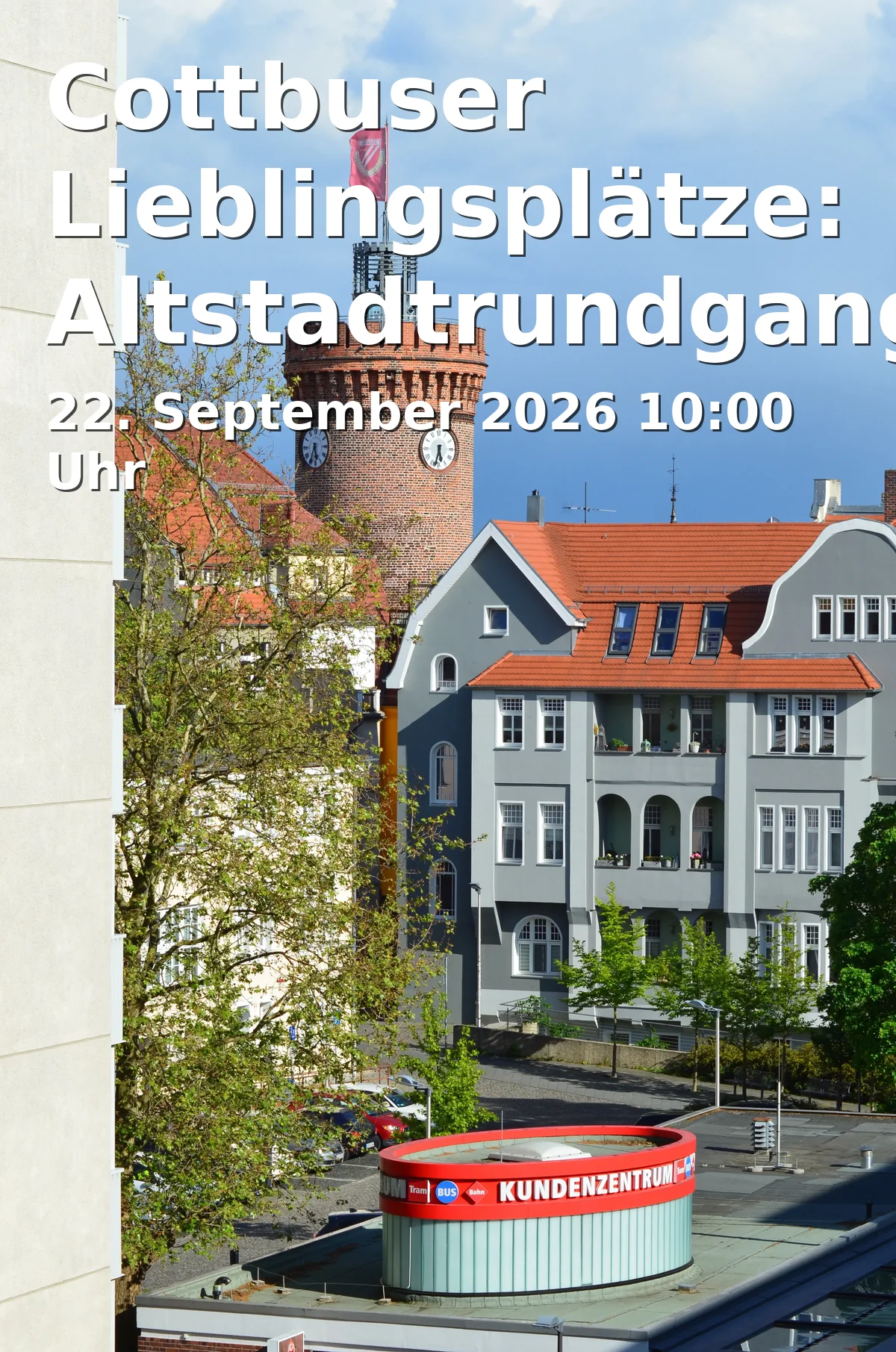
Cottbus' Favorite Places: Old Town Tour (Tue)
Discover Cottbus new: The Old Town tour leads to favorite places, Altmarkt, and Stadtmauer. On 22.09.2026 at 10:00 AM from City Hall. #Cottbus
Opening of the traveling exhibition Education Through Work. Asocials as Enemies of the State in the GDR
An moving evening in Cottbus: The traveling exhibition on GDR injustice, stigmatization, and human dignity opens on 09/22/2026. Admission is free. #CultureOfRemembrance
Traveling Exhibition Education through Work – Asocials as Enemies of the State in the GDR
A compelling traveling exhibition in Cottbus: Photos, documents and eyewitnesses make the injustice of the GDR visible. 22.09.2026, free admission. #CultureOfRemembrance
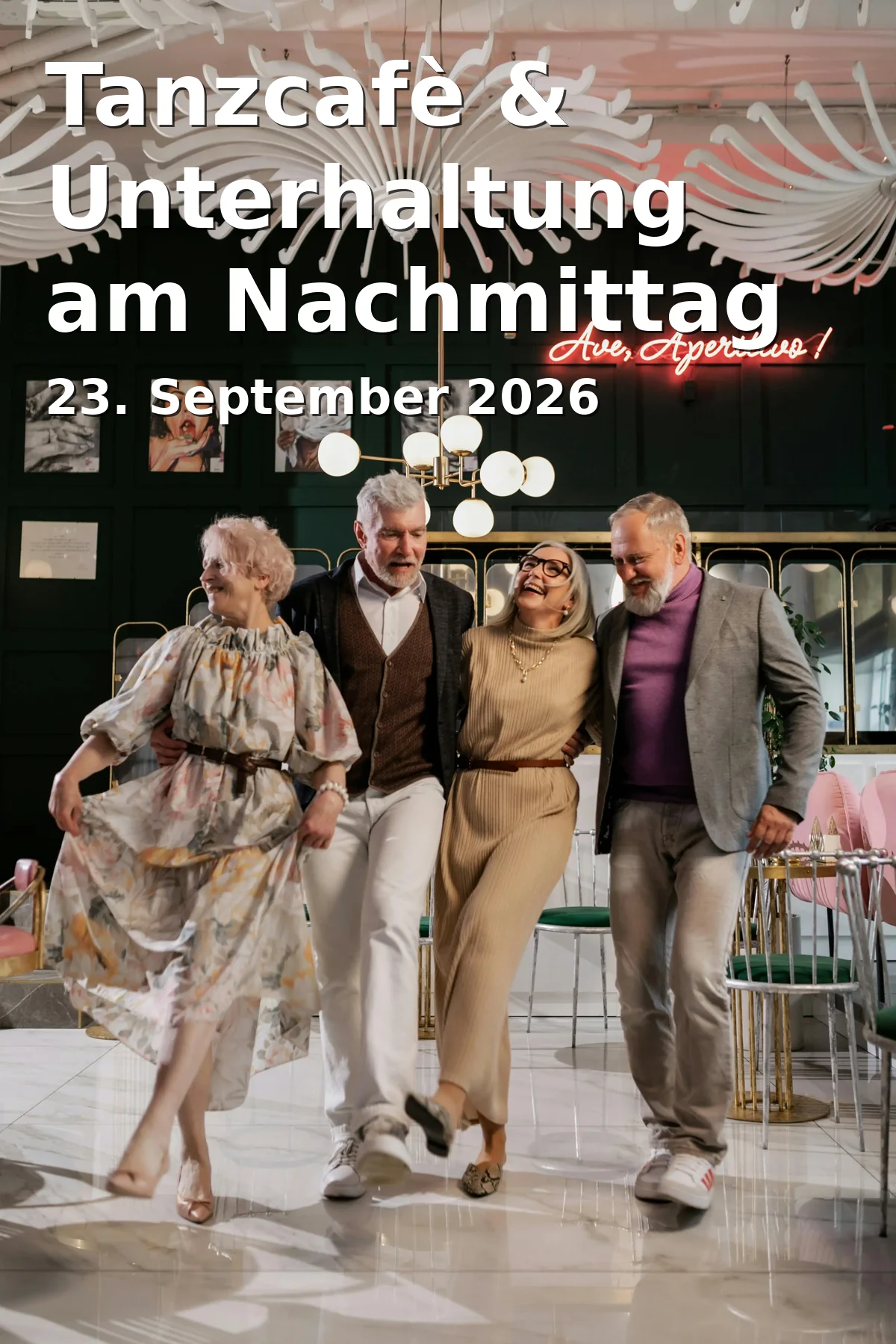
Dance Café & Entertainment in the Afternoon
Spend a relaxed afternoon with dance, coffee, and cake on September 23, 2026, at the Cottbus City Hall. Admission free!
Special Exhibition Who Invented It? Perhaps a Pharmacist!
Experience in Cottbus the special exhibition around pharmacies, inventiveness, and exciting discoveries. Historical spaces, guided tours, and knowledge to marvel at. #Cottbus
Frequently Asked Questions
Reviews
No reviews found