
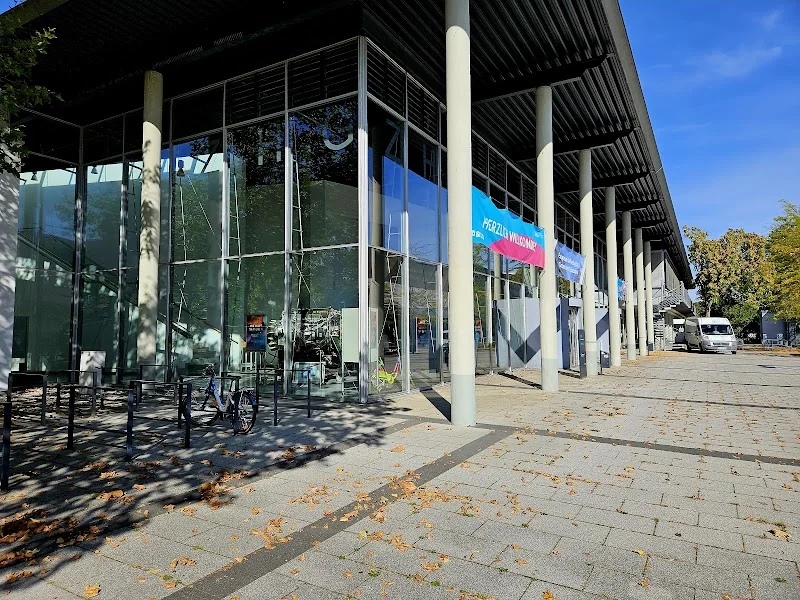
Cottbus
Platz d. Deutschen Einheit 1, 03046 Cottbus, Deutschland
Central Lecture Hall Building (ZHG) | Directions & Parking
The Central Lecture Hall Building, or ZHG for short, is one of the most important landmarks for students, staff, guests, and event visitors on the central campus of BTU Cottbus-Senftenberg. On the official campus map page, the ZHG is listed as a separate building on the central campus; the visitor address for the campus is Platz der Deutschen Einheit 1 in 03046 Cottbus. Additionally, the address Konrad-Wachsmann-Allee 3 is specified in BTU documents related to accessibility. This dual perspective is helpful for navigation: those heading to the campus as a whole orient themselves at the central visitor entrance, while those specifically attending a lecture or event at the ZHG pay attention to the building address and the respective room designation. ([b-tu.de](https://www.b-tu.de/campusplan/zentralcampus-cottbus))
The building is more than just a lecture hall complex. BTU uses the ZHG as a central location for lectures, exams, presentations, exhibitions, and larger university events. In current and past BTU announcements, the ZHG regularly appears as a conference venue, trade fair location, or site for central campus formats. This is precisely why it garners interest: many users search not only for the name of the building but also for directions, parking, lecture hall names, seating or room orientation, and current program items. Therefore, the ZHG is a typical example of a location where practical visitor information and event utility are closely intertwined. ([www-docs.b-tu.de](https://www-docs.b-tu.de/presse/public/BTU-Zeitung/Ausgaben_2016/161221_BTU-News_Nr47_WEB3.pdf))
Events, Lectures, and Exams at the ZHG
The greatest interest in the ZHG often arises when an event is upcoming. BTU utilizes the building for very different formats: scientific conferences, recruiting fairs, expert lectures, public lecture series, student celebrations, and exams. For instance, the Brandenburg Civil Engineering Day 2026 took place at the ZHG, the career and recruiting fair campus-X-change was also announced at the ZHG or in the immediate vicinity of the sports hall and ZHG, and professional discussion events or European policy dialogue formats regularly utilize rooms in the building. This is important for visitors because the ZHG is not limited to a single type of event but remains a flexible venue for the academic life of the university. ([b-tu.de](https://www.b-tu.de/institut-bauingenieurwesen/aktuelles/ansicht/29644-brandenburgischer-bauingenieurtag-bbit2026?utm_source=openai))
The use of the ZHG as an event venue has a clear tradition at BTU. A university announcement from 2016 described the ZHG as the only building on campus with spacious foyer areas where, in addition to lectures, exhibitions, presentations, the open day, the matriculation ceremony, and even student parties take place. This description clearly shows why the building frequently appears in searches for programs, tickets, lectures, or event information: the ZHG is not just a space for teaching but a social and representative hub of the campus. The foyer serves a dual function. It acts as a distributor for visitor flows, creates space for exhibitions and accompanying programs, and makes larger events organizationally feasible. ([www-docs.b-tu.de](https://www-docs.b-tu.de/presse/public/BTU-Zeitung/Ausgaben_2016/161221_BTU-News_Nr47_WEB3.pdf))
The building is also omnipresent in teaching. BTU's semester overviews regularly list the ZHG as a location for lectures, exercises, and exams. Audimax 2 and lecture halls A, B, and C are particularly frequently mentioned, and the designation Lecture Hall 1 appears in some overviews as a room reference. This is important for the search intent around the keyword Lecture Hall 1 BTU: those searching this way usually do not want just any lecture hall but a precise room assignment on the central campus. The official BTU event and teaching pages show that this room logic is well maintained in the ZHG. As a result, the building is relevant for students during the semester as well as for external guests attending a one-time conference or a public lecture. ([b-tu.de](https://www.b-tu.de/fg-finanzierung/lehre/semesteruebersicht?utm_source=openai))
Directions, Address, and Parking at the Central Campus
For arrival, BTU recommends a clear route via the A13 and A15 highways to the Cottbus-West exit. From there, continue towards the city center and follow the signs towards the university to the central campus. On the official arrival page, BTU also provides the address Platz der Deutschen Einheit 1, 03046 Cottbus, for the trade fair and campus area, and refers to free parking options on campus. Those using a navigation system will also find Friedlieb-Runge-Straße 3 as a navigation point for the central campus. For the ZHG itself, the BTU documentation related to accessibility also recommends parking in the north on Konrad-Zuse-Straße. The interplay of this information is particularly helpful when visitors need to distinguish between campus address, navigation address, and building designation. ([b-tu.de](https://www.b-tu.de/careercenter/jobmesse/fuer-aussteller/anreise))
The location is also easily accessible by public transport. BTU recommends traveling via Cottbus Central Station and then continuing by bus or tram to the central campus. Among others, Bus 16 to the TU Mensa stop, Buses 15-44 and 47 to Technische Universität, and Tram 4 to Zimmerstraße are mentioned. From there, according to BTU, it is about a five-minute walk via Huberstraße towards the university. For many guests, this is a practical advantage, as they can reach the vicinity of the ZHG without complicated transfers. Especially for conferences, open lectures, or recruiting events, it is therefore worthwhile to orient oneself to the official stop designations rather than just knowing the campus name. ([b-tu.de](https://www.b-tu.de/careercenter/jobmesse/fuer-aussteller/anreise))
For first-time visitors, the location on campus is also important. The central campus is depicted on the campus map page as a contiguous area with many buildings, including ZHG, main building, cafeteria, IKMZ, multipurpose building, and sports hall. Thus, the ZHG is not an isolated place but part of a dense campus structure. Upon arrival, one should therefore pay attention not only to the address but also to the room and building designation on the respective invitation or schedule. Especially for large events, it can make a difference whether an appointment takes place in the foyer, in Audimax 2, or in a seminar room. This is why directions along with the room designation are always the first practical step for safe orientation. ([b-tu.de](https://www.b-tu.de/campusplan/zentralcampus-cottbus))
Audimax 1 and 2, Lecture Halls A-C, and Seminar Rooms 1-4
The ZHG is clearly structured spatially. According to BTU documents, the building includes Audimax 1 and 2, lecture halls A to C, and seminar rooms 1 to 4. This is an important point for anyone looking for seating plans, room designations, or a specific lecture. While other buildings often depict only one room type, the ZHG combines several event formats in one place. This explains why different room specifications appear in schedules, exam overviews, and event announcements. If one reads only ZHG in the calendar, they should still pay attention to the sub-designation. A lecture in Audimax 2 can organizationally mean something different than a course in Lecture Hall C or a small seminar in Room 3. ([www-docs.b-tu.de](https://www.b-tu.de/barrierefreies-studium/public/leitfaden/leitfaden-fuer-menschen-mit-einschraenkungen.pdf?utm_source=openai))
This is particularly relevant for keyword searches because many users do not know the official building designation but search for the room they see on the notice board or in the Moodle calendar. This applies, for example, to Audimax 1 BTU, Audimax 2 BTU, or Lecture Hall A BTU. BTU standardizes these room designations, and this allows lectures, exams, and public formats to be well assigned. For a large event, the Audimax is usually the prominent location; for parallel working groups, workshops, or smaller specialist events, the lecture halls and seminar rooms are the appropriate solution. Thus, the ZHG creates a modular structure of large and smaller units that covers both academic and representative uses. ([www-docs.b-tu.de](https://www.b-tu.de/barrierefreies-studium/public/leitfaden/leitfaden-fuer-menschen-mit-einschraenkungen.pdf?utm_source=openai))
The structure of the building is also pleasant from a visitor's perspective, as it creates orientation. Once one understands that the ZHG bundles several clearly named room types, they can read notices, invitations, and semester plans much faster. This is especially helpful for central events when many participants arrive simultaneously and disperse throughout the building. BTU also mentions in its official documents a technical setup and clear access to the rooms, making the ZHG functional for teaching and conference operations. Combined with the central foyer, this results in a building that not only provides space but also organizes movement and gathering areas. This is one of the reasons why the ZHG is so well suited for events with multiple program points. ([www-docs.b-tu.de](https://www.b-tu.de/barrierefreies-studium/public/leitfaden/leitfaden-fuer-menschen-mit-einschraenkungen.pdf?utm_source=openai))
Accessibility and Practical Visitor Comfort
A strong feature of the ZHG is its barrier-free access. BTU describes in its guideline documentation for the central campus a lift, a restroom on the ground floor, barrier-free accessible corridors and public event spaces, and the accessibility of all rooms via elevator. This is important for visitors with mobility impairments, wheelchair users, companions, and organizers, as it makes planning access to lectures and events significantly easier. According to BTU, the ground-level access is somewhat hidden to the right of the spiral staircase; a lift is located directly near this entrance. The ZHG is thus organized so that not only the large rooms but also the pathways within the building are as uncomplicated to use as possible. ([www-docs.b-tu.de](https://www.b-tu.de/barrierefreies-studium/public/leitfaden/leitfaden-fuer-menschen-mit-einschraenkungen.pdf?utm_source=openai))
Practical accessibility also includes the technical use in lecture hall operations. BTU points out that in all lecture halls of the ZHG, namely Audimax 1 and 2 as well as lecture halls A to C, sound capture from the regular sound system can be switched to a suitable transmission system. This is particularly interesting for events where speech and intelligibility are central, such as scientific lectures, conferences, or ceremonial program points. The room is thus not only accessible but also functionally oriented towards presentations and public communication. For organizers, this is an essential detail as it facilitates the use of technology and the inclusion of various target groups. ([www-docs.b-tu.de](https://www.b-tu.de/barrierefreies-studium/public/leitfaden/leitfaden-fuer-menschen-mit-einschraenkungen.pdf?utm_source=openai))
The parking and access logic is also designed for a comfortable visit. While the central campus offers free parking options overall, the BTU accessibility document mentions the northern Konrad-Zuse-Straße as a particularly practical access point for the ZHG. This allows guests, depending on the occasion, mobility, and mode of arrival, to choose the best option. Especially for multi-day conferences or heavily attended events, it is helpful that the campus does not function through a single access point but has several logical arrival and distribution points. The ZHG benefits from this doubly: it is centrally located and equipped so that arrival creates as few hurdles as possible. ([b-tu.de](https://www.b-tu.de/careercenter/jobmesse/fuer-aussteller/anreise))
History, Function, and Significance for BTU
The ZHG is not just a useful building on the central campus but a place with a clear university identity. In a BTU publication from 2016, the building is described as the location where, in addition to lectures, exhibitions, presentations, and central large events take place. Interestingly, it is noted that this use represented a change from the original planning and had to be considered from a fire protection perspective. This shows how the role of the ZHG has expanded over time: from a lecture hall building to a multifunctional event venue that shapes the everyday life of the university as much as its significant moments. For visitors, this is an important indication that the ZHG is not just a place to sit and listen but a building with a public, representative character. ([www-docs.b-tu.de](https://www.b-tu.de/presse/public/BTU-Zeitung/Ausgaben_2016/161221_BTU-News_Nr47_WEB3.pdf))
The same development is evident in current BTU events. Whether it is the Civil Engineering Day, European policy discussion round, recruiting fair, or academic lecture series: the ZHG is repeatedly the host for formats that go far beyond traditional lecture operations. This consistency makes the place valuable for the university. It is centrally located, well organized, and has the necessary variety of spaces to accommodate different group sizes and uses. Thus, the building fulfills a bridging function between teaching, research, transfer, and campus life. Those visiting the ZHG therefore experience very different aspects of BTU in a short distance: scientific exchange, student everyday culture, and public visibility of the university. ([b-tu.de](https://www.b-tu.de/institut-bauingenieurwesen/aktuelles/ansicht/29644-brandenburgischer-bauingenieurtag-bbit2026?utm_source=openai))
The campus context is also important for understanding. The BTU campus map page shows the ZHG as part of a larger central campus with other prominent buildings such as the cafeteria, main building, IKMZ, and sports hall. Thus, the ZHG is not a peripheral location but a hub within the university structure. This position explains why the university repeatedly selects it for high-profile or well-attended appointments. Proximity to other central facilities facilitates pathways, transitions, and events with multiple stations. In this sense, the ZHG is a place where BTU as a campus university can be particularly well observed: concentrated, functional, and open to the public and exchange. ([b-tu.de](https://www.b-tu.de/campusplan/zentralcampus-cottbus))
Photos, Campus Map, and Orientation on the Central Campus
Those searching for photos of the ZHG often want to see not only the building itself but also to orient themselves on campus. The official campus map page of BTU is particularly useful for this, as it explicitly lists the ZHG in the building selection and presents the central campus in its overall context. The layout of the campus map makes visible how the ZHG is located in proximity to the cafeteria, main building, sports hall, and other buildings. This visual orientation is practical for first-time visitors, conference guests, and students, as it simplifies the paths between arrival, event room, and catering. The campus map does not replace a photo album, but it fulfills exactly the function that many need when searching for photos: location, context, and recognition. ([b-tu.de](https://www.b-tu.de/campusplan/zentralcampus-cottbus))
BTU's arrival information also aids in visual orientation. There, the central campus is explained in a graphic where the ZHG and the sports hall are highlighted in light blue, while parking options are emphasized in dark blue. For users who want to get an idea before a visit, this is almost as valuable as a classic photo because it not only makes the architecture visible but especially the function of the place. Therefore, anyone planning a meeting, conference, or lecture at the ZHG should not only pay attention to the pure address but also read the campus map as a digital preview. This creates a realistic idea of where one arrives, where to park, and how to get from the parking lot or stop to the building. ([b-tu.de](https://www.b-tu.de/careercenter/jobmesse/fuer-aussteller/anreise))
Combined with the room designations, this results in a clear orientation system. ZHG is the building name, Audimax 1 and 2 as well as Lecture Halls A-C are the room designations, and campus map or navigation address are the tools for arrival. This tripartite division is particularly important for the search intent behind the building name. Those searching for photos, directions, or seating plans ultimately need not an abstract description but precise indications of how the place functions in everyday life. The ZHG meets this expectation on the central campus very well because it becomes quickly understandable through its central location, clear room logic, and recurring use. ([b-tu.de](https://www.b-tu.de/campusplan/zentralcampus-cottbus))
Sources:
- BTU Campus Map Central Campus Cottbus ([b-tu.de](https://www.b-tu.de/campusplan/zentralcampus-cottbus))
- BTU Directions to the Central Campus and Campus Parking ([b-tu.de](https://www.b-tu.de/careercenter/jobmesse/fuer-aussteller/anreise))
- BTU Guide to Accessibility at BTU Cottbus-Senftenberg ([www-docs.b-tu.de](https://www-docs.b-tu.de/barrierefreies-studium/public/leitfaden/leitfaden-fuer-menschen-mit-einschraenkungen.pdf?utm_source=openai))
- BTU News and Event Pages for the ZHG as Event and Teaching Location ([www-docs.b-tu.de](https://www-docs.b-tu.de/presse/public/BTU-Zeitung/Ausgaben_2016/161221_BTU-News_Nr47_WEB3.pdf))
- BTU Semester Overviews with Room Designations in the ZHG ([b-tu.de](https://www.b-tu.de/fg-finanzierung/lehre/semesteruebersicht?utm_source=openai))
Show moreShow less
Central Lecture Hall Building (ZHG) | Directions & Parking
The Central Lecture Hall Building, or ZHG for short, is one of the most important landmarks for students, staff, guests, and event visitors on the central campus of BTU Cottbus-Senftenberg. On the official campus map page, the ZHG is listed as a separate building on the central campus; the visitor address for the campus is Platz der Deutschen Einheit 1 in 03046 Cottbus. Additionally, the address Konrad-Wachsmann-Allee 3 is specified in BTU documents related to accessibility. This dual perspective is helpful for navigation: those heading to the campus as a whole orient themselves at the central visitor entrance, while those specifically attending a lecture or event at the ZHG pay attention to the building address and the respective room designation. ([b-tu.de](https://www.b-tu.de/campusplan/zentralcampus-cottbus))
The building is more than just a lecture hall complex. BTU uses the ZHG as a central location for lectures, exams, presentations, exhibitions, and larger university events. In current and past BTU announcements, the ZHG regularly appears as a conference venue, trade fair location, or site for central campus formats. This is precisely why it garners interest: many users search not only for the name of the building but also for directions, parking, lecture hall names, seating or room orientation, and current program items. Therefore, the ZHG is a typical example of a location where practical visitor information and event utility are closely intertwined. ([www-docs.b-tu.de](https://www-docs.b-tu.de/presse/public/BTU-Zeitung/Ausgaben_2016/161221_BTU-News_Nr47_WEB3.pdf))
Events, Lectures, and Exams at the ZHG
The greatest interest in the ZHG often arises when an event is upcoming. BTU utilizes the building for very different formats: scientific conferences, recruiting fairs, expert lectures, public lecture series, student celebrations, and exams. For instance, the Brandenburg Civil Engineering Day 2026 took place at the ZHG, the career and recruiting fair campus-X-change was also announced at the ZHG or in the immediate vicinity of the sports hall and ZHG, and professional discussion events or European policy dialogue formats regularly utilize rooms in the building. This is important for visitors because the ZHG is not limited to a single type of event but remains a flexible venue for the academic life of the university. ([b-tu.de](https://www.b-tu.de/institut-bauingenieurwesen/aktuelles/ansicht/29644-brandenburgischer-bauingenieurtag-bbit2026?utm_source=openai))
The use of the ZHG as an event venue has a clear tradition at BTU. A university announcement from 2016 described the ZHG as the only building on campus with spacious foyer areas where, in addition to lectures, exhibitions, presentations, the open day, the matriculation ceremony, and even student parties take place. This description clearly shows why the building frequently appears in searches for programs, tickets, lectures, or event information: the ZHG is not just a space for teaching but a social and representative hub of the campus. The foyer serves a dual function. It acts as a distributor for visitor flows, creates space for exhibitions and accompanying programs, and makes larger events organizationally feasible. ([www-docs.b-tu.de](https://www-docs.b-tu.de/presse/public/BTU-Zeitung/Ausgaben_2016/161221_BTU-News_Nr47_WEB3.pdf))
The building is also omnipresent in teaching. BTU's semester overviews regularly list the ZHG as a location for lectures, exercises, and exams. Audimax 2 and lecture halls A, B, and C are particularly frequently mentioned, and the designation Lecture Hall 1 appears in some overviews as a room reference. This is important for the search intent around the keyword Lecture Hall 1 BTU: those searching this way usually do not want just any lecture hall but a precise room assignment on the central campus. The official BTU event and teaching pages show that this room logic is well maintained in the ZHG. As a result, the building is relevant for students during the semester as well as for external guests attending a one-time conference or a public lecture. ([b-tu.de](https://www.b-tu.de/fg-finanzierung/lehre/semesteruebersicht?utm_source=openai))
Directions, Address, and Parking at the Central Campus
For arrival, BTU recommends a clear route via the A13 and A15 highways to the Cottbus-West exit. From there, continue towards the city center and follow the signs towards the university to the central campus. On the official arrival page, BTU also provides the address Platz der Deutschen Einheit 1, 03046 Cottbus, for the trade fair and campus area, and refers to free parking options on campus. Those using a navigation system will also find Friedlieb-Runge-Straße 3 as a navigation point for the central campus. For the ZHG itself, the BTU documentation related to accessibility also recommends parking in the north on Konrad-Zuse-Straße. The interplay of this information is particularly helpful when visitors need to distinguish between campus address, navigation address, and building designation. ([b-tu.de](https://www.b-tu.de/careercenter/jobmesse/fuer-aussteller/anreise))
The location is also easily accessible by public transport. BTU recommends traveling via Cottbus Central Station and then continuing by bus or tram to the central campus. Among others, Bus 16 to the TU Mensa stop, Buses 15-44 and 47 to Technische Universität, and Tram 4 to Zimmerstraße are mentioned. From there, according to BTU, it is about a five-minute walk via Huberstraße towards the university. For many guests, this is a practical advantage, as they can reach the vicinity of the ZHG without complicated transfers. Especially for conferences, open lectures, or recruiting events, it is therefore worthwhile to orient oneself to the official stop designations rather than just knowing the campus name. ([b-tu.de](https://www.b-tu.de/careercenter/jobmesse/fuer-aussteller/anreise))
For first-time visitors, the location on campus is also important. The central campus is depicted on the campus map page as a contiguous area with many buildings, including ZHG, main building, cafeteria, IKMZ, multipurpose building, and sports hall. Thus, the ZHG is not an isolated place but part of a dense campus structure. Upon arrival, one should therefore pay attention not only to the address but also to the room and building designation on the respective invitation or schedule. Especially for large events, it can make a difference whether an appointment takes place in the foyer, in Audimax 2, or in a seminar room. This is why directions along with the room designation are always the first practical step for safe orientation. ([b-tu.de](https://www.b-tu.de/campusplan/zentralcampus-cottbus))
Audimax 1 and 2, Lecture Halls A-C, and Seminar Rooms 1-4
The ZHG is clearly structured spatially. According to BTU documents, the building includes Audimax 1 and 2, lecture halls A to C, and seminar rooms 1 to 4. This is an important point for anyone looking for seating plans, room designations, or a specific lecture. While other buildings often depict only one room type, the ZHG combines several event formats in one place. This explains why different room specifications appear in schedules, exam overviews, and event announcements. If one reads only ZHG in the calendar, they should still pay attention to the sub-designation. A lecture in Audimax 2 can organizationally mean something different than a course in Lecture Hall C or a small seminar in Room 3. ([www-docs.b-tu.de](https://www.b-tu.de/barrierefreies-studium/public/leitfaden/leitfaden-fuer-menschen-mit-einschraenkungen.pdf?utm_source=openai))
This is particularly relevant for keyword searches because many users do not know the official building designation but search for the room they see on the notice board or in the Moodle calendar. This applies, for example, to Audimax 1 BTU, Audimax 2 BTU, or Lecture Hall A BTU. BTU standardizes these room designations, and this allows lectures, exams, and public formats to be well assigned. For a large event, the Audimax is usually the prominent location; for parallel working groups, workshops, or smaller specialist events, the lecture halls and seminar rooms are the appropriate solution. Thus, the ZHG creates a modular structure of large and smaller units that covers both academic and representative uses. ([www-docs.b-tu.de](https://www.b-tu.de/barrierefreies-studium/public/leitfaden/leitfaden-fuer-menschen-mit-einschraenkungen.pdf?utm_source=openai))
The structure of the building is also pleasant from a visitor's perspective, as it creates orientation. Once one understands that the ZHG bundles several clearly named room types, they can read notices, invitations, and semester plans much faster. This is especially helpful for central events when many participants arrive simultaneously and disperse throughout the building. BTU also mentions in its official documents a technical setup and clear access to the rooms, making the ZHG functional for teaching and conference operations. Combined with the central foyer, this results in a building that not only provides space but also organizes movement and gathering areas. This is one of the reasons why the ZHG is so well suited for events with multiple program points. ([www-docs.b-tu.de](https://www.b-tu.de/barrierefreies-studium/public/leitfaden/leitfaden-fuer-menschen-mit-einschraenkungen.pdf?utm_source=openai))
Accessibility and Practical Visitor Comfort
A strong feature of the ZHG is its barrier-free access. BTU describes in its guideline documentation for the central campus a lift, a restroom on the ground floor, barrier-free accessible corridors and public event spaces, and the accessibility of all rooms via elevator. This is important for visitors with mobility impairments, wheelchair users, companions, and organizers, as it makes planning access to lectures and events significantly easier. According to BTU, the ground-level access is somewhat hidden to the right of the spiral staircase; a lift is located directly near this entrance. The ZHG is thus organized so that not only the large rooms but also the pathways within the building are as uncomplicated to use as possible. ([www-docs.b-tu.de](https://www.b-tu.de/barrierefreies-studium/public/leitfaden/leitfaden-fuer-menschen-mit-einschraenkungen.pdf?utm_source=openai))
Practical accessibility also includes the technical use in lecture hall operations. BTU points out that in all lecture halls of the ZHG, namely Audimax 1 and 2 as well as lecture halls A to C, sound capture from the regular sound system can be switched to a suitable transmission system. This is particularly interesting for events where speech and intelligibility are central, such as scientific lectures, conferences, or ceremonial program points. The room is thus not only accessible but also functionally oriented towards presentations and public communication. For organizers, this is an essential detail as it facilitates the use of technology and the inclusion of various target groups. ([www-docs.b-tu.de](https://www.b-tu.de/barrierefreies-studium/public/leitfaden/leitfaden-fuer-menschen-mit-einschraenkungen.pdf?utm_source=openai))
The parking and access logic is also designed for a comfortable visit. While the central campus offers free parking options overall, the BTU accessibility document mentions the northern Konrad-Zuse-Straße as a particularly practical access point for the ZHG. This allows guests, depending on the occasion, mobility, and mode of arrival, to choose the best option. Especially for multi-day conferences or heavily attended events, it is helpful that the campus does not function through a single access point but has several logical arrival and distribution points. The ZHG benefits from this doubly: it is centrally located and equipped so that arrival creates as few hurdles as possible. ([b-tu.de](https://www.b-tu.de/careercenter/jobmesse/fuer-aussteller/anreise))
History, Function, and Significance for BTU
The ZHG is not just a useful building on the central campus but a place with a clear university identity. In a BTU publication from 2016, the building is described as the location where, in addition to lectures, exhibitions, presentations, and central large events take place. Interestingly, it is noted that this use represented a change from the original planning and had to be considered from a fire protection perspective. This shows how the role of the ZHG has expanded over time: from a lecture hall building to a multifunctional event venue that shapes the everyday life of the university as much as its significant moments. For visitors, this is an important indication that the ZHG is not just a place to sit and listen but a building with a public, representative character. ([www-docs.b-tu.de](https://www.b-tu.de/presse/public/BTU-Zeitung/Ausgaben_2016/161221_BTU-News_Nr47_WEB3.pdf))
The same development is evident in current BTU events. Whether it is the Civil Engineering Day, European policy discussion round, recruiting fair, or academic lecture series: the ZHG is repeatedly the host for formats that go far beyond traditional lecture operations. This consistency makes the place valuable for the university. It is centrally located, well organized, and has the necessary variety of spaces to accommodate different group sizes and uses. Thus, the building fulfills a bridging function between teaching, research, transfer, and campus life. Those visiting the ZHG therefore experience very different aspects of BTU in a short distance: scientific exchange, student everyday culture, and public visibility of the university. ([b-tu.de](https://www.b-tu.de/institut-bauingenieurwesen/aktuelles/ansicht/29644-brandenburgischer-bauingenieurtag-bbit2026?utm_source=openai))
The campus context is also important for understanding. The BTU campus map page shows the ZHG as part of a larger central campus with other prominent buildings such as the cafeteria, main building, IKMZ, and sports hall. Thus, the ZHG is not a peripheral location but a hub within the university structure. This position explains why the university repeatedly selects it for high-profile or well-attended appointments. Proximity to other central facilities facilitates pathways, transitions, and events with multiple stations. In this sense, the ZHG is a place where BTU as a campus university can be particularly well observed: concentrated, functional, and open to the public and exchange. ([b-tu.de](https://www.b-tu.de/campusplan/zentralcampus-cottbus))
Photos, Campus Map, and Orientation on the Central Campus
Those searching for photos of the ZHG often want to see not only the building itself but also to orient themselves on campus. The official campus map page of BTU is particularly useful for this, as it explicitly lists the ZHG in the building selection and presents the central campus in its overall context. The layout of the campus map makes visible how the ZHG is located in proximity to the cafeteria, main building, sports hall, and other buildings. This visual orientation is practical for first-time visitors, conference guests, and students, as it simplifies the paths between arrival, event room, and catering. The campus map does not replace a photo album, but it fulfills exactly the function that many need when searching for photos: location, context, and recognition. ([b-tu.de](https://www.b-tu.de/campusplan/zentralcampus-cottbus))
BTU's arrival information also aids in visual orientation. There, the central campus is explained in a graphic where the ZHG and the sports hall are highlighted in light blue, while parking options are emphasized in dark blue. For users who want to get an idea before a visit, this is almost as valuable as a classic photo because it not only makes the architecture visible but especially the function of the place. Therefore, anyone planning a meeting, conference, or lecture at the ZHG should not only pay attention to the pure address but also read the campus map as a digital preview. This creates a realistic idea of where one arrives, where to park, and how to get from the parking lot or stop to the building. ([b-tu.de](https://www.b-tu.de/careercenter/jobmesse/fuer-aussteller/anreise))
Combined with the room designations, this results in a clear orientation system. ZHG is the building name, Audimax 1 and 2 as well as Lecture Halls A-C are the room designations, and campus map or navigation address are the tools for arrival. This tripartite division is particularly important for the search intent behind the building name. Those searching for photos, directions, or seating plans ultimately need not an abstract description but precise indications of how the place functions in everyday life. The ZHG meets this expectation on the central campus very well because it becomes quickly understandable through its central location, clear room logic, and recurring use. ([b-tu.de](https://www.b-tu.de/campusplan/zentralcampus-cottbus))
Sources:
- BTU Campus Map Central Campus Cottbus ([b-tu.de](https://www.b-tu.de/campusplan/zentralcampus-cottbus))
- BTU Directions to the Central Campus and Campus Parking ([b-tu.de](https://www.b-tu.de/careercenter/jobmesse/fuer-aussteller/anreise))
- BTU Guide to Accessibility at BTU Cottbus-Senftenberg ([www-docs.b-tu.de](https://www-docs.b-tu.de/barrierefreies-studium/public/leitfaden/leitfaden-fuer-menschen-mit-einschraenkungen.pdf?utm_source=openai))
- BTU News and Event Pages for the ZHG as Event and Teaching Location ([www-docs.b-tu.de](https://www-docs.b-tu.de/presse/public/BTU-Zeitung/Ausgaben_2016/161221_BTU-News_Nr47_WEB3.pdf))
- BTU Semester Overviews with Room Designations in the ZHG ([b-tu.de](https://www.b-tu.de/fg-finanzierung/lehre/semesteruebersicht?utm_source=openai))
Central Lecture Hall Building (ZHG) | Directions & Parking
The Central Lecture Hall Building, or ZHG for short, is one of the most important landmarks for students, staff, guests, and event visitors on the central campus of BTU Cottbus-Senftenberg. On the official campus map page, the ZHG is listed as a separate building on the central campus; the visitor address for the campus is Platz der Deutschen Einheit 1 in 03046 Cottbus. Additionally, the address Konrad-Wachsmann-Allee 3 is specified in BTU documents related to accessibility. This dual perspective is helpful for navigation: those heading to the campus as a whole orient themselves at the central visitor entrance, while those specifically attending a lecture or event at the ZHG pay attention to the building address and the respective room designation. ([b-tu.de](https://www.b-tu.de/campusplan/zentralcampus-cottbus))
The building is more than just a lecture hall complex. BTU uses the ZHG as a central location for lectures, exams, presentations, exhibitions, and larger university events. In current and past BTU announcements, the ZHG regularly appears as a conference venue, trade fair location, or site for central campus formats. This is precisely why it garners interest: many users search not only for the name of the building but also for directions, parking, lecture hall names, seating or room orientation, and current program items. Therefore, the ZHG is a typical example of a location where practical visitor information and event utility are closely intertwined. ([www-docs.b-tu.de](https://www-docs.b-tu.de/presse/public/BTU-Zeitung/Ausgaben_2016/161221_BTU-News_Nr47_WEB3.pdf))
Events, Lectures, and Exams at the ZHG
The greatest interest in the ZHG often arises when an event is upcoming. BTU utilizes the building for very different formats: scientific conferences, recruiting fairs, expert lectures, public lecture series, student celebrations, and exams. For instance, the Brandenburg Civil Engineering Day 2026 took place at the ZHG, the career and recruiting fair campus-X-change was also announced at the ZHG or in the immediate vicinity of the sports hall and ZHG, and professional discussion events or European policy dialogue formats regularly utilize rooms in the building. This is important for visitors because the ZHG is not limited to a single type of event but remains a flexible venue for the academic life of the university. ([b-tu.de](https://www.b-tu.de/institut-bauingenieurwesen/aktuelles/ansicht/29644-brandenburgischer-bauingenieurtag-bbit2026?utm_source=openai))
The use of the ZHG as an event venue has a clear tradition at BTU. A university announcement from 2016 described the ZHG as the only building on campus with spacious foyer areas where, in addition to lectures, exhibitions, presentations, the open day, the matriculation ceremony, and even student parties take place. This description clearly shows why the building frequently appears in searches for programs, tickets, lectures, or event information: the ZHG is not just a space for teaching but a social and representative hub of the campus. The foyer serves a dual function. It acts as a distributor for visitor flows, creates space for exhibitions and accompanying programs, and makes larger events organizationally feasible. ([www-docs.b-tu.de](https://www-docs.b-tu.de/presse/public/BTU-Zeitung/Ausgaben_2016/161221_BTU-News_Nr47_WEB3.pdf))
The building is also omnipresent in teaching. BTU's semester overviews regularly list the ZHG as a location for lectures, exercises, and exams. Audimax 2 and lecture halls A, B, and C are particularly frequently mentioned, and the designation Lecture Hall 1 appears in some overviews as a room reference. This is important for the search intent around the keyword Lecture Hall 1 BTU: those searching this way usually do not want just any lecture hall but a precise room assignment on the central campus. The official BTU event and teaching pages show that this room logic is well maintained in the ZHG. As a result, the building is relevant for students during the semester as well as for external guests attending a one-time conference or a public lecture. ([b-tu.de](https://www.b-tu.de/fg-finanzierung/lehre/semesteruebersicht?utm_source=openai))
Directions, Address, and Parking at the Central Campus
For arrival, BTU recommends a clear route via the A13 and A15 highways to the Cottbus-West exit. From there, continue towards the city center and follow the signs towards the university to the central campus. On the official arrival page, BTU also provides the address Platz der Deutschen Einheit 1, 03046 Cottbus, for the trade fair and campus area, and refers to free parking options on campus. Those using a navigation system will also find Friedlieb-Runge-Straße 3 as a navigation point for the central campus. For the ZHG itself, the BTU documentation related to accessibility also recommends parking in the north on Konrad-Zuse-Straße. The interplay of this information is particularly helpful when visitors need to distinguish between campus address, navigation address, and building designation. ([b-tu.de](https://www.b-tu.de/careercenter/jobmesse/fuer-aussteller/anreise))
The location is also easily accessible by public transport. BTU recommends traveling via Cottbus Central Station and then continuing by bus or tram to the central campus. Among others, Bus 16 to the TU Mensa stop, Buses 15-44 and 47 to Technische Universität, and Tram 4 to Zimmerstraße are mentioned. From there, according to BTU, it is about a five-minute walk via Huberstraße towards the university. For many guests, this is a practical advantage, as they can reach the vicinity of the ZHG without complicated transfers. Especially for conferences, open lectures, or recruiting events, it is therefore worthwhile to orient oneself to the official stop designations rather than just knowing the campus name. ([b-tu.de](https://www.b-tu.de/careercenter/jobmesse/fuer-aussteller/anreise))
For first-time visitors, the location on campus is also important. The central campus is depicted on the campus map page as a contiguous area with many buildings, including ZHG, main building, cafeteria, IKMZ, multipurpose building, and sports hall. Thus, the ZHG is not an isolated place but part of a dense campus structure. Upon arrival, one should therefore pay attention not only to the address but also to the room and building designation on the respective invitation or schedule. Especially for large events, it can make a difference whether an appointment takes place in the foyer, in Audimax 2, or in a seminar room. This is why directions along with the room designation are always the first practical step for safe orientation. ([b-tu.de](https://www.b-tu.de/campusplan/zentralcampus-cottbus))
Audimax 1 and 2, Lecture Halls A-C, and Seminar Rooms 1-4
The ZHG is clearly structured spatially. According to BTU documents, the building includes Audimax 1 and 2, lecture halls A to C, and seminar rooms 1 to 4. This is an important point for anyone looking for seating plans, room designations, or a specific lecture. While other buildings often depict only one room type, the ZHG combines several event formats in one place. This explains why different room specifications appear in schedules, exam overviews, and event announcements. If one reads only ZHG in the calendar, they should still pay attention to the sub-designation. A lecture in Audimax 2 can organizationally mean something different than a course in Lecture Hall C or a small seminar in Room 3. ([www-docs.b-tu.de](https://www.b-tu.de/barrierefreies-studium/public/leitfaden/leitfaden-fuer-menschen-mit-einschraenkungen.pdf?utm_source=openai))
This is particularly relevant for keyword searches because many users do not know the official building designation but search for the room they see on the notice board or in the Moodle calendar. This applies, for example, to Audimax 1 BTU, Audimax 2 BTU, or Lecture Hall A BTU. BTU standardizes these room designations, and this allows lectures, exams, and public formats to be well assigned. For a large event, the Audimax is usually the prominent location; for parallel working groups, workshops, or smaller specialist events, the lecture halls and seminar rooms are the appropriate solution. Thus, the ZHG creates a modular structure of large and smaller units that covers both academic and representative uses. ([www-docs.b-tu.de](https://www.b-tu.de/barrierefreies-studium/public/leitfaden/leitfaden-fuer-menschen-mit-einschraenkungen.pdf?utm_source=openai))
The structure of the building is also pleasant from a visitor's perspective, as it creates orientation. Once one understands that the ZHG bundles several clearly named room types, they can read notices, invitations, and semester plans much faster. This is especially helpful for central events when many participants arrive simultaneously and disperse throughout the building. BTU also mentions in its official documents a technical setup and clear access to the rooms, making the ZHG functional for teaching and conference operations. Combined with the central foyer, this results in a building that not only provides space but also organizes movement and gathering areas. This is one of the reasons why the ZHG is so well suited for events with multiple program points. ([www-docs.b-tu.de](https://www.b-tu.de/barrierefreies-studium/public/leitfaden/leitfaden-fuer-menschen-mit-einschraenkungen.pdf?utm_source=openai))
Accessibility and Practical Visitor Comfort
A strong feature of the ZHG is its barrier-free access. BTU describes in its guideline documentation for the central campus a lift, a restroom on the ground floor, barrier-free accessible corridors and public event spaces, and the accessibility of all rooms via elevator. This is important for visitors with mobility impairments, wheelchair users, companions, and organizers, as it makes planning access to lectures and events significantly easier. According to BTU, the ground-level access is somewhat hidden to the right of the spiral staircase; a lift is located directly near this entrance. The ZHG is thus organized so that not only the large rooms but also the pathways within the building are as uncomplicated to use as possible. ([www-docs.b-tu.de](https://www.b-tu.de/barrierefreies-studium/public/leitfaden/leitfaden-fuer-menschen-mit-einschraenkungen.pdf?utm_source=openai))
Practical accessibility also includes the technical use in lecture hall operations. BTU points out that in all lecture halls of the ZHG, namely Audimax 1 and 2 as well as lecture halls A to C, sound capture from the regular sound system can be switched to a suitable transmission system. This is particularly interesting for events where speech and intelligibility are central, such as scientific lectures, conferences, or ceremonial program points. The room is thus not only accessible but also functionally oriented towards presentations and public communication. For organizers, this is an essential detail as it facilitates the use of technology and the inclusion of various target groups. ([www-docs.b-tu.de](https://www.b-tu.de/barrierefreies-studium/public/leitfaden/leitfaden-fuer-menschen-mit-einschraenkungen.pdf?utm_source=openai))
The parking and access logic is also designed for a comfortable visit. While the central campus offers free parking options overall, the BTU accessibility document mentions the northern Konrad-Zuse-Straße as a particularly practical access point for the ZHG. This allows guests, depending on the occasion, mobility, and mode of arrival, to choose the best option. Especially for multi-day conferences or heavily attended events, it is helpful that the campus does not function through a single access point but has several logical arrival and distribution points. The ZHG benefits from this doubly: it is centrally located and equipped so that arrival creates as few hurdles as possible. ([b-tu.de](https://www.b-tu.de/careercenter/jobmesse/fuer-aussteller/anreise))
History, Function, and Significance for BTU
The ZHG is not just a useful building on the central campus but a place with a clear university identity. In a BTU publication from 2016, the building is described as the location where, in addition to lectures, exhibitions, presentations, and central large events take place. Interestingly, it is noted that this use represented a change from the original planning and had to be considered from a fire protection perspective. This shows how the role of the ZHG has expanded over time: from a lecture hall building to a multifunctional event venue that shapes the everyday life of the university as much as its significant moments. For visitors, this is an important indication that the ZHG is not just a place to sit and listen but a building with a public, representative character. ([www-docs.b-tu.de](https://www.b-tu.de/presse/public/BTU-Zeitung/Ausgaben_2016/161221_BTU-News_Nr47_WEB3.pdf))
The same development is evident in current BTU events. Whether it is the Civil Engineering Day, European policy discussion round, recruiting fair, or academic lecture series: the ZHG is repeatedly the host for formats that go far beyond traditional lecture operations. This consistency makes the place valuable for the university. It is centrally located, well organized, and has the necessary variety of spaces to accommodate different group sizes and uses. Thus, the building fulfills a bridging function between teaching, research, transfer, and campus life. Those visiting the ZHG therefore experience very different aspects of BTU in a short distance: scientific exchange, student everyday culture, and public visibility of the university. ([b-tu.de](https://www.b-tu.de/institut-bauingenieurwesen/aktuelles/ansicht/29644-brandenburgischer-bauingenieurtag-bbit2026?utm_source=openai))
The campus context is also important for understanding. The BTU campus map page shows the ZHG as part of a larger central campus with other prominent buildings such as the cafeteria, main building, IKMZ, and sports hall. Thus, the ZHG is not a peripheral location but a hub within the university structure. This position explains why the university repeatedly selects it for high-profile or well-attended appointments. Proximity to other central facilities facilitates pathways, transitions, and events with multiple stations. In this sense, the ZHG is a place where BTU as a campus university can be particularly well observed: concentrated, functional, and open to the public and exchange. ([b-tu.de](https://www.b-tu.de/campusplan/zentralcampus-cottbus))
Photos, Campus Map, and Orientation on the Central Campus
Those searching for photos of the ZHG often want to see not only the building itself but also to orient themselves on campus. The official campus map page of BTU is particularly useful for this, as it explicitly lists the ZHG in the building selection and presents the central campus in its overall context. The layout of the campus map makes visible how the ZHG is located in proximity to the cafeteria, main building, sports hall, and other buildings. This visual orientation is practical for first-time visitors, conference guests, and students, as it simplifies the paths between arrival, event room, and catering. The campus map does not replace a photo album, but it fulfills exactly the function that many need when searching for photos: location, context, and recognition. ([b-tu.de](https://www.b-tu.de/campusplan/zentralcampus-cottbus))
BTU's arrival information also aids in visual orientation. There, the central campus is explained in a graphic where the ZHG and the sports hall are highlighted in light blue, while parking options are emphasized in dark blue. For users who want to get an idea before a visit, this is almost as valuable as a classic photo because it not only makes the architecture visible but especially the function of the place. Therefore, anyone planning a meeting, conference, or lecture at the ZHG should not only pay attention to the pure address but also read the campus map as a digital preview. This creates a realistic idea of where one arrives, where to park, and how to get from the parking lot or stop to the building. ([b-tu.de](https://www.b-tu.de/careercenter/jobmesse/fuer-aussteller/anreise))
Combined with the room designations, this results in a clear orientation system. ZHG is the building name, Audimax 1 and 2 as well as Lecture Halls A-C are the room designations, and campus map or navigation address are the tools for arrival. This tripartite division is particularly important for the search intent behind the building name. Those searching for photos, directions, or seating plans ultimately need not an abstract description but precise indications of how the place functions in everyday life. The ZHG meets this expectation on the central campus very well because it becomes quickly understandable through its central location, clear room logic, and recurring use. ([b-tu.de](https://www.b-tu.de/campusplan/zentralcampus-cottbus))
Sources:
- BTU Campus Map Central Campus Cottbus ([b-tu.de](https://www.b-tu.de/campusplan/zentralcampus-cottbus))
- BTU Directions to the Central Campus and Campus Parking ([b-tu.de](https://www.b-tu.de/careercenter/jobmesse/fuer-aussteller/anreise))
- BTU Guide to Accessibility at BTU Cottbus-Senftenberg ([www-docs.b-tu.de](https://www-docs.b-tu.de/barrierefreies-studium/public/leitfaden/leitfaden-fuer-menschen-mit-einschraenkungen.pdf?utm_source=openai))
- BTU News and Event Pages for the ZHG as Event and Teaching Location ([www-docs.b-tu.de](https://www-docs.b-tu.de/presse/public/BTU-Zeitung/Ausgaben_2016/161221_BTU-News_Nr47_WEB3.pdf))
- BTU Semester Overviews with Room Designations in the ZHG ([b-tu.de](https://www.b-tu.de/fg-finanzierung/lehre/semesteruebersicht?utm_source=openai))
Upcoming Events
No events found
Frequently Asked Questions
Reviews
No reviews found