
Cottbus
Adolph-Kolping-Straße 17, 03046 Cottbus, Deutschland
Protestant Church St. Mary Queen of Peace | Photos & History
The Protestant Church St. Mary Queen of Peace is one of the most prominent Catholic churches in Cottbus and is sought after by many visitors not only because of its name but also due to its unusual impact. It is located on Adolph-Kolping-Straße in the Mitte district, belongs to the Catholic Propstei Parish of the Good Shepherd, and today serves as both a propstei and parish church for Cottbus and the surrounding areas of the parish. Those looking for the church will quickly come across two addresses: The church itself is listed on the parish's website as Adolph-Kolping-Straße 18, while the parish office is located next door at Adolph-Kolping-Straße 17. It is also important for visitors to know that the parish church is open daily for devotion and prayer according to the parish. Thus, St. Mary Queen of Peace is not just a monument but a vibrant place of faith, history, and encounter. This mix also explains why so many users search for photos, history, service times, visits, directions, and parking: The church is, on one hand, a historical building with a clear construction history, and on the other hand, an active community location with fixed liturgical times and a very special interior design. ([kath-cottbus.de](https://www.kath-cottbus.de/index.php?option=com_contact))
History of the Protestant Church St. Mary Queen of Peace
The history of the church is closely linked to the growth of the Catholic community in Cottbus. After the Reformation, there was no Catholic church in the city for a long time. It was not until 1850 that the church of the Good Shepherd on Dresdener Straße was consecrated, but with the growth of the community, this space soon became insufficient. In response, the community founded a church building fundraising association in 1928 to make a new construction possible. The foundation stone was laid in 1932, and in 1934 Cardinal Bertram, the Archbishop of Breslau, consecrated the new church under the patronage of St. Mary Queen of Peace. The patronage was deliberately chosen and referred to the politically threatening situation perceived at the time. This origin story already shows that the building was not just a structure but also a testament to ecclesiastical self-assertion in a minority situation. The community understood the new building as a response to real spatial needs but also as a visible sign of Catholic presence in a city where Catholics had long been in the minority. ([kath-cottbus.de](https://www.kath-cottbus.de/seite/783224/geschichte-der-pfarrei.html))
After World War II, the church remained a central symbol of Catholic life in Cottbus. In 1994, it was elevated to a propstei due to its significance for the newly established diocese of Görlitz and the region. Today, it serves as both a propstei and parish church for the city area of Cottbus as well as for the surrounding areas of the newly established parish of the Good Shepherd in 2012. The community itself points out that despite the diaspora situation, it lives a vibrant faith and diverse engagement. This is important for visitors because the church is not only visited but also regularly used liturgically. Therefore, those searching for history will find not only dates here but a continuous thread: from the church building association through the consecration in 1934 to the elevation to a propstei and its current function as a spiritual center of the region. The church is thus a place where architectural history, diocesan history, and community life overlap. ([kath-cottbus.de](https://www.kath-cottbus.de/index.php?option=com_contact))
Architecture and Exterior in Downtown Cottbus
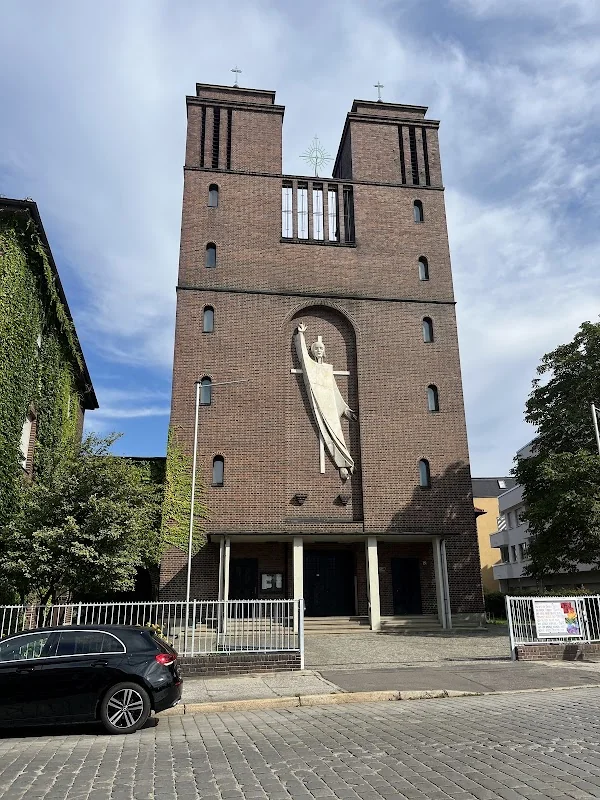
Architecturally, St. Mary Queen of Peace stands out from the outside. The city of Cottbus describes the church as a brick building constructed in 1934/35, while the Street of Modernity characterizes the building as a clearly structured brick construction with a powerful double-tower facade amidst Gründerzeit residential buildings. This contrast is exactly what makes it appealing: Those walking through the residential streets of the city center initially expect a classic church building but then encounter a very independent, modern sacred architecture. The church stands on Adolph-Kolping-Straße in a conspicuously urban environment and forms a visible ensemble together with the parish house. The descriptions from the expert site also make it clear that the building, with its twin-tower facade and red bricks, was designed not only functionally but also deliberately representatively. The external effect is calm, strict, and clear, yet powerful enough to assert itself in the cityscape. This mix of objectivity and monumentality is a key reason why the church is frequently photographed and appears in search queries related to architecture and photos. ([cottbus.de](https://cottbus.de/kultur-und-tourismus/kirchen/propstei-und-pfarrkirche/))
The external effect also includes the artworks on the facade and the historical references of the building. The city of Cottbus points out that the church houses artworks by the Cottbus sculptor Felix Hertelt and received a large Christ sculpture on the tower front in the 1950s. The Street of Modernity adds that the exterior is characterized by a clear form language, the entrance portal with three portals, and the Christ figure placed on the connecting bridge. These details are important because they show that St. Mary Queen of Peace is not just a brick building but a deliberately composed sacred sign in the urban space. The facade already tells of the theological and artistic idea of the building: verticality, doubling, strictness, and at the same time a clear orientation towards the entrance and the church space. For this reason, the church is so attractive to visitors interested in architecture, art, or urban history. It belongs to the buildings where the external appearance already creates a strong expectation that the interior later significantly exceeds. ([cottbus.de](https://cottbus.de/kultur-und-tourismus/kirchen/propstei-und-pfarrkirche/))
Interior, Artworks, and the Unique Spatial Effect
The interior is the main reason why the Protestant Church St. Mary Queen of Peace is considered surprisingly or even provocatively in many descriptions. From 1976 to 1982, the church was remodeled through years of evening work by its own forces. The Dresden architect Wolfram Starke and the sculptor Friedrich Press were significantly involved in this process. The remodeling had not only liturgical but also very practical reasons: The community needed spaces for religious education, and at the same time, as many seats as possible should be retained. From this requirement emerged a newly ordered space that changed the original pilgrimage church form and oriented the worship space transversely. Particularly striking is the large symbolic crown of thorns that surrounds the space and is interrupted by a white wooden cross facing the altar. This spatial idea is theologically charged and at the same time spatially extremely strong because it places visitors and the community in a kind of tension between threat and hope. The ambo, the tabernacle, and the baptismal font also follow this reduced but highly symbolic form language. The Street of Modernity emphasizes that visitors do not find what is expected inside but a sacred space that deliberately irritates and at the same time captivates. ([strasse-der-moderne.de](https://strasse-der-moderne.de/kirchen/cottbus-st-maria-friedenskoenigin/))
The furnishings include several other layers of art that have shaped the building over decades. The city of Cottbus explicitly mentions the artworks of the Cottbus sculptor Felix Hertelt, and the expert site describes that Hertelt created the statues of saints for the church and the life-sized figure of Mary for the high altar. In the 1950s, the large Christ sculpture was added to the tower front. During the remodeling in the 1970s, the interior decoration was reorganized by Friedrich Press and Wolfram Starke; additionally, part of the colored windows was preserved. Particularly important is also the early Baroque figure of Mary from the Erfurt Cathedral, which found a place in the altar area. An upper floor chapel was established where the Madonna as Queen of Peace found her place. When a new organ was installed in 2014, the important namesake for the community, the life-sized statue of Mary, could be reinserted into the church space. This creates an unusual mix of historical devotion, DDR-influenced redesign, and later reintegration of individual artworks. This very complexity makes the interior so photogenic and so needing explanation at the same time. Those searching for interior, art, or special photos will find a church space that does not reveal itself in one glance but wants to be read step by step. ([cottbus.de](https://cottbus.de/kultur-und-tourismus/kirchen/propstei-und-pfarrkirche/))
Service Times and Vibrant Community Life
The Protestant Church is not a quiet museum but an actively used place of worship. The current times for the Protestant Church St. Mary Queen of Peace in Cottbus are published on the parish's homepage. Currently, Holy Masses take place on Sundays at 10:00 AM and 6:00 PM. On Tuesdays, the morning begins with rosary prayer and confession opportunities at 8:00 AM, followed by Holy Mass at 8:30 AM. On Wednesdays, Mass is celebrated at 6:00 PM, on Fridays at 8:30 AM Holy Mass with Lauds and at 6:00 PM Vespers, and on Saturdays there is Eucharistic adoration at 8:00 AM and Holy Mass at 8:30 AM. The community also points out that changes are possible and that one should pay attention to the current service schedule. This is particularly relevant for search queries regarding Masses, sermons, service times, or current dates because visitors can not only see the architecture here but also participate in the liturgical life. Additionally, the community makes it clear that the parish church is open daily and thus suitable for quiet prayers, short visits, or a conscious pause. ([kath-cottbus.de](https://www.kath-cottbus.de/index.php?option=com_contact))
However, community life extends far beyond the mere Mass schedule. The parish is one of the larger communities in the diocese of Görlitz; the homepage mentions more than 4,000 Catholics, which also includes the places Drebkau, Neuhausen, and Peitz. The fact that the Protestant Church functions as a center of a diaspora community shapes its special role: It is simultaneously a place of worship, a contact point for pastoral questions, and an identity-forming building. On the contact page, the community also explains that the parish office organizes Mass intentions, baptisms, weddings, wedding anniversaries, sick communions, and other concerns. For visitors, this means: The church is not only of tourist interest but part of a functioning pastoral everyday life. This connection of liturgy, administration, and community activity explains why the church appears on many portals under Cottbus, worship, Catholic church, and events. It is a place where lived religion and visible architecture come together particularly closely. ([kath-cottbus.de](https://www.kath-cottbus.de/index.php?option=com_contact))
Visiting, Opening Hours, Directions, and Parking
Those wishing to visit the church should distinguish between worship, quiet devotion, and visits. According to the Street of Modernity, a visit is possible by prior telephone arrangement; the parish church is also open daily for devotion and prayer. The parish office is located at Adolph-Kolping-Straße 17 and is open on Tuesdays. ([strasse-der-moderne.de](https://strasse-der-moderne.de/kirchen/cottbus-st-maria-friedenskoenigin/?utm_source=openai))
Regarding directions, in a city center location, the parking question always arises. The Cottbus tourism site mentions several public options for the center, including the City parking garage on August-Bebel-Straße, the parking garage at Neustädter Platz, the Spreegalerie parking garage on Karl-Marx-Straße, the Blechen Carré parking garage on Karl-Liebknecht-Straße, the StadtforumK parking garage on August-Bebel-Straße, the underground garage at Schlosskirchplatz, the Oberkirchplatz parking lot, the Berliner Platz parking lot, the Sandower Dreieck parking lot, and the Parzellenstraße / Alte Chemiefabrik parking lot. For a church in the city center, this is good news, as visitors thus find several established parking options in the immediate vicinity, even if the community itself does not designate its own church parking garage. It is most sensible to check the current occupancy and the respective distance because city center parking can vary in occupancy depending on the time of day. Those who prefer to arrive without a car benefit from the central location in the urban area. Overall, the journey is therefore uncomplicated as long as one uses the address of the church and not just that of the parish office. These practical details are often sought in search queries regarding directions and parking and should be clarified before a visit. ([cottbus-tourismus.de](https://cottbus-tourismus.de/de/cottbus-entdecken/einkaufen-und-parken/parkmoeglichkeiten.html))
Photos, Impressions, and Search Queries Related to the Church
The high number of search queries for photos can be explained mainly by the strong contrast between the external and internal effects. Outside, the church presents itself as a clearly structured brick building with a double-tower facade, while inside it is a deliberately condensed, symbolically charged space with a crown of thorns, light guidance, and modern art. This contrast makes it exciting for photographers, culture enthusiasts, and church visitors. On the city of Cottbus's website, there is a picture of the Protestant Church in autumn, the Street of Modernity shows both the overall effect and interior views, and the community itself uses a picture of the parish church on its site. Thus, the church is visually present in several places and is well-suited for people who want to gain an impression in advance. Particularly valuable is that the images not only show the building as a monument but also its liturgical and artistic use. Photos thus help not only with orientation but also with understanding: Those who first see the space in the pictures recognize more quickly why the church in Cottbus is considered one of the most independent sacred buildings. ([cottbus.de](https://cottbus.de/kultur-und-tourismus/kirchen/propstei-und-pfarrkirche/))
The search terms related to St. Mary Queen of Peace clearly show what visitors expect: information about history, images, services, visits, and practical directions. This is understandable because the church is not just beautiful but also needs explanation. It combines the consecration of 1934, the elevation to a propstei in 1994, the architectural signature of Anton Mokroß, the remodeling phase from 1976 to 1982 with Wolfram Starke and Friedrich Press, as well as later additions like the new organ from 2014. At the same time, it is an active place with regular Masses and a church that is open daily. Therefore, those searching for Protestant Church St. Mary Queen of Peace Cottbus, photos, or sermons are usually looking for not just an image but access to a special church space. This access is provided by the combination of architecture, art, and community life. For a good content page, it is therefore important to think about all three levels together: the historical building, the vibrant liturgical place, and the practical visitor perspective on opening hours, parking, and visits. This way, a search query becomes a real visit, and a church photo becomes an understandable impression of Cottbus and its Catholic history. ([kath-cottbus.de](https://www.kath-cottbus.de/index.php?option=com_contact))
Sources:
- Catholic Propstei Community of the Good Shepherd - Parish Church ([kath-cottbus.de](https://www.kath-cottbus.de/seite/783230/pfarrkirche.html?utm_source=openai))
- Catholic Propstei Parish of the Good Shepherd - Homepage and Contact ([kath-cottbus.de](https://www.kath-cottbus.de/index.php?option=com_contact))
- City Cottbus - Propstei and Parish Church St. Mary Queen of Peace ([cottbus.de](https://cottbus.de/kultur-und-tourismus/kirchen/propstei-und-pfarrkirche/))
- Street of Modernity - St. Mary Queen of Peace in Cottbus ([strasse-der-moderne.de](https://strasse-der-moderne.de/kirchen/cottbus-st-maria-friedenskoenigin/?utm_source=openai))
- Cottbus Tourism - Parking Options in the City Center ([cottbus-tourismus.de](https://cottbus-tourismus.de/de/cottbus-entdecken/einkaufen-und-parken/parkmoeglichkeiten.html))
Show moreShow less
Protestant Church St. Mary Queen of Peace | Photos & History
The Protestant Church St. Mary Queen of Peace is one of the most prominent Catholic churches in Cottbus and is sought after by many visitors not only because of its name but also due to its unusual impact. It is located on Adolph-Kolping-Straße in the Mitte district, belongs to the Catholic Propstei Parish of the Good Shepherd, and today serves as both a propstei and parish church for Cottbus and the surrounding areas of the parish. Those looking for the church will quickly come across two addresses: The church itself is listed on the parish's website as Adolph-Kolping-Straße 18, while the parish office is located next door at Adolph-Kolping-Straße 17. It is also important for visitors to know that the parish church is open daily for devotion and prayer according to the parish. Thus, St. Mary Queen of Peace is not just a monument but a vibrant place of faith, history, and encounter. This mix also explains why so many users search for photos, history, service times, visits, directions, and parking: The church is, on one hand, a historical building with a clear construction history, and on the other hand, an active community location with fixed liturgical times and a very special interior design. ([kath-cottbus.de](https://www.kath-cottbus.de/index.php?option=com_contact))
History of the Protestant Church St. Mary Queen of Peace
The history of the church is closely linked to the growth of the Catholic community in Cottbus. After the Reformation, there was no Catholic church in the city for a long time. It was not until 1850 that the church of the Good Shepherd on Dresdener Straße was consecrated, but with the growth of the community, this space soon became insufficient. In response, the community founded a church building fundraising association in 1928 to make a new construction possible. The foundation stone was laid in 1932, and in 1934 Cardinal Bertram, the Archbishop of Breslau, consecrated the new church under the patronage of St. Mary Queen of Peace. The patronage was deliberately chosen and referred to the politically threatening situation perceived at the time. This origin story already shows that the building was not just a structure but also a testament to ecclesiastical self-assertion in a minority situation. The community understood the new building as a response to real spatial needs but also as a visible sign of Catholic presence in a city where Catholics had long been in the minority. ([kath-cottbus.de](https://www.kath-cottbus.de/seite/783224/geschichte-der-pfarrei.html))
After World War II, the church remained a central symbol of Catholic life in Cottbus. In 1994, it was elevated to a propstei due to its significance for the newly established diocese of Görlitz and the region. Today, it serves as both a propstei and parish church for the city area of Cottbus as well as for the surrounding areas of the newly established parish of the Good Shepherd in 2012. The community itself points out that despite the diaspora situation, it lives a vibrant faith and diverse engagement. This is important for visitors because the church is not only visited but also regularly used liturgically. Therefore, those searching for history will find not only dates here but a continuous thread: from the church building association through the consecration in 1934 to the elevation to a propstei and its current function as a spiritual center of the region. The church is thus a place where architectural history, diocesan history, and community life overlap. ([kath-cottbus.de](https://www.kath-cottbus.de/index.php?option=com_contact))
Architecture and Exterior in Downtown Cottbus
Architecturally, St. Mary Queen of Peace stands out from the outside. The city of Cottbus describes the church as a brick building constructed in 1934/35, while the Street of Modernity characterizes the building as a clearly structured brick construction with a powerful double-tower facade amidst Gründerzeit residential buildings. This contrast is exactly what makes it appealing: Those walking through the residential streets of the city center initially expect a classic church building but then encounter a very independent, modern sacred architecture. The church stands on Adolph-Kolping-Straße in a conspicuously urban environment and forms a visible ensemble together with the parish house. The descriptions from the expert site also make it clear that the building, with its twin-tower facade and red bricks, was designed not only functionally but also deliberately representatively. The external effect is calm, strict, and clear, yet powerful enough to assert itself in the cityscape. This mix of objectivity and monumentality is a key reason why the church is frequently photographed and appears in search queries related to architecture and photos. ([cottbus.de](https://cottbus.de/kultur-und-tourismus/kirchen/propstei-und-pfarrkirche/))
The external effect also includes the artworks on the facade and the historical references of the building. The city of Cottbus points out that the church houses artworks by the Cottbus sculptor Felix Hertelt and received a large Christ sculpture on the tower front in the 1950s. The Street of Modernity adds that the exterior is characterized by a clear form language, the entrance portal with three portals, and the Christ figure placed on the connecting bridge. These details are important because they show that St. Mary Queen of Peace is not just a brick building but a deliberately composed sacred sign in the urban space. The facade already tells of the theological and artistic idea of the building: verticality, doubling, strictness, and at the same time a clear orientation towards the entrance and the church space. For this reason, the church is so attractive to visitors interested in architecture, art, or urban history. It belongs to the buildings where the external appearance already creates a strong expectation that the interior later significantly exceeds. ([cottbus.de](https://cottbus.de/kultur-und-tourismus/kirchen/propstei-und-pfarrkirche/))
Interior, Artworks, and the Unique Spatial Effect
The interior is the main reason why the Protestant Church St. Mary Queen of Peace is considered surprisingly or even provocatively in many descriptions. From 1976 to 1982, the church was remodeled through years of evening work by its own forces. The Dresden architect Wolfram Starke and the sculptor Friedrich Press were significantly involved in this process. The remodeling had not only liturgical but also very practical reasons: The community needed spaces for religious education, and at the same time, as many seats as possible should be retained. From this requirement emerged a newly ordered space that changed the original pilgrimage church form and oriented the worship space transversely. Particularly striking is the large symbolic crown of thorns that surrounds the space and is interrupted by a white wooden cross facing the altar. This spatial idea is theologically charged and at the same time spatially extremely strong because it places visitors and the community in a kind of tension between threat and hope. The ambo, the tabernacle, and the baptismal font also follow this reduced but highly symbolic form language. The Street of Modernity emphasizes that visitors do not find what is expected inside but a sacred space that deliberately irritates and at the same time captivates. ([strasse-der-moderne.de](https://strasse-der-moderne.de/kirchen/cottbus-st-maria-friedenskoenigin/))
The furnishings include several other layers of art that have shaped the building over decades. The city of Cottbus explicitly mentions the artworks of the Cottbus sculptor Felix Hertelt, and the expert site describes that Hertelt created the statues of saints for the church and the life-sized figure of Mary for the high altar. In the 1950s, the large Christ sculpture was added to the tower front. During the remodeling in the 1970s, the interior decoration was reorganized by Friedrich Press and Wolfram Starke; additionally, part of the colored windows was preserved. Particularly important is also the early Baroque figure of Mary from the Erfurt Cathedral, which found a place in the altar area. An upper floor chapel was established where the Madonna as Queen of Peace found her place. When a new organ was installed in 2014, the important namesake for the community, the life-sized statue of Mary, could be reinserted into the church space. This creates an unusual mix of historical devotion, DDR-influenced redesign, and later reintegration of individual artworks. This very complexity makes the interior so photogenic and so needing explanation at the same time. Those searching for interior, art, or special photos will find a church space that does not reveal itself in one glance but wants to be read step by step. ([cottbus.de](https://cottbus.de/kultur-und-tourismus/kirchen/propstei-und-pfarrkirche/))
Service Times and Vibrant Community Life
The Protestant Church is not a quiet museum but an actively used place of worship. The current times for the Protestant Church St. Mary Queen of Peace in Cottbus are published on the parish's homepage. Currently, Holy Masses take place on Sundays at 10:00 AM and 6:00 PM. On Tuesdays, the morning begins with rosary prayer and confession opportunities at 8:00 AM, followed by Holy Mass at 8:30 AM. On Wednesdays, Mass is celebrated at 6:00 PM, on Fridays at 8:30 AM Holy Mass with Lauds and at 6:00 PM Vespers, and on Saturdays there is Eucharistic adoration at 8:00 AM and Holy Mass at 8:30 AM. The community also points out that changes are possible and that one should pay attention to the current service schedule. This is particularly relevant for search queries regarding Masses, sermons, service times, or current dates because visitors can not only see the architecture here but also participate in the liturgical life. Additionally, the community makes it clear that the parish church is open daily and thus suitable for quiet prayers, short visits, or a conscious pause. ([kath-cottbus.de](https://www.kath-cottbus.de/index.php?option=com_contact))
However, community life extends far beyond the mere Mass schedule. The parish is one of the larger communities in the diocese of Görlitz; the homepage mentions more than 4,000 Catholics, which also includes the places Drebkau, Neuhausen, and Peitz. The fact that the Protestant Church functions as a center of a diaspora community shapes its special role: It is simultaneously a place of worship, a contact point for pastoral questions, and an identity-forming building. On the contact page, the community also explains that the parish office organizes Mass intentions, baptisms, weddings, wedding anniversaries, sick communions, and other concerns. For visitors, this means: The church is not only of tourist interest but part of a functioning pastoral everyday life. This connection of liturgy, administration, and community activity explains why the church appears on many portals under Cottbus, worship, Catholic church, and events. It is a place where lived religion and visible architecture come together particularly closely. ([kath-cottbus.de](https://www.kath-cottbus.de/index.php?option=com_contact))
Visiting, Opening Hours, Directions, and Parking
Those wishing to visit the church should distinguish between worship, quiet devotion, and visits. According to the Street of Modernity, a visit is possible by prior telephone arrangement; the parish church is also open daily for devotion and prayer. The parish office is located at Adolph-Kolping-Straße 17 and is open on Tuesdays. ([strasse-der-moderne.de](https://strasse-der-moderne.de/kirchen/cottbus-st-maria-friedenskoenigin/?utm_source=openai))
Regarding directions, in a city center location, the parking question always arises. The Cottbus tourism site mentions several public options for the center, including the City parking garage on August-Bebel-Straße, the parking garage at Neustädter Platz, the Spreegalerie parking garage on Karl-Marx-Straße, the Blechen Carré parking garage on Karl-Liebknecht-Straße, the StadtforumK parking garage on August-Bebel-Straße, the underground garage at Schlosskirchplatz, the Oberkirchplatz parking lot, the Berliner Platz parking lot, the Sandower Dreieck parking lot, and the Parzellenstraße / Alte Chemiefabrik parking lot. For a church in the city center, this is good news, as visitors thus find several established parking options in the immediate vicinity, even if the community itself does not designate its own church parking garage. It is most sensible to check the current occupancy and the respective distance because city center parking can vary in occupancy depending on the time of day. Those who prefer to arrive without a car benefit from the central location in the urban area. Overall, the journey is therefore uncomplicated as long as one uses the address of the church and not just that of the parish office. These practical details are often sought in search queries regarding directions and parking and should be clarified before a visit. ([cottbus-tourismus.de](https://cottbus-tourismus.de/de/cottbus-entdecken/einkaufen-und-parken/parkmoeglichkeiten.html))
Photos, Impressions, and Search Queries Related to the Church
The high number of search queries for photos can be explained mainly by the strong contrast between the external and internal effects. Outside, the church presents itself as a clearly structured brick building with a double-tower facade, while inside it is a deliberately condensed, symbolically charged space with a crown of thorns, light guidance, and modern art. This contrast makes it exciting for photographers, culture enthusiasts, and church visitors. On the city of Cottbus's website, there is a picture of the Protestant Church in autumn, the Street of Modernity shows both the overall effect and interior views, and the community itself uses a picture of the parish church on its site. Thus, the church is visually present in several places and is well-suited for people who want to gain an impression in advance. Particularly valuable is that the images not only show the building as a monument but also its liturgical and artistic use. Photos thus help not only with orientation but also with understanding: Those who first see the space in the pictures recognize more quickly why the church in Cottbus is considered one of the most independent sacred buildings. ([cottbus.de](https://cottbus.de/kultur-und-tourismus/kirchen/propstei-und-pfarrkirche/))
The search terms related to St. Mary Queen of Peace clearly show what visitors expect: information about history, images, services, visits, and practical directions. This is understandable because the church is not just beautiful but also needs explanation. It combines the consecration of 1934, the elevation to a propstei in 1994, the architectural signature of Anton Mokroß, the remodeling phase from 1976 to 1982 with Wolfram Starke and Friedrich Press, as well as later additions like the new organ from 2014. At the same time, it is an active place with regular Masses and a church that is open daily. Therefore, those searching for Protestant Church St. Mary Queen of Peace Cottbus, photos, or sermons are usually looking for not just an image but access to a special church space. This access is provided by the combination of architecture, art, and community life. For a good content page, it is therefore important to think about all three levels together: the historical building, the vibrant liturgical place, and the practical visitor perspective on opening hours, parking, and visits. This way, a search query becomes a real visit, and a church photo becomes an understandable impression of Cottbus and its Catholic history. ([kath-cottbus.de](https://www.kath-cottbus.de/index.php?option=com_contact))
Sources:
- Catholic Propstei Community of the Good Shepherd - Parish Church ([kath-cottbus.de](https://www.kath-cottbus.de/seite/783230/pfarrkirche.html?utm_source=openai))
- Catholic Propstei Parish of the Good Shepherd - Homepage and Contact ([kath-cottbus.de](https://www.kath-cottbus.de/index.php?option=com_contact))
- City Cottbus - Propstei and Parish Church St. Mary Queen of Peace ([cottbus.de](https://cottbus.de/kultur-und-tourismus/kirchen/propstei-und-pfarrkirche/))
- Street of Modernity - St. Mary Queen of Peace in Cottbus ([strasse-der-moderne.de](https://strasse-der-moderne.de/kirchen/cottbus-st-maria-friedenskoenigin/?utm_source=openai))
- Cottbus Tourism - Parking Options in the City Center ([cottbus-tourismus.de](https://cottbus-tourismus.de/de/cottbus-entdecken/einkaufen-und-parken/parkmoeglichkeiten.html))
Protestant Church St. Mary Queen of Peace | Photos & History
The Protestant Church St. Mary Queen of Peace is one of the most prominent Catholic churches in Cottbus and is sought after by many visitors not only because of its name but also due to its unusual impact. It is located on Adolph-Kolping-Straße in the Mitte district, belongs to the Catholic Propstei Parish of the Good Shepherd, and today serves as both a propstei and parish church for Cottbus and the surrounding areas of the parish. Those looking for the church will quickly come across two addresses: The church itself is listed on the parish's website as Adolph-Kolping-Straße 18, while the parish office is located next door at Adolph-Kolping-Straße 17. It is also important for visitors to know that the parish church is open daily for devotion and prayer according to the parish. Thus, St. Mary Queen of Peace is not just a monument but a vibrant place of faith, history, and encounter. This mix also explains why so many users search for photos, history, service times, visits, directions, and parking: The church is, on one hand, a historical building with a clear construction history, and on the other hand, an active community location with fixed liturgical times and a very special interior design. ([kath-cottbus.de](https://www.kath-cottbus.de/index.php?option=com_contact))
History of the Protestant Church St. Mary Queen of Peace
The history of the church is closely linked to the growth of the Catholic community in Cottbus. After the Reformation, there was no Catholic church in the city for a long time. It was not until 1850 that the church of the Good Shepherd on Dresdener Straße was consecrated, but with the growth of the community, this space soon became insufficient. In response, the community founded a church building fundraising association in 1928 to make a new construction possible. The foundation stone was laid in 1932, and in 1934 Cardinal Bertram, the Archbishop of Breslau, consecrated the new church under the patronage of St. Mary Queen of Peace. The patronage was deliberately chosen and referred to the politically threatening situation perceived at the time. This origin story already shows that the building was not just a structure but also a testament to ecclesiastical self-assertion in a minority situation. The community understood the new building as a response to real spatial needs but also as a visible sign of Catholic presence in a city where Catholics had long been in the minority. ([kath-cottbus.de](https://www.kath-cottbus.de/seite/783224/geschichte-der-pfarrei.html))
After World War II, the church remained a central symbol of Catholic life in Cottbus. In 1994, it was elevated to a propstei due to its significance for the newly established diocese of Görlitz and the region. Today, it serves as both a propstei and parish church for the city area of Cottbus as well as for the surrounding areas of the newly established parish of the Good Shepherd in 2012. The community itself points out that despite the diaspora situation, it lives a vibrant faith and diverse engagement. This is important for visitors because the church is not only visited but also regularly used liturgically. Therefore, those searching for history will find not only dates here but a continuous thread: from the church building association through the consecration in 1934 to the elevation to a propstei and its current function as a spiritual center of the region. The church is thus a place where architectural history, diocesan history, and community life overlap. ([kath-cottbus.de](https://www.kath-cottbus.de/index.php?option=com_contact))
Architecture and Exterior in Downtown Cottbus
Architecturally, St. Mary Queen of Peace stands out from the outside. The city of Cottbus describes the church as a brick building constructed in 1934/35, while the Street of Modernity characterizes the building as a clearly structured brick construction with a powerful double-tower facade amidst Gründerzeit residential buildings. This contrast is exactly what makes it appealing: Those walking through the residential streets of the city center initially expect a classic church building but then encounter a very independent, modern sacred architecture. The church stands on Adolph-Kolping-Straße in a conspicuously urban environment and forms a visible ensemble together with the parish house. The descriptions from the expert site also make it clear that the building, with its twin-tower facade and red bricks, was designed not only functionally but also deliberately representatively. The external effect is calm, strict, and clear, yet powerful enough to assert itself in the cityscape. This mix of objectivity and monumentality is a key reason why the church is frequently photographed and appears in search queries related to architecture and photos. ([cottbus.de](https://cottbus.de/kultur-und-tourismus/kirchen/propstei-und-pfarrkirche/))
The external effect also includes the artworks on the facade and the historical references of the building. The city of Cottbus points out that the church houses artworks by the Cottbus sculptor Felix Hertelt and received a large Christ sculpture on the tower front in the 1950s. The Street of Modernity adds that the exterior is characterized by a clear form language, the entrance portal with three portals, and the Christ figure placed on the connecting bridge. These details are important because they show that St. Mary Queen of Peace is not just a brick building but a deliberately composed sacred sign in the urban space. The facade already tells of the theological and artistic idea of the building: verticality, doubling, strictness, and at the same time a clear orientation towards the entrance and the church space. For this reason, the church is so attractive to visitors interested in architecture, art, or urban history. It belongs to the buildings where the external appearance already creates a strong expectation that the interior later significantly exceeds. ([cottbus.de](https://cottbus.de/kultur-und-tourismus/kirchen/propstei-und-pfarrkirche/))
Interior, Artworks, and the Unique Spatial Effect
The interior is the main reason why the Protestant Church St. Mary Queen of Peace is considered surprisingly or even provocatively in many descriptions. From 1976 to 1982, the church was remodeled through years of evening work by its own forces. The Dresden architect Wolfram Starke and the sculptor Friedrich Press were significantly involved in this process. The remodeling had not only liturgical but also very practical reasons: The community needed spaces for religious education, and at the same time, as many seats as possible should be retained. From this requirement emerged a newly ordered space that changed the original pilgrimage church form and oriented the worship space transversely. Particularly striking is the large symbolic crown of thorns that surrounds the space and is interrupted by a white wooden cross facing the altar. This spatial idea is theologically charged and at the same time spatially extremely strong because it places visitors and the community in a kind of tension between threat and hope. The ambo, the tabernacle, and the baptismal font also follow this reduced but highly symbolic form language. The Street of Modernity emphasizes that visitors do not find what is expected inside but a sacred space that deliberately irritates and at the same time captivates. ([strasse-der-moderne.de](https://strasse-der-moderne.de/kirchen/cottbus-st-maria-friedenskoenigin/))
The furnishings include several other layers of art that have shaped the building over decades. The city of Cottbus explicitly mentions the artworks of the Cottbus sculptor Felix Hertelt, and the expert site describes that Hertelt created the statues of saints for the church and the life-sized figure of Mary for the high altar. In the 1950s, the large Christ sculpture was added to the tower front. During the remodeling in the 1970s, the interior decoration was reorganized by Friedrich Press and Wolfram Starke; additionally, part of the colored windows was preserved. Particularly important is also the early Baroque figure of Mary from the Erfurt Cathedral, which found a place in the altar area. An upper floor chapel was established where the Madonna as Queen of Peace found her place. When a new organ was installed in 2014, the important namesake for the community, the life-sized statue of Mary, could be reinserted into the church space. This creates an unusual mix of historical devotion, DDR-influenced redesign, and later reintegration of individual artworks. This very complexity makes the interior so photogenic and so needing explanation at the same time. Those searching for interior, art, or special photos will find a church space that does not reveal itself in one glance but wants to be read step by step. ([cottbus.de](https://cottbus.de/kultur-und-tourismus/kirchen/propstei-und-pfarrkirche/))
Service Times and Vibrant Community Life
The Protestant Church is not a quiet museum but an actively used place of worship. The current times for the Protestant Church St. Mary Queen of Peace in Cottbus are published on the parish's homepage. Currently, Holy Masses take place on Sundays at 10:00 AM and 6:00 PM. On Tuesdays, the morning begins with rosary prayer and confession opportunities at 8:00 AM, followed by Holy Mass at 8:30 AM. On Wednesdays, Mass is celebrated at 6:00 PM, on Fridays at 8:30 AM Holy Mass with Lauds and at 6:00 PM Vespers, and on Saturdays there is Eucharistic adoration at 8:00 AM and Holy Mass at 8:30 AM. The community also points out that changes are possible and that one should pay attention to the current service schedule. This is particularly relevant for search queries regarding Masses, sermons, service times, or current dates because visitors can not only see the architecture here but also participate in the liturgical life. Additionally, the community makes it clear that the parish church is open daily and thus suitable for quiet prayers, short visits, or a conscious pause. ([kath-cottbus.de](https://www.kath-cottbus.de/index.php?option=com_contact))
However, community life extends far beyond the mere Mass schedule. The parish is one of the larger communities in the diocese of Görlitz; the homepage mentions more than 4,000 Catholics, which also includes the places Drebkau, Neuhausen, and Peitz. The fact that the Protestant Church functions as a center of a diaspora community shapes its special role: It is simultaneously a place of worship, a contact point for pastoral questions, and an identity-forming building. On the contact page, the community also explains that the parish office organizes Mass intentions, baptisms, weddings, wedding anniversaries, sick communions, and other concerns. For visitors, this means: The church is not only of tourist interest but part of a functioning pastoral everyday life. This connection of liturgy, administration, and community activity explains why the church appears on many portals under Cottbus, worship, Catholic church, and events. It is a place where lived religion and visible architecture come together particularly closely. ([kath-cottbus.de](https://www.kath-cottbus.de/index.php?option=com_contact))
Visiting, Opening Hours, Directions, and Parking
Those wishing to visit the church should distinguish between worship, quiet devotion, and visits. According to the Street of Modernity, a visit is possible by prior telephone arrangement; the parish church is also open daily for devotion and prayer. The parish office is located at Adolph-Kolping-Straße 17 and is open on Tuesdays. ([strasse-der-moderne.de](https://strasse-der-moderne.de/kirchen/cottbus-st-maria-friedenskoenigin/?utm_source=openai))
Regarding directions, in a city center location, the parking question always arises. The Cottbus tourism site mentions several public options for the center, including the City parking garage on August-Bebel-Straße, the parking garage at Neustädter Platz, the Spreegalerie parking garage on Karl-Marx-Straße, the Blechen Carré parking garage on Karl-Liebknecht-Straße, the StadtforumK parking garage on August-Bebel-Straße, the underground garage at Schlosskirchplatz, the Oberkirchplatz parking lot, the Berliner Platz parking lot, the Sandower Dreieck parking lot, and the Parzellenstraße / Alte Chemiefabrik parking lot. For a church in the city center, this is good news, as visitors thus find several established parking options in the immediate vicinity, even if the community itself does not designate its own church parking garage. It is most sensible to check the current occupancy and the respective distance because city center parking can vary in occupancy depending on the time of day. Those who prefer to arrive without a car benefit from the central location in the urban area. Overall, the journey is therefore uncomplicated as long as one uses the address of the church and not just that of the parish office. These practical details are often sought in search queries regarding directions and parking and should be clarified before a visit. ([cottbus-tourismus.de](https://cottbus-tourismus.de/de/cottbus-entdecken/einkaufen-und-parken/parkmoeglichkeiten.html))
Photos, Impressions, and Search Queries Related to the Church
The high number of search queries for photos can be explained mainly by the strong contrast between the external and internal effects. Outside, the church presents itself as a clearly structured brick building with a double-tower facade, while inside it is a deliberately condensed, symbolically charged space with a crown of thorns, light guidance, and modern art. This contrast makes it exciting for photographers, culture enthusiasts, and church visitors. On the city of Cottbus's website, there is a picture of the Protestant Church in autumn, the Street of Modernity shows both the overall effect and interior views, and the community itself uses a picture of the parish church on its site. Thus, the church is visually present in several places and is well-suited for people who want to gain an impression in advance. Particularly valuable is that the images not only show the building as a monument but also its liturgical and artistic use. Photos thus help not only with orientation but also with understanding: Those who first see the space in the pictures recognize more quickly why the church in Cottbus is considered one of the most independent sacred buildings. ([cottbus.de](https://cottbus.de/kultur-und-tourismus/kirchen/propstei-und-pfarrkirche/))
The search terms related to St. Mary Queen of Peace clearly show what visitors expect: information about history, images, services, visits, and practical directions. This is understandable because the church is not just beautiful but also needs explanation. It combines the consecration of 1934, the elevation to a propstei in 1994, the architectural signature of Anton Mokroß, the remodeling phase from 1976 to 1982 with Wolfram Starke and Friedrich Press, as well as later additions like the new organ from 2014. At the same time, it is an active place with regular Masses and a church that is open daily. Therefore, those searching for Protestant Church St. Mary Queen of Peace Cottbus, photos, or sermons are usually looking for not just an image but access to a special church space. This access is provided by the combination of architecture, art, and community life. For a good content page, it is therefore important to think about all three levels together: the historical building, the vibrant liturgical place, and the practical visitor perspective on opening hours, parking, and visits. This way, a search query becomes a real visit, and a church photo becomes an understandable impression of Cottbus and its Catholic history. ([kath-cottbus.de](https://www.kath-cottbus.de/index.php?option=com_contact))
Sources:
- Catholic Propstei Community of the Good Shepherd - Parish Church ([kath-cottbus.de](https://www.kath-cottbus.de/seite/783230/pfarrkirche.html?utm_source=openai))
- Catholic Propstei Parish of the Good Shepherd - Homepage and Contact ([kath-cottbus.de](https://www.kath-cottbus.de/index.php?option=com_contact))
- City Cottbus - Propstei and Parish Church St. Mary Queen of Peace ([cottbus.de](https://cottbus.de/kultur-und-tourismus/kirchen/propstei-und-pfarrkirche/))
- Street of Modernity - St. Mary Queen of Peace in Cottbus ([strasse-der-moderne.de](https://strasse-der-moderne.de/kirchen/cottbus-st-maria-friedenskoenigin/?utm_source=openai))
- Cottbus Tourism - Parking Options in the City Center ([cottbus-tourismus.de](https://cottbus-tourismus.de/de/cottbus-entdecken/einkaufen-und-parken/parkmoeglichkeiten.html))
Upcoming Events
No events found
Frequently Asked Questions
Reviews
Joel Jose
3. December 2023
One of the beautiful churches in Cottbus. Prayers are conducted in the Latin Catholic way. It has a great divine ambience that can't be described in a sentence...
Christopher Thomas
11. January 2023
Very spiritual
Silke Götze
14. May 2023
Very beautiful modern church, we were guests at a golden wedding there. The organist team in the gallery provided very good musical accompaniment.
M. Krautz
14. November 2021
The church is good, a beautiful building & a great name - it is well attended for services and they even sang something there today. I'm giving 4 stars with reservations, but I've had good experiences there so far.
Herr F.
19. September 2020
Inside, the Marienkirche is one of the most beautiful churches in the world. A must-see.