
Oberkirchpl. 12, Cottbus
Oberkirchpl. 12, 03046 Cottbus, Germany
Oberkirche St. Nikolai | Opening Hours & Parking
The Oberkirche St. Nikolai is one of the defining places in Cottbus and connects history, present, and urban life in an unusually vibrant way. It is located at Oberkirchplatz in the city center, not far from the Altmarkt, and serves as an evangelical parish church, an open church, a concert venue, and a visual highlight in the street scene. Those interested in the Oberkirche St. Nikolai Cottbus are often looking not only for photos but also for opening hours, parking, the church tower, services, history, and the musical offerings available on site. This mixture creates its special charm: during the day, it is a quiet place to enter, look, and linger; on Sundays, it is the home of the service, and throughout the year, it repeatedly serves as a stage for music, encounters, and events. The parish explicitly describes the Oberkirche as an open church that welcomes visitors daily; the city of Cottbus and the tourism information additionally emphasize its urban presence, the tower, and the weekly market at Oberkirchplatz. ([st-nikolai-cottbus.de](https://www.st-nikolai-cottbus.de/))
Opening Hours, Services, and Open Church
The Oberkirche St. Nikolai is not only a historical monument but primarily a living place of faith. On the church community's website, it is described as an open church. In summer, it is open daily from 10 AM to 5 PM, and in winter, daily from 11 AM to 4 PM. On Sundays, the community invites everyone to the service at 10 AM, and church holidays are also part of the regular spiritual life of the house. This makes the church easily accessible for both locals and guests, fulfilling exactly the function one would expect from a central city church: it is a place of devotion, but also a place of encounter, reflection, and orientation in the city center. That visitors can not only enter during opening hours but also gather information is demonstrated by the mentioned book table, where volunteers are available to answer questions and open the church during the day and close it in the evening. This lived openness is an important part of the community's self-understanding and contributes to the fact that the Oberkirche does not appear as a closed tourist attraction but as an inviting space for different people and occasions. ([st-nikolai-cottbus.de](https://www.st-nikolai-cottbus.de/))
This mixture of liturgical reliability and everyday accessibility shapes the character of the place. Those passing by on a weekday often experience a quiet church with a spacious interior and clear atmosphere; those coming on Sunday experience a lively service; and those returning throughout the year find new spiritual and cultural occasions. The community refers not only to the classic services but also to peace prayers, Bible study groups, children's and family offerings, as well as diverse community work that places the church in a broader social context. Thus, the Oberkirche is visible not only as a building but as part of everyday church and urban life. For visitors, this is particularly pleasant because a short detour is just as worthwhile as a planned longer stay. Even the simple walk through the main entrance makes it clear that an open church is maintained here, which invites people not only on festive days but day after day. ([st-nikolai-cottbus.de](https://www.st-nikolai-cottbus.de/))
History and Architecture of the Oberkirche St. Nikolai
Architecturally, the Oberkirche St. Nikolai is one of the most significant churches in the region. The tourism information describes it as the largest church in Lower Lusatia and as a late Gothic three-nave brick building, whose history dates back to the 14th century. At the same time, the city museum page refers to its first mention in 1156, making it clear how deeply the church is embedded in the city's history. The current building developed over centuries, shaped by city fires and repeatedly altered and rebuilt after severe destruction. The historical core, the powerful tower, and the later late Gothic form combine to create a structure that does not appear as a static monument but as a visible archive of the city's history. The church is also part of a series of large northeastern German city churches of brick Gothic, characterized by clear divisions, red wall surfaces, and a striking presence in the urban space. Even from the outside, the strong elevation of the nave is striking, making the difference between the central and side naves clearly visible. ([cottbus-tourismus.de](https://cottbus-tourismus.de/de/winter/cottbus-besonders/winter-in-cottbus/sehenswuerdigkeiten-in-cottbus/artikel-oberkirche-st-nikolai-cottbus.html?utm_source=openai))
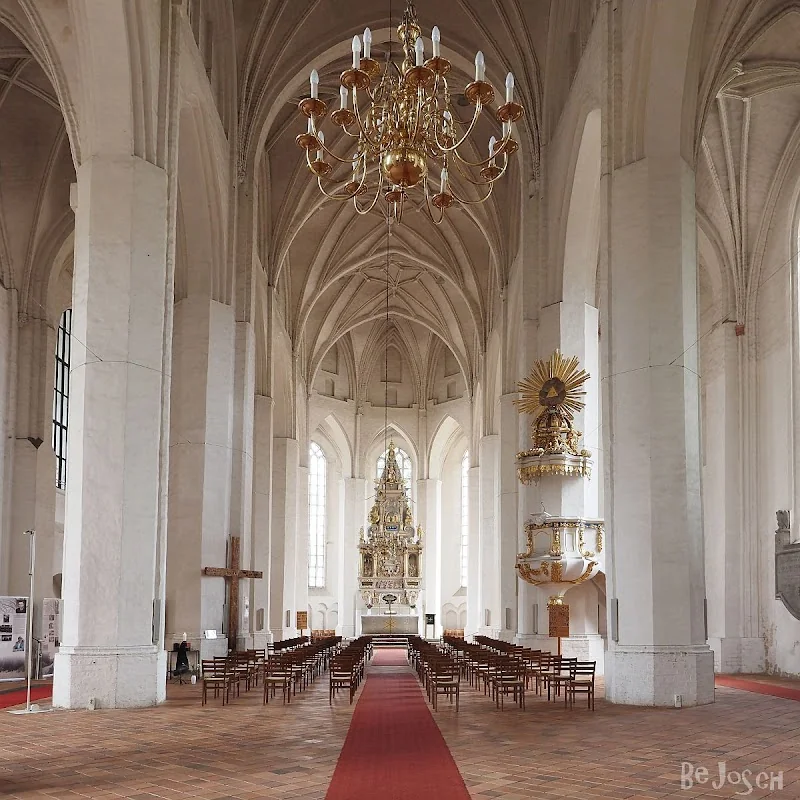
Particularly impressive is the community's reference to the consequences of World War II: The fire at the end of the war destroyed nearly all of the interior furnishings, and the vaults and roof structure also collapsed. After reconstruction, the church was intentionally not closed off with the wooden furnishings of earlier centuries but designed as an open, bright space. This creates the characteristic spaciousness that many visitors immediately perceive today. The church appears clear, high, and flooded with light; the view remains unobstructed from the entrance to the altar and is guided by pairs of pillars, high vaults, and the bright chancel. Among the most important works of art is the high altar, which was created in the 17th century and survived the fire because it was walled in for protection. The Baroque pulpit, grave monuments from the 16th and 17th centuries, as well as the vaults with their shapes and decorations also shape the interior. This mixture of medieval architectural ideas, Baroque furnishings, and post-war space creates the charm of the Oberkirche and explains why it is perceived not only as a church but also as a space for art and culture. ([st-nikolai-cottbus.de](https://www.st-nikolai-cottbus.de/die-oberkirche-st-nikolai/geschichte-und-architektur))
For visitors, the architecture is not only historically interesting but also immediately tangible. The church appears harmonious in its proportions because length, width, and height are in a clear relationship to each other. Especially in the interior, it becomes clear that this is not just a tourist attraction but a designed spiritual space. The community also describes that in the side naves, not all rows of chairs are present, but also exhibition panels, information offerings, and sales tables find their place. This shows that the architecture is not museum-like and frozen but is consciously used for today's forms of communication and mediation. Therefore, those interested in church construction, city history, and sacred art will find several levels here: the early mention of the place, the late Gothic architectural form, the traces of destruction, the reconstruction, and the current use as an open, lively house. ([st-nikolai-cottbus.de](https://www.st-nikolai-cottbus.de/die-oberkirche-st-nikolai/geschichte-und-architektur))
Church Tower, Organ, and Musical Events
A special attraction of the Oberkirche St. Nikolai is the accessible church tower. The tourism information states a height of 55 meters and points out that the tower can be climbed during opening hours outside of services. From the top, the view opens over Cottbus and the green urban landscape, which expands the visit to the church with a very concrete perspective: not only inward into the bright space but also far over the roofs of the city. Especially for guests looking for photos of the Oberkirche, the tower is an important part of the experience because it combines architecture, urban space, and views in a single location. Climbing the tower is thus one of the reasons why the church is much more than a historical building on the edge of a city center. It is a real excursion destination with perspective. ([cottbus-tourismus.de](https://cottbus-tourismus.de/de/winter/cottbus-besonders/winter-in-cottbus/sehenswuerdigkeiten-in-cottbus/artikel-oberkirche-st-nikolai-cottbus.html?utm_source=openai))
Equally formative is the music. On the community's website, there are dedicated sections for organ music from the Oberkirche, choral music, choirs, organs, St. Nikolai music, brass choir, and the Musica Sacra friends' circle. This clearly shows that musical work is not a marginal topic but is part of the core of the church's identity. The tourism information adds that the powerful organ above the entrance, with 3,672 pipes, is among the largest in Lusatia. The history page of the community also describes that the organ prospect dates back to 1759 and that the organ was renewed in 1984; it also mentions 50 registers. Together, this creates a very strong image: a historical prospect, a modern organ, and an acoustic space suitable for services as well as concerts. That the church is used for this is evidenced by numerous events such as concerts for Reformation Day, Advent and Christmas music, New Year's concert, Night of Open Churches, or musical services for Cantate Sunday. ([st-nikolai-cottbus.de](https://www.st-nikolai-cottbus.de/))
This connection between liturgy and culture makes the Oberkirche interesting for different target groups. Those who love classical church music will regularly find choirs, organ programs, and spiritual concerts here. Those who are more casually passing by may experience a rehearsal, a musical devotion, or a festive concert. The community itself emphasizes that besides services and church music, there are also information evenings, conferences, and performances. This makes the Oberkirche a space where music does not appear in isolation but goes hand in hand with faith, education, and encounter. For the city of Cottbus, this is a gain because the church thus remains not only a monument but also a functioning cultural venue. Visitors searching for program, concert, organ, or music will find exactly what they are looking for here. ([st-nikolai-cottbus.de](https://www.st-nikolai-cottbus.de/die-oberkirche-st-nikolai/geschichte-und-architektur))
Parking, Directions, and Practical Visitor Information
The Oberkirche St. Nikolai is centrally located in Cottbus and can therefore be easily integrated into a city walk. The official address is Oberkirchplatz 12, 03046 Cottbus. The community states that the church is openly accessible and refers to the parish office on Gertraudtenstraße, showing that visitors can turn to clear points of contact with questions. For directions, it is particularly important that there are public parking options in the immediate vicinity. Municipal documents explicitly mention the Oberkirche parking lot and the Friedrich-Ludwig-Jahn-Straße parking lot. The city's parking fee regulations also state that both parking lots are exempt from management on Saturdays. This is of interest to anyone who wants to combine a visit to the church, the market, or a city stroll with a car. ([st-nikolai-cottbus.de](https://www.st-nikolai-cottbus.de/))
Practical for the visit is also the immediate surroundings. In April 2025, the city of Cottbus opened a new barrier-free, publicly accessible restroom facility at Oberkirchplatz, located on Klosterstraße near the Oberkirche, which is open daily from 5 AM to 10 PM. This is a useful detail for guests who stay longer in the city center. Equally helpful is the orientation at Oberkirchplatz itself: it lies between pedestrian movement, weekly market, and church life, making it a lively yet well-overviewed place. Those walking can usually easily incorporate the church into a tour through the city center; those arriving by car should pay attention to the signage of municipal parking lots and plan some time for arrival and departure during larger events. Especially on market days and during concerts, it is advisable to arrive early, as the area around Oberkirchplatz becomes particularly lively. ([cottbus.de](https://cottbus.de/allgemein/lwg-errichtet-im-auftrag-der-stadt-cottbus-eine-neue-oeffentliche-wc-anlage/?utm_source=openai))
For mobility-sensitive visitors, the location is also pleasant because the central urban area allows for short distances. The official address and the municipal information show that the Oberkirche is not located off the beaten path but in the middle of the urban fabric. It is also fitting that the community itself mentions the visitor table and volunteer helpers who are available to tourists and guests during the day. So if someone has a question about the church, events, or the best time for climbing the tower, they usually find support on site. For an SEO-relevant search intention such as directions, parking, or parking lot, the Oberkirche is therefore a very clear case: there are central parking options, the city names specific parking spaces, and special regulations apply on Saturdays. This makes the visit planable and uncomplicated. ([st-nikolai-cottbus.de](https://www.st-nikolai-cottbus.de/))
Oberkirchplatz, Weekly Market, and City Center Environment
The Oberkirche St. Nikolai is inseparably linked to Oberkirchplatz, and it is here that its connection to daily life in Cottbus is particularly evident. The city and the tourism information describe the weekly market as a market with up to 40 vendors, traditionally held in the city center in the shadow of the Oberkirche. The market hours are clearly regulated: Tuesdays from 8 AM to 4 PM and Saturdays from 6 AM to 1 PM. Offered are, among other things, vegetable growers, flower vendors, sausage and poultry suppliers, as well as stalls with household goods. At the same time, cafés and restaurants around the square invite visitors to relax after their market visit. This makes the church not only visible as a backdrop but also as the spatial center of a lively neighborhood. ([cottbus-tourismus.de](https://cottbus-tourismus.de/de/sommer/cottbus-erleben/veranstaltungskalender/artikel-wochenmarkt_auf_dem_oberkirchplatz_di_sa_-82.html?utm_source=openai))
This combination of market, church, and city center is particularly attractive for visitors. One can experience the Oberkirche on a market day, combine the view of the tower with shopping, and immediately absorb the atmosphere of the square. The market contributes to the fact that Oberkirchplatz exists not only as an address on a map but as a social place with its own rhythms. The city's history is also palpable here, as the area is located in the city center and is closely related to the paths, squares, and sightlines around Altmarkt and Klosterstraße. Therefore, those interested in photos will find not only a building at Oberkirchplatz but a lively urban scene with market stalls, pedestrians, and the distinctive silhouette of the church. The interplay of historical architecture and everyday use makes the place particularly photogenic and authentic. ([cottbus-tourismus.de](https://cottbus-tourismus.de/de/winter/cottbus-besonders/winter-in-cottbus/sehenswuerdigkeiten-in-cottbus/artikel-oberkirche-st-nikolai-cottbus.html?utm_source=openai))
Even in the broader cityscape, the Oberkirche has a strong impact. The tourism information and city history show that it has been a point of orientation in Cottbus for centuries. The weekly market confirms this to this day: Around the church, people work, shop, talk, and linger. Thus, the Oberkirche is not only a destination for a short church visit but a natural part of a day in the city center. Therefore, those searching for weekly market, Oberkirchplatz, or Cottbus attractions will find a place where all three themes can be meaningfully connected. This mixture of everyday life and monumentality creates its charm. ([cottbus-tourismus.de](https://cottbus-tourismus.de/de/winter/cottbus-besonders/winter-in-cottbus/sehenswuerdigkeiten-in-cottbus/artikel-oberkirche-st-nikolai-cottbus.html?utm_source=openai))
Photos, 3D Panorama, and Why a Visit is Worthwhile
Those searching for photos of the Oberkirche St. Nikolai will quickly find reasons why this church is so often photographed. The official website already refers to its own photo page as well as a 3D panorama on Google Maps. This shows that the community consciously considers the visual impression of the church and makes the special effect of the building accessible online. From the outside, the massive tower, the brick architecture, and the clear silhouette shape the image; inside, the bright reconstruction after the war destruction creates an open, calm spatial impression. The community describes the unobstructed view from the entrance to the altar, the brightening church, and the light-flooded chancel. This combination of external lines and internal spaciousness makes the Oberkirche so photogenic and at the same time so pleasant for a genuine visit. ([st-nikolai-cottbus.de](https://www.st-nikolai-cottbus.de/))
Another reason to visit is the complexity of the place. The Oberkirche is not only a beautiful motif but also a space where history remains visible. The interior bears traces of destruction and reconstruction, Baroque furnishings, and modern use. The chancel, the high altar, the vaults, the grave monuments, and the open design of the side naves create a total image that is impressive in photos but even more striking in person. Upon entering the church, one quickly feels that light, height, and silence play together deliberately. At the same time, the atmosphere is not distant but inviting. This makes the Oberkirche equally interesting for tourists, architecture enthusiasts, and those seeking a quiet moment in the city. ([st-nikolai-cottbus.de](https://www.st-nikolai-cottbus.de/die-oberkirche-st-nikolai/geschichte-und-architektur))
The connection between the interior and exterior view is also remarkable. Outside, the church stands as a clear, late Gothic landmark in the urban space; inside, it opens up as a spacious, white room with rich historical depth. Additionally, there is the opportunity to climb the church tower and see the city from above. Therefore, those planning to stop by briefly should take a little more time if possible. A visit can ideally be combined with the tower, market, city center, and a quiet moment in the church space. For search queries like photos, interior, tower, or open church, the Oberkirche St. Nikolai is thus a strong destination with high recognition value and genuine quality of stay. ([cottbus-tourismus.de](https://cottbus-tourismus.de/de/winter/cottbus-besonders/winter-in-cottbus/sehenswuerdigkeiten-in-cottbus/artikel-oberkirche-st-nikolai-cottbus.html?utm_source=openai))
Sources:
- Church Community St. Nikolai Cottbus - Official Website ([st-nikolai-cottbus.de](https://www.st-nikolai-cottbus.de/))
- St. Nikolai Cottbus - History and Architecture ([st-nikolai-cottbus.de](https://www.st-nikolai-cottbus.de/die-oberkirche-st-nikolai/geschichte-und-architektur))
- Cottbus Tourism - Oberkirche St. Nikolai Cottbus ([cottbus-tourismus.de](https://cottbus-tourismus.de/de/winter/cottbus-besonders/winter-in-cottbus/sehenswuerdigkeiten-in-cottbus/artikel-oberkirche-st-nikolai-cottbus.html?utm_source=openai))
- City Museum Cottbus - Oberkirche St. Nikolai ([stadtmuseum-cottbus.de](https://stadtmuseum-cottbus.de/cottbus-lexikon-detail/oberkirche-st-nikolai.html))
- City of Cottbus - Parking Fee Regulations ([cottbus.de](https://www.cottbus.de/.files/storage/file/643bccb0-625d-4685-93fa-bd102654059d/Parkgebuehrenordnung.pdf))
- City of Cottbus - Weekly Market at Oberkirchplatz ([cottbus.de](https://cottbus.de/veranstaltungen/wochenmarkt-auf-dem-oberkirchplatz/?utm_source=openai))
Show moreShow less
Oberkirche St. Nikolai | Opening Hours & Parking
The Oberkirche St. Nikolai is one of the defining places in Cottbus and connects history, present, and urban life in an unusually vibrant way. It is located at Oberkirchplatz in the city center, not far from the Altmarkt, and serves as an evangelical parish church, an open church, a concert venue, and a visual highlight in the street scene. Those interested in the Oberkirche St. Nikolai Cottbus are often looking not only for photos but also for opening hours, parking, the church tower, services, history, and the musical offerings available on site. This mixture creates its special charm: during the day, it is a quiet place to enter, look, and linger; on Sundays, it is the home of the service, and throughout the year, it repeatedly serves as a stage for music, encounters, and events. The parish explicitly describes the Oberkirche as an open church that welcomes visitors daily; the city of Cottbus and the tourism information additionally emphasize its urban presence, the tower, and the weekly market at Oberkirchplatz. ([st-nikolai-cottbus.de](https://www.st-nikolai-cottbus.de/))
Opening Hours, Services, and Open Church
The Oberkirche St. Nikolai is not only a historical monument but primarily a living place of faith. On the church community's website, it is described as an open church. In summer, it is open daily from 10 AM to 5 PM, and in winter, daily from 11 AM to 4 PM. On Sundays, the community invites everyone to the service at 10 AM, and church holidays are also part of the regular spiritual life of the house. This makes the church easily accessible for both locals and guests, fulfilling exactly the function one would expect from a central city church: it is a place of devotion, but also a place of encounter, reflection, and orientation in the city center. That visitors can not only enter during opening hours but also gather information is demonstrated by the mentioned book table, where volunteers are available to answer questions and open the church during the day and close it in the evening. This lived openness is an important part of the community's self-understanding and contributes to the fact that the Oberkirche does not appear as a closed tourist attraction but as an inviting space for different people and occasions. ([st-nikolai-cottbus.de](https://www.st-nikolai-cottbus.de/))
This mixture of liturgical reliability and everyday accessibility shapes the character of the place. Those passing by on a weekday often experience a quiet church with a spacious interior and clear atmosphere; those coming on Sunday experience a lively service; and those returning throughout the year find new spiritual and cultural occasions. The community refers not only to the classic services but also to peace prayers, Bible study groups, children's and family offerings, as well as diverse community work that places the church in a broader social context. Thus, the Oberkirche is visible not only as a building but as part of everyday church and urban life. For visitors, this is particularly pleasant because a short detour is just as worthwhile as a planned longer stay. Even the simple walk through the main entrance makes it clear that an open church is maintained here, which invites people not only on festive days but day after day. ([st-nikolai-cottbus.de](https://www.st-nikolai-cottbus.de/))
History and Architecture of the Oberkirche St. Nikolai
Architecturally, the Oberkirche St. Nikolai is one of the most significant churches in the region. The tourism information describes it as the largest church in Lower Lusatia and as a late Gothic three-nave brick building, whose history dates back to the 14th century. At the same time, the city museum page refers to its first mention in 1156, making it clear how deeply the church is embedded in the city's history. The current building developed over centuries, shaped by city fires and repeatedly altered and rebuilt after severe destruction. The historical core, the powerful tower, and the later late Gothic form combine to create a structure that does not appear as a static monument but as a visible archive of the city's history. The church is also part of a series of large northeastern German city churches of brick Gothic, characterized by clear divisions, red wall surfaces, and a striking presence in the urban space. Even from the outside, the strong elevation of the nave is striking, making the difference between the central and side naves clearly visible. ([cottbus-tourismus.de](https://cottbus-tourismus.de/de/winter/cottbus-besonders/winter-in-cottbus/sehenswuerdigkeiten-in-cottbus/artikel-oberkirche-st-nikolai-cottbus.html?utm_source=openai))
Particularly impressive is the community's reference to the consequences of World War II: The fire at the end of the war destroyed nearly all of the interior furnishings, and the vaults and roof structure also collapsed. After reconstruction, the church was intentionally not closed off with the wooden furnishings of earlier centuries but designed as an open, bright space. This creates the characteristic spaciousness that many visitors immediately perceive today. The church appears clear, high, and flooded with light; the view remains unobstructed from the entrance to the altar and is guided by pairs of pillars, high vaults, and the bright chancel. Among the most important works of art is the high altar, which was created in the 17th century and survived the fire because it was walled in for protection. The Baroque pulpit, grave monuments from the 16th and 17th centuries, as well as the vaults with their shapes and decorations also shape the interior. This mixture of medieval architectural ideas, Baroque furnishings, and post-war space creates the charm of the Oberkirche and explains why it is perceived not only as a church but also as a space for art and culture. ([st-nikolai-cottbus.de](https://www.st-nikolai-cottbus.de/die-oberkirche-st-nikolai/geschichte-und-architektur))
For visitors, the architecture is not only historically interesting but also immediately tangible. The church appears harmonious in its proportions because length, width, and height are in a clear relationship to each other. Especially in the interior, it becomes clear that this is not just a tourist attraction but a designed spiritual space. The community also describes that in the side naves, not all rows of chairs are present, but also exhibition panels, information offerings, and sales tables find their place. This shows that the architecture is not museum-like and frozen but is consciously used for today's forms of communication and mediation. Therefore, those interested in church construction, city history, and sacred art will find several levels here: the early mention of the place, the late Gothic architectural form, the traces of destruction, the reconstruction, and the current use as an open, lively house. ([st-nikolai-cottbus.de](https://www.st-nikolai-cottbus.de/die-oberkirche-st-nikolai/geschichte-und-architektur))
Church Tower, Organ, and Musical Events
A special attraction of the Oberkirche St. Nikolai is the accessible church tower. The tourism information states a height of 55 meters and points out that the tower can be climbed during opening hours outside of services. From the top, the view opens over Cottbus and the green urban landscape, which expands the visit to the church with a very concrete perspective: not only inward into the bright space but also far over the roofs of the city. Especially for guests looking for photos of the Oberkirche, the tower is an important part of the experience because it combines architecture, urban space, and views in a single location. Climbing the tower is thus one of the reasons why the church is much more than a historical building on the edge of a city center. It is a real excursion destination with perspective. ([cottbus-tourismus.de](https://cottbus-tourismus.de/de/winter/cottbus-besonders/winter-in-cottbus/sehenswuerdigkeiten-in-cottbus/artikel-oberkirche-st-nikolai-cottbus.html?utm_source=openai))
Equally formative is the music. On the community's website, there are dedicated sections for organ music from the Oberkirche, choral music, choirs, organs, St. Nikolai music, brass choir, and the Musica Sacra friends' circle. This clearly shows that musical work is not a marginal topic but is part of the core of the church's identity. The tourism information adds that the powerful organ above the entrance, with 3,672 pipes, is among the largest in Lusatia. The history page of the community also describes that the organ prospect dates back to 1759 and that the organ was renewed in 1984; it also mentions 50 registers. Together, this creates a very strong image: a historical prospect, a modern organ, and an acoustic space suitable for services as well as concerts. That the church is used for this is evidenced by numerous events such as concerts for Reformation Day, Advent and Christmas music, New Year's concert, Night of Open Churches, or musical services for Cantate Sunday. ([st-nikolai-cottbus.de](https://www.st-nikolai-cottbus.de/))
This connection between liturgy and culture makes the Oberkirche interesting for different target groups. Those who love classical church music will regularly find choirs, organ programs, and spiritual concerts here. Those who are more casually passing by may experience a rehearsal, a musical devotion, or a festive concert. The community itself emphasizes that besides services and church music, there are also information evenings, conferences, and performances. This makes the Oberkirche a space where music does not appear in isolation but goes hand in hand with faith, education, and encounter. For the city of Cottbus, this is a gain because the church thus remains not only a monument but also a functioning cultural venue. Visitors searching for program, concert, organ, or music will find exactly what they are looking for here. ([st-nikolai-cottbus.de](https://www.st-nikolai-cottbus.de/die-oberkirche-st-nikolai/geschichte-und-architektur))
Parking, Directions, and Practical Visitor Information
The Oberkirche St. Nikolai is centrally located in Cottbus and can therefore be easily integrated into a city walk. The official address is Oberkirchplatz 12, 03046 Cottbus. The community states that the church is openly accessible and refers to the parish office on Gertraudtenstraße, showing that visitors can turn to clear points of contact with questions. For directions, it is particularly important that there are public parking options in the immediate vicinity. Municipal documents explicitly mention the Oberkirche parking lot and the Friedrich-Ludwig-Jahn-Straße parking lot. The city's parking fee regulations also state that both parking lots are exempt from management on Saturdays. This is of interest to anyone who wants to combine a visit to the church, the market, or a city stroll with a car. ([st-nikolai-cottbus.de](https://www.st-nikolai-cottbus.de/))
Practical for the visit is also the immediate surroundings. In April 2025, the city of Cottbus opened a new barrier-free, publicly accessible restroom facility at Oberkirchplatz, located on Klosterstraße near the Oberkirche, which is open daily from 5 AM to 10 PM. This is a useful detail for guests who stay longer in the city center. Equally helpful is the orientation at Oberkirchplatz itself: it lies between pedestrian movement, weekly market, and church life, making it a lively yet well-overviewed place. Those walking can usually easily incorporate the church into a tour through the city center; those arriving by car should pay attention to the signage of municipal parking lots and plan some time for arrival and departure during larger events. Especially on market days and during concerts, it is advisable to arrive early, as the area around Oberkirchplatz becomes particularly lively. ([cottbus.de](https://cottbus.de/allgemein/lwg-errichtet-im-auftrag-der-stadt-cottbus-eine-neue-oeffentliche-wc-anlage/?utm_source=openai))
For mobility-sensitive visitors, the location is also pleasant because the central urban area allows for short distances. The official address and the municipal information show that the Oberkirche is not located off the beaten path but in the middle of the urban fabric. It is also fitting that the community itself mentions the visitor table and volunteer helpers who are available to tourists and guests during the day. So if someone has a question about the church, events, or the best time for climbing the tower, they usually find support on site. For an SEO-relevant search intention such as directions, parking, or parking lot, the Oberkirche is therefore a very clear case: there are central parking options, the city names specific parking spaces, and special regulations apply on Saturdays. This makes the visit planable and uncomplicated. ([st-nikolai-cottbus.de](https://www.st-nikolai-cottbus.de/))
Oberkirchplatz, Weekly Market, and City Center Environment
The Oberkirche St. Nikolai is inseparably linked to Oberkirchplatz, and it is here that its connection to daily life in Cottbus is particularly evident. The city and the tourism information describe the weekly market as a market with up to 40 vendors, traditionally held in the city center in the shadow of the Oberkirche. The market hours are clearly regulated: Tuesdays from 8 AM to 4 PM and Saturdays from 6 AM to 1 PM. Offered are, among other things, vegetable growers, flower vendors, sausage and poultry suppliers, as well as stalls with household goods. At the same time, cafés and restaurants around the square invite visitors to relax after their market visit. This makes the church not only visible as a backdrop but also as the spatial center of a lively neighborhood. ([cottbus-tourismus.de](https://cottbus-tourismus.de/de/sommer/cottbus-erleben/veranstaltungskalender/artikel-wochenmarkt_auf_dem_oberkirchplatz_di_sa_-82.html?utm_source=openai))
This combination of market, church, and city center is particularly attractive for visitors. One can experience the Oberkirche on a market day, combine the view of the tower with shopping, and immediately absorb the atmosphere of the square. The market contributes to the fact that Oberkirchplatz exists not only as an address on a map but as a social place with its own rhythms. The city's history is also palpable here, as the area is located in the city center and is closely related to the paths, squares, and sightlines around Altmarkt and Klosterstraße. Therefore, those interested in photos will find not only a building at Oberkirchplatz but a lively urban scene with market stalls, pedestrians, and the distinctive silhouette of the church. The interplay of historical architecture and everyday use makes the place particularly photogenic and authentic. ([cottbus-tourismus.de](https://cottbus-tourismus.de/de/winter/cottbus-besonders/winter-in-cottbus/sehenswuerdigkeiten-in-cottbus/artikel-oberkirche-st-nikolai-cottbus.html?utm_source=openai))
Even in the broader cityscape, the Oberkirche has a strong impact. The tourism information and city history show that it has been a point of orientation in Cottbus for centuries. The weekly market confirms this to this day: Around the church, people work, shop, talk, and linger. Thus, the Oberkirche is not only a destination for a short church visit but a natural part of a day in the city center. Therefore, those searching for weekly market, Oberkirchplatz, or Cottbus attractions will find a place where all three themes can be meaningfully connected. This mixture of everyday life and monumentality creates its charm. ([cottbus-tourismus.de](https://cottbus-tourismus.de/de/winter/cottbus-besonders/winter-in-cottbus/sehenswuerdigkeiten-in-cottbus/artikel-oberkirche-st-nikolai-cottbus.html?utm_source=openai))
Photos, 3D Panorama, and Why a Visit is Worthwhile
Those searching for photos of the Oberkirche St. Nikolai will quickly find reasons why this church is so often photographed. The official website already refers to its own photo page as well as a 3D panorama on Google Maps. This shows that the community consciously considers the visual impression of the church and makes the special effect of the building accessible online. From the outside, the massive tower, the brick architecture, and the clear silhouette shape the image; inside, the bright reconstruction after the war destruction creates an open, calm spatial impression. The community describes the unobstructed view from the entrance to the altar, the brightening church, and the light-flooded chancel. This combination of external lines and internal spaciousness makes the Oberkirche so photogenic and at the same time so pleasant for a genuine visit. ([st-nikolai-cottbus.de](https://www.st-nikolai-cottbus.de/))
Another reason to visit is the complexity of the place. The Oberkirche is not only a beautiful motif but also a space where history remains visible. The interior bears traces of destruction and reconstruction, Baroque furnishings, and modern use. The chancel, the high altar, the vaults, the grave monuments, and the open design of the side naves create a total image that is impressive in photos but even more striking in person. Upon entering the church, one quickly feels that light, height, and silence play together deliberately. At the same time, the atmosphere is not distant but inviting. This makes the Oberkirche equally interesting for tourists, architecture enthusiasts, and those seeking a quiet moment in the city. ([st-nikolai-cottbus.de](https://www.st-nikolai-cottbus.de/die-oberkirche-st-nikolai/geschichte-und-architektur))
The connection between the interior and exterior view is also remarkable. Outside, the church stands as a clear, late Gothic landmark in the urban space; inside, it opens up as a spacious, white room with rich historical depth. Additionally, there is the opportunity to climb the church tower and see the city from above. Therefore, those planning to stop by briefly should take a little more time if possible. A visit can ideally be combined with the tower, market, city center, and a quiet moment in the church space. For search queries like photos, interior, tower, or open church, the Oberkirche St. Nikolai is thus a strong destination with high recognition value and genuine quality of stay. ([cottbus-tourismus.de](https://cottbus-tourismus.de/de/winter/cottbus-besonders/winter-in-cottbus/sehenswuerdigkeiten-in-cottbus/artikel-oberkirche-st-nikolai-cottbus.html?utm_source=openai))
Sources:
- Church Community St. Nikolai Cottbus - Official Website ([st-nikolai-cottbus.de](https://www.st-nikolai-cottbus.de/))
- St. Nikolai Cottbus - History and Architecture ([st-nikolai-cottbus.de](https://www.st-nikolai-cottbus.de/die-oberkirche-st-nikolai/geschichte-und-architektur))
- Cottbus Tourism - Oberkirche St. Nikolai Cottbus ([cottbus-tourismus.de](https://cottbus-tourismus.de/de/winter/cottbus-besonders/winter-in-cottbus/sehenswuerdigkeiten-in-cottbus/artikel-oberkirche-st-nikolai-cottbus.html?utm_source=openai))
- City Museum Cottbus - Oberkirche St. Nikolai ([stadtmuseum-cottbus.de](https://stadtmuseum-cottbus.de/cottbus-lexikon-detail/oberkirche-st-nikolai.html))
- City of Cottbus - Parking Fee Regulations ([cottbus.de](https://www.cottbus.de/.files/storage/file/643bccb0-625d-4685-93fa-bd102654059d/Parkgebuehrenordnung.pdf))
- City of Cottbus - Weekly Market at Oberkirchplatz ([cottbus.de](https://cottbus.de/veranstaltungen/wochenmarkt-auf-dem-oberkirchplatz/?utm_source=openai))
Oberkirche St. Nikolai | Opening Hours & Parking
The Oberkirche St. Nikolai is one of the defining places in Cottbus and connects history, present, and urban life in an unusually vibrant way. It is located at Oberkirchplatz in the city center, not far from the Altmarkt, and serves as an evangelical parish church, an open church, a concert venue, and a visual highlight in the street scene. Those interested in the Oberkirche St. Nikolai Cottbus are often looking not only for photos but also for opening hours, parking, the church tower, services, history, and the musical offerings available on site. This mixture creates its special charm: during the day, it is a quiet place to enter, look, and linger; on Sundays, it is the home of the service, and throughout the year, it repeatedly serves as a stage for music, encounters, and events. The parish explicitly describes the Oberkirche as an open church that welcomes visitors daily; the city of Cottbus and the tourism information additionally emphasize its urban presence, the tower, and the weekly market at Oberkirchplatz. ([st-nikolai-cottbus.de](https://www.st-nikolai-cottbus.de/))
Opening Hours, Services, and Open Church
The Oberkirche St. Nikolai is not only a historical monument but primarily a living place of faith. On the church community's website, it is described as an open church. In summer, it is open daily from 10 AM to 5 PM, and in winter, daily from 11 AM to 4 PM. On Sundays, the community invites everyone to the service at 10 AM, and church holidays are also part of the regular spiritual life of the house. This makes the church easily accessible for both locals and guests, fulfilling exactly the function one would expect from a central city church: it is a place of devotion, but also a place of encounter, reflection, and orientation in the city center. That visitors can not only enter during opening hours but also gather information is demonstrated by the mentioned book table, where volunteers are available to answer questions and open the church during the day and close it in the evening. This lived openness is an important part of the community's self-understanding and contributes to the fact that the Oberkirche does not appear as a closed tourist attraction but as an inviting space for different people and occasions. ([st-nikolai-cottbus.de](https://www.st-nikolai-cottbus.de/))
This mixture of liturgical reliability and everyday accessibility shapes the character of the place. Those passing by on a weekday often experience a quiet church with a spacious interior and clear atmosphere; those coming on Sunday experience a lively service; and those returning throughout the year find new spiritual and cultural occasions. The community refers not only to the classic services but also to peace prayers, Bible study groups, children's and family offerings, as well as diverse community work that places the church in a broader social context. Thus, the Oberkirche is visible not only as a building but as part of everyday church and urban life. For visitors, this is particularly pleasant because a short detour is just as worthwhile as a planned longer stay. Even the simple walk through the main entrance makes it clear that an open church is maintained here, which invites people not only on festive days but day after day. ([st-nikolai-cottbus.de](https://www.st-nikolai-cottbus.de/))
History and Architecture of the Oberkirche St. Nikolai
Architecturally, the Oberkirche St. Nikolai is one of the most significant churches in the region. The tourism information describes it as the largest church in Lower Lusatia and as a late Gothic three-nave brick building, whose history dates back to the 14th century. At the same time, the city museum page refers to its first mention in 1156, making it clear how deeply the church is embedded in the city's history. The current building developed over centuries, shaped by city fires and repeatedly altered and rebuilt after severe destruction. The historical core, the powerful tower, and the later late Gothic form combine to create a structure that does not appear as a static monument but as a visible archive of the city's history. The church is also part of a series of large northeastern German city churches of brick Gothic, characterized by clear divisions, red wall surfaces, and a striking presence in the urban space. Even from the outside, the strong elevation of the nave is striking, making the difference between the central and side naves clearly visible. ([cottbus-tourismus.de](https://cottbus-tourismus.de/de/winter/cottbus-besonders/winter-in-cottbus/sehenswuerdigkeiten-in-cottbus/artikel-oberkirche-st-nikolai-cottbus.html?utm_source=openai))
Particularly impressive is the community's reference to the consequences of World War II: The fire at the end of the war destroyed nearly all of the interior furnishings, and the vaults and roof structure also collapsed. After reconstruction, the church was intentionally not closed off with the wooden furnishings of earlier centuries but designed as an open, bright space. This creates the characteristic spaciousness that many visitors immediately perceive today. The church appears clear, high, and flooded with light; the view remains unobstructed from the entrance to the altar and is guided by pairs of pillars, high vaults, and the bright chancel. Among the most important works of art is the high altar, which was created in the 17th century and survived the fire because it was walled in for protection. The Baroque pulpit, grave monuments from the 16th and 17th centuries, as well as the vaults with their shapes and decorations also shape the interior. This mixture of medieval architectural ideas, Baroque furnishings, and post-war space creates the charm of the Oberkirche and explains why it is perceived not only as a church but also as a space for art and culture. ([st-nikolai-cottbus.de](https://www.st-nikolai-cottbus.de/die-oberkirche-st-nikolai/geschichte-und-architektur))
For visitors, the architecture is not only historically interesting but also immediately tangible. The church appears harmonious in its proportions because length, width, and height are in a clear relationship to each other. Especially in the interior, it becomes clear that this is not just a tourist attraction but a designed spiritual space. The community also describes that in the side naves, not all rows of chairs are present, but also exhibition panels, information offerings, and sales tables find their place. This shows that the architecture is not museum-like and frozen but is consciously used for today's forms of communication and mediation. Therefore, those interested in church construction, city history, and sacred art will find several levels here: the early mention of the place, the late Gothic architectural form, the traces of destruction, the reconstruction, and the current use as an open, lively house. ([st-nikolai-cottbus.de](https://www.st-nikolai-cottbus.de/die-oberkirche-st-nikolai/geschichte-und-architektur))
Church Tower, Organ, and Musical Events
A special attraction of the Oberkirche St. Nikolai is the accessible church tower. The tourism information states a height of 55 meters and points out that the tower can be climbed during opening hours outside of services. From the top, the view opens over Cottbus and the green urban landscape, which expands the visit to the church with a very concrete perspective: not only inward into the bright space but also far over the roofs of the city. Especially for guests looking for photos of the Oberkirche, the tower is an important part of the experience because it combines architecture, urban space, and views in a single location. Climbing the tower is thus one of the reasons why the church is much more than a historical building on the edge of a city center. It is a real excursion destination with perspective. ([cottbus-tourismus.de](https://cottbus-tourismus.de/de/winter/cottbus-besonders/winter-in-cottbus/sehenswuerdigkeiten-in-cottbus/artikel-oberkirche-st-nikolai-cottbus.html?utm_source=openai))
Equally formative is the music. On the community's website, there are dedicated sections for organ music from the Oberkirche, choral music, choirs, organs, St. Nikolai music, brass choir, and the Musica Sacra friends' circle. This clearly shows that musical work is not a marginal topic but is part of the core of the church's identity. The tourism information adds that the powerful organ above the entrance, with 3,672 pipes, is among the largest in Lusatia. The history page of the community also describes that the organ prospect dates back to 1759 and that the organ was renewed in 1984; it also mentions 50 registers. Together, this creates a very strong image: a historical prospect, a modern organ, and an acoustic space suitable for services as well as concerts. That the church is used for this is evidenced by numerous events such as concerts for Reformation Day, Advent and Christmas music, New Year's concert, Night of Open Churches, or musical services for Cantate Sunday. ([st-nikolai-cottbus.de](https://www.st-nikolai-cottbus.de/))
This connection between liturgy and culture makes the Oberkirche interesting for different target groups. Those who love classical church music will regularly find choirs, organ programs, and spiritual concerts here. Those who are more casually passing by may experience a rehearsal, a musical devotion, or a festive concert. The community itself emphasizes that besides services and church music, there are also information evenings, conferences, and performances. This makes the Oberkirche a space where music does not appear in isolation but goes hand in hand with faith, education, and encounter. For the city of Cottbus, this is a gain because the church thus remains not only a monument but also a functioning cultural venue. Visitors searching for program, concert, organ, or music will find exactly what they are looking for here. ([st-nikolai-cottbus.de](https://www.st-nikolai-cottbus.de/die-oberkirche-st-nikolai/geschichte-und-architektur))
Parking, Directions, and Practical Visitor Information
The Oberkirche St. Nikolai is centrally located in Cottbus and can therefore be easily integrated into a city walk. The official address is Oberkirchplatz 12, 03046 Cottbus. The community states that the church is openly accessible and refers to the parish office on Gertraudtenstraße, showing that visitors can turn to clear points of contact with questions. For directions, it is particularly important that there are public parking options in the immediate vicinity. Municipal documents explicitly mention the Oberkirche parking lot and the Friedrich-Ludwig-Jahn-Straße parking lot. The city's parking fee regulations also state that both parking lots are exempt from management on Saturdays. This is of interest to anyone who wants to combine a visit to the church, the market, or a city stroll with a car. ([st-nikolai-cottbus.de](https://www.st-nikolai-cottbus.de/))
Practical for the visit is also the immediate surroundings. In April 2025, the city of Cottbus opened a new barrier-free, publicly accessible restroom facility at Oberkirchplatz, located on Klosterstraße near the Oberkirche, which is open daily from 5 AM to 10 PM. This is a useful detail for guests who stay longer in the city center. Equally helpful is the orientation at Oberkirchplatz itself: it lies between pedestrian movement, weekly market, and church life, making it a lively yet well-overviewed place. Those walking can usually easily incorporate the church into a tour through the city center; those arriving by car should pay attention to the signage of municipal parking lots and plan some time for arrival and departure during larger events. Especially on market days and during concerts, it is advisable to arrive early, as the area around Oberkirchplatz becomes particularly lively. ([cottbus.de](https://cottbus.de/allgemein/lwg-errichtet-im-auftrag-der-stadt-cottbus-eine-neue-oeffentliche-wc-anlage/?utm_source=openai))
For mobility-sensitive visitors, the location is also pleasant because the central urban area allows for short distances. The official address and the municipal information show that the Oberkirche is not located off the beaten path but in the middle of the urban fabric. It is also fitting that the community itself mentions the visitor table and volunteer helpers who are available to tourists and guests during the day. So if someone has a question about the church, events, or the best time for climbing the tower, they usually find support on site. For an SEO-relevant search intention such as directions, parking, or parking lot, the Oberkirche is therefore a very clear case: there are central parking options, the city names specific parking spaces, and special regulations apply on Saturdays. This makes the visit planable and uncomplicated. ([st-nikolai-cottbus.de](https://www.st-nikolai-cottbus.de/))
Oberkirchplatz, Weekly Market, and City Center Environment
The Oberkirche St. Nikolai is inseparably linked to Oberkirchplatz, and it is here that its connection to daily life in Cottbus is particularly evident. The city and the tourism information describe the weekly market as a market with up to 40 vendors, traditionally held in the city center in the shadow of the Oberkirche. The market hours are clearly regulated: Tuesdays from 8 AM to 4 PM and Saturdays from 6 AM to 1 PM. Offered are, among other things, vegetable growers, flower vendors, sausage and poultry suppliers, as well as stalls with household goods. At the same time, cafés and restaurants around the square invite visitors to relax after their market visit. This makes the church not only visible as a backdrop but also as the spatial center of a lively neighborhood. ([cottbus-tourismus.de](https://cottbus-tourismus.de/de/sommer/cottbus-erleben/veranstaltungskalender/artikel-wochenmarkt_auf_dem_oberkirchplatz_di_sa_-82.html?utm_source=openai))
This combination of market, church, and city center is particularly attractive for visitors. One can experience the Oberkirche on a market day, combine the view of the tower with shopping, and immediately absorb the atmosphere of the square. The market contributes to the fact that Oberkirchplatz exists not only as an address on a map but as a social place with its own rhythms. The city's history is also palpable here, as the area is located in the city center and is closely related to the paths, squares, and sightlines around Altmarkt and Klosterstraße. Therefore, those interested in photos will find not only a building at Oberkirchplatz but a lively urban scene with market stalls, pedestrians, and the distinctive silhouette of the church. The interplay of historical architecture and everyday use makes the place particularly photogenic and authentic. ([cottbus-tourismus.de](https://cottbus-tourismus.de/de/winter/cottbus-besonders/winter-in-cottbus/sehenswuerdigkeiten-in-cottbus/artikel-oberkirche-st-nikolai-cottbus.html?utm_source=openai))
Even in the broader cityscape, the Oberkirche has a strong impact. The tourism information and city history show that it has been a point of orientation in Cottbus for centuries. The weekly market confirms this to this day: Around the church, people work, shop, talk, and linger. Thus, the Oberkirche is not only a destination for a short church visit but a natural part of a day in the city center. Therefore, those searching for weekly market, Oberkirchplatz, or Cottbus attractions will find a place where all three themes can be meaningfully connected. This mixture of everyday life and monumentality creates its charm. ([cottbus-tourismus.de](https://cottbus-tourismus.de/de/winter/cottbus-besonders/winter-in-cottbus/sehenswuerdigkeiten-in-cottbus/artikel-oberkirche-st-nikolai-cottbus.html?utm_source=openai))
Photos, 3D Panorama, and Why a Visit is Worthwhile
Those searching for photos of the Oberkirche St. Nikolai will quickly find reasons why this church is so often photographed. The official website already refers to its own photo page as well as a 3D panorama on Google Maps. This shows that the community consciously considers the visual impression of the church and makes the special effect of the building accessible online. From the outside, the massive tower, the brick architecture, and the clear silhouette shape the image; inside, the bright reconstruction after the war destruction creates an open, calm spatial impression. The community describes the unobstructed view from the entrance to the altar, the brightening church, and the light-flooded chancel. This combination of external lines and internal spaciousness makes the Oberkirche so photogenic and at the same time so pleasant for a genuine visit. ([st-nikolai-cottbus.de](https://www.st-nikolai-cottbus.de/))
Another reason to visit is the complexity of the place. The Oberkirche is not only a beautiful motif but also a space where history remains visible. The interior bears traces of destruction and reconstruction, Baroque furnishings, and modern use. The chancel, the high altar, the vaults, the grave monuments, and the open design of the side naves create a total image that is impressive in photos but even more striking in person. Upon entering the church, one quickly feels that light, height, and silence play together deliberately. At the same time, the atmosphere is not distant but inviting. This makes the Oberkirche equally interesting for tourists, architecture enthusiasts, and those seeking a quiet moment in the city. ([st-nikolai-cottbus.de](https://www.st-nikolai-cottbus.de/die-oberkirche-st-nikolai/geschichte-und-architektur))
The connection between the interior and exterior view is also remarkable. Outside, the church stands as a clear, late Gothic landmark in the urban space; inside, it opens up as a spacious, white room with rich historical depth. Additionally, there is the opportunity to climb the church tower and see the city from above. Therefore, those planning to stop by briefly should take a little more time if possible. A visit can ideally be combined with the tower, market, city center, and a quiet moment in the church space. For search queries like photos, interior, tower, or open church, the Oberkirche St. Nikolai is thus a strong destination with high recognition value and genuine quality of stay. ([cottbus-tourismus.de](https://cottbus-tourismus.de/de/winter/cottbus-besonders/winter-in-cottbus/sehenswuerdigkeiten-in-cottbus/artikel-oberkirche-st-nikolai-cottbus.html?utm_source=openai))
Sources:
- Church Community St. Nikolai Cottbus - Official Website ([st-nikolai-cottbus.de](https://www.st-nikolai-cottbus.de/))
- St. Nikolai Cottbus - History and Architecture ([st-nikolai-cottbus.de](https://www.st-nikolai-cottbus.de/die-oberkirche-st-nikolai/geschichte-und-architektur))
- Cottbus Tourism - Oberkirche St. Nikolai Cottbus ([cottbus-tourismus.de](https://cottbus-tourismus.de/de/winter/cottbus-besonders/winter-in-cottbus/sehenswuerdigkeiten-in-cottbus/artikel-oberkirche-st-nikolai-cottbus.html?utm_source=openai))
- City Museum Cottbus - Oberkirche St. Nikolai ([stadtmuseum-cottbus.de](https://stadtmuseum-cottbus.de/cottbus-lexikon-detail/oberkirche-st-nikolai.html))
- City of Cottbus - Parking Fee Regulations ([cottbus.de](https://www.cottbus.de/.files/storage/file/643bccb0-625d-4685-93fa-bd102654059d/Parkgebuehrenordnung.pdf))
- City of Cottbus - Weekly Market at Oberkirchplatz ([cottbus.de](https://cottbus.de/veranstaltungen/wochenmarkt-auf-dem-oberkirchplatz/?utm_source=openai))
Upcoming Events
No events found
Frequently Asked Questions
Reviews
Francesco Prestini
2. August 2025
Impressive church
Doğa
26. December 2024
Nice church.
Taurus C.
2. August 2024
We were there on a Sunday and found a parking spot right next to the pretty church. Since it was open, we naturally went inside. It's quite lovely from the outside. The interior is bright and airy. I found it friendly and inviting. Worth seeing.
Piotr Piotrowski
31. May 2024
A beautiful Gothic church, completely destroyed during World War II. It was decided to rebuild it, and the original furnishings include a Mannerist altar. Inside, there are numerous preserved tombstones, magnificent epigraphic works. Inside, there's a Baroque baptismal font. Worth seeing.
Hans-Peter Staps
28. September 2024
The Upper Church in Cottbus is a late Gothic brick church in the city center. It is the largest medieval church in Lower Lusatia. It has been a listed building since the 1970s.