
Cottbus
Bautzener Str. 140, 03050 Cottbus, Deutschland
Human Rights Center Cottbus e.V. | Photos & Reviews
The Human Rights Center Cottbus e.V. - Memorial Zuchthaus Cottbus is not an ordinary place to visit, but a historical learning site with strong relevance to the present. On the grounds at Bautzener Straße 140, visitors encounter a former detention area that was used from 1860 to 2002 and today continues to live on as a memorial, educational site, and place of encounter. The association was founded in October 2007 by former political prisoners; since May 2011, it has been the owner of the area and operator of the memorial. Those looking for photos or reviews usually want to quickly understand how the place feels, what makes it special, and whether a visit is worthwhile. Here, Cottbus impresses with authenticity: historical substance, a clear thematic stance, exhibitions with a biographical focus, and a site that does not decorate the past but makes it visible. The rating data you provided, with 4.6 stars from 317 reviews, further speaks to strong visitor interest and lasting impact. ([menschenrechtszentrum-cottbus.de](https://www.menschenrechtszentrum-cottbus.de/))
Particularly interesting is the mix of independent exploration and curated tours. In the main building and on the outdoor grounds, photos, documents, exhibits, and drawings introduce visitors to detention and working conditions; there are also several permanent exhibitions, special exhibitions, lectures, panel discussions, film screenings, and networking meetings. Schools, universities, and training companies find suitable educational formats just like individual visitors interested in the history of political persecution, memory culture, and concrete life stories. The location is thus not only exciting for history enthusiasts but also for travelers looking for a content-rich and atmospherically unique place in Cottbus. ([menschenrechtszentrum-cottbus.de](https://www.menschenrechtszentrum-cottbus.de/))
Photos and Reviews of the Memorial Zuchthaus Cottbus
Those searching for photos of the Memorial Zuchthaus Cottbus will find particularly meaningful images on the official website that not only show architecture but also explain the character of the place. This is important because Cottbus is not a place with a smooth show facade but a historical site with traces of various uses. The website features images from the main building, the memorial, the gatehouse, reconstructions, and the exhibitions themselves. The outdoor exhibition also uses old and new photos, historical plans, and quotes to make the development of the 22,000 m² area comprehensible. For users who want to compare images in advance, a very realistic impression of the atmosphere, size, and seriousness of the place is already created online. ([menschenrechtszentrum-cottbus.de](https://www.menschenrechtszentrum-cottbus.de/besuch/dauerausstellungen/index.php))
When it comes to reviews, a place of this kind is rarely evaluated according to classical entertainment criteria. Credibility, tranquility, comprehensibility, and the quality of communication are decisive. This is precisely why the strong rating data you provided fits very well with the profile of the memorial. Those seeking a place with a stance that does not simplify political detention, Nazi terror, and SED dictatorship but makes it comprehensible will find it here. The combination of historical substance, biographical narratives, and modern communication ensures that photos not only look beautiful but also convey substantive depth. This is crucial for a memorial: the first impression should not seduce but prepare. ([menschenrechtszentrum-cottbus.de](https://www.menschenrechtszentrum-cottbus.de/))
History of the Former Zuchthaus Cottbus
The history of the site dates back far: The former Royal Central Prison was put into operation in 1860 and served as a detention place until 2002. The site experienced several political systems, including the Imperial Era, Weimar Republic, Nazi Era, GDR, and the years after the peaceful revolution. Particularly important for the current profile of the memorial is the fact that numerous people were imprisoned here for political reasons between 1933 and 1945 as well as between 1951 and 1989. Thus, Cottbus is not only a local monument but a place where the history of German dictatorship can be read concretely in buildings, rooms, and biographies. During the GDR, in 1961, a remand prison was also established in a building previously used as a cell house; after reunification, the prison remained in operation until the relocation of the correctional facility to Cottbus-Dissenchen in 2002. ([menschenrechtszentrum-cottbus.de](https://www.menschenrechtszentrum-cottbus.de/gelaende/historischer-ort/))
The transformation from a detention site to a memorial began after its closure and subsequent vacancy. The Human Rights Center Cottbus e.V. was established in 2007 after a meeting of former prisoners, acquired the prison area in 2011, and opened the Memorial Zuchthaus Cottbus on September 4, 2012. Later, in August 2020, the area was placed under monument protection; since November 2021, the Federal Archives has also had a branch of the Stasi Records Archive as a tenant on the grounds. This development is remarkable because it shows how a place of coercion can be transformed into a place of processing without smoothing over its harshness. This is precisely why the memorial appears so credible: it not only tells of the past but also of the conscious decision to make memory permanently visible. ([menschenrechtszentrum-cottbus.de](https://www.menschenrechtszentrum-cottbus.de/gelaende/historischer-ort/))
Opening Hours, Prices, and Admission for the Visit
For planning the visit, the official opening hours are clear and pleasantly simple: Monday is a rest day, Tuesday to Friday is open from 10:00 AM to 5:00 PM, Saturday and Sunday from 1:00 PM to 6:00 PM. On public holidays, the memorial remains closed, and admission ends one hour before closing. This is important for day trips as it allows for a good combination of the visit with a guided tour or a walk through Cottbus. The structure is also sensible in terms of content: those who want to concentrate on the exhibitions will manage well during the week; those who are out on the weekend also have reliable times. The memorial does not see itself as a quickly consumable place but as a space where one should bring time. ([menschenrechtszentrum-cottbus.de](https://www.menschenrechtszentrum-cottbus.de/besuch/info/))
The prices are also transparent. Adults pay 8.00 euros, reduced admission costs 5.00 euros. Guided tours are charged additionally: a standard tour costs 45.00 euros per group of up to 25 people and lasts about 60 to 90 minutes; tours with a contemporary witness cost 90.00 euros and last about two hours. The special tour Hidden Places costs 25.00 euros per person, is limited to ten people, and also lasts about two hours; it can even be booked without visiting the exhibition. Important for practice is also that animals are not allowed, but guide and companion dogs are exceptions. Large parts of the grounds are accessible, the main building has an elevator, although some areas are only accessible via steps. ([menschenrechtszentrum-cottbus.de](https://www.menschenrechtszentrum-cottbus.de/besuch/info/))
Directions, Parking, and Accessible Visit
The directions are well described both by car and by train and public transport. By car, the route from Leipzig or Dresden leads via A14 or A13 to the Spreewald motorway triangle, then on the A15 to Cottbus-Süd and then via B168 and Hermann-Löns-Straße to Bautzener Straße. From Berlin, the route runs via A113 or A13 also to the Spreewald motorway triangle and then continues on the same route. Those who prefer to travel by train can go to Cottbus Hbf; the official site mentions, among others, RE 18 from Leipzig and Dresden as well as RE 2 from Berlin. ([menschenrechtszentrum-cottbus.de](https://www.menschenrechtszentrum-cottbus.de/besuch/info/))
On site, public transport is also practical: with trams 1, 3, or 4 or with buses 9, 25, 32, 41, 3N, or 4N, one can ride to Görlitzer Str. and then walk about seven minutes or 600 meters. For many visitors, it is particularly interesting that free parking is mentioned on the grounds. This is a real advantage for a memorial site because arrival is possible without additional parking search and without complicated city logistics. Those planning Cottbus as a day trip can thus very well combine the memorial with other attractions in the city without losing the character of the visit. ([menschenrechtszentrum-cottbus.de](https://www.menschenrechtszentrum-cottbus.de/besuch/info/))
Permanent Exhibitions and Reconstructed Areas
The heart of the memorial is the permanent exhibitions. Several formats inform about the history of the detention site and the facets of daily life in detention. Fixed stations include among others DETENTION – COERCION – ARBITRARINESS – From Youth Prison to Women's Detention Center 1933-1945, Checked Clouds – Political Detention in Zuchthaus Cottbus 1933-1989, Reconstructed Cells and Workspaces, Past, Not Forgotten – Zuchthaus Cottbus in the Mirror of Time, DETENTION – COERCION – WORK in Zuchthaus Cottbus 1933-1989, as well as the memorial for the victims of death at the borders of the Iron Curtain and the Berlin Wall. Particularly strong is the new design of the exhibition Detention – Coercion – Arbitrariness, which was revised in summer 2024 and presents the history of the youth prison, women's prison, and women's detention center through biographies, documents, objects, and media stations. ([menschenrechtszentrum-cottbus.de](https://www.menschenrechtszentrum-cottbus.de/besuch/dauerausstellungen/))
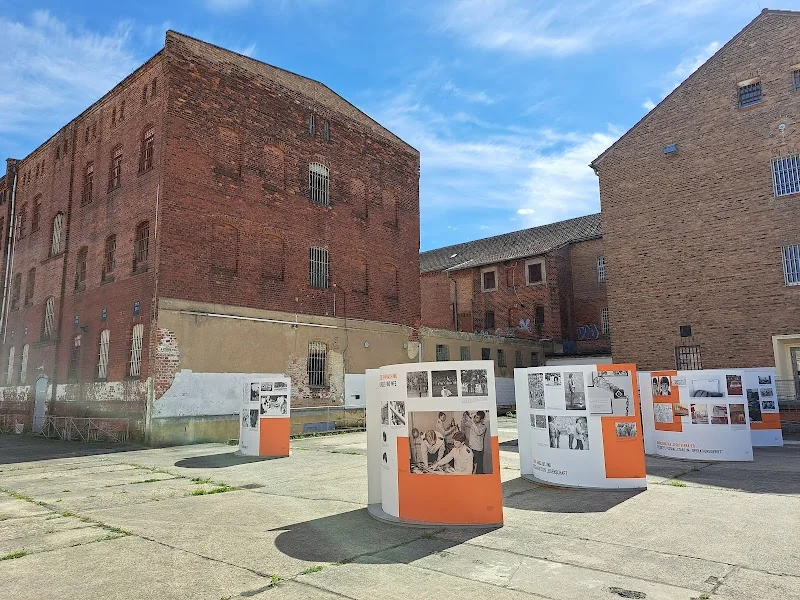
In the outdoor area, history becomes spatially tangible. The exhibition Past, Not Forgotten is spread over 16 stations and illuminates the eventful development of the 22,000 m² area from the first buildings to its current use by the Human Rights Center. Old and new photos, historical plans, and explanatory texts help to understand the transformation of the site; quotes from former detainees give the historical perspectives a personal voice. Additionally, there are reconstructed cells and functional rooms that make central aspects of daily life in detention visible. Another special place is the former workshop of VEB Pentacon Dresden, which can be visited as part of guided tours. This mix of architecture, documentation, biography, and spatial effect makes the visit strong for both photo seekers and history enthusiasts alike. ([menschenrechtszentrum-cottbus.de](https://www.menschenrechtszentrum-cottbus.de/besuch/dauerausstellungen/index.php))
Guided Tours, Events, and Educational Offers
Those who want to understand the place more intensively should plan a guided tour. The Human Rights Center offers guided tours by prior arrangement; the visit page also mentions the possibility of booking tours in English or in simple language upon request. In addition to the regular tour, there is the contemporary witness tour as well as the special tour Hidden Places. This is particularly valuable because the history of the site is conveyed not only through texts but also through direct narratives and concrete spaces. Thus, a walk becomes a conversation about detention, resistance, dignity, and memory. For many visitors, this personal access is crucial, as the history of the place is told not in a sterile museum manner but in a human and comprehensible way. ([menschenrechtszentrum-cottbus.de](https://www.menschenrechtszentrum-cottbus.de/besuch/info/))
Furthermore, the memorial sees itself as an active educational and event location. Regular public lectures, panel discussions, film screenings, and networking meetings take place; schools, universities, and training companies can also choose from a diverse educational offering or have tailored formats developed. Seminar and event rooms can also be rented. This is complemented by research, archival work, and a shop in the foyer, where books, educational materials, DVDs, and small items related to the history of the GDR, Nazi terror, and the Cottbus detention center are offered. Thus, a one-sided memorial space does not emerge, but a lively place where research, communication, and public engagement come together. ([menschenrechtszentrum-cottbus.de](https://www.menschenrechtszentrum-cottbus.de/gelaende/gedenkstaette/))
Sources:
- Human Rights Center Cottbus e.V. - Welcome ([menschenrechtszentrum-cottbus.de](https://www.menschenrechtszentrum-cottbus.de/))
- Human Rights Center Cottbus e.V. - Directions, Prices, and Opening Hours ([menschenrechtszentrum-cottbus.de](https://www.menschenrechtszentrum-cottbus.de/besuch/info/))
- Human Rights Center Cottbus e.V. - Memorial Zuchthaus Cottbus ([menschenrechtszentrum-cottbus.de](https://www.menschenrechtszentrum-cottbus.de/gelaende/gedenkstaette/))
- Human Rights Center Cottbus e.V. - Historical Site ([menschenrechtszentrum-cottbus.de](https://www.menschenrechtszentrum-cottbus.de/gelaende/historischer-ort/))
- Human Rights Center Cottbus e.V. - Permanent Exhibitions ([menschenrechtszentrum-cottbus.de](https://www.menschenrechtszentrum-cottbus.de/besuch/dauerausstellungen/))
- Human Rights Center Cottbus e.V. - About Us ([menschenrechtszentrum-cottbus.de](https://www.menschenrechtszentrum-cottbus.de/menschenrechtszentrum/ueber-uns/))
Show moreShow less
Human Rights Center Cottbus e.V. | Photos & Reviews
The Human Rights Center Cottbus e.V. - Memorial Zuchthaus Cottbus is not an ordinary place to visit, but a historical learning site with strong relevance to the present. On the grounds at Bautzener Straße 140, visitors encounter a former detention area that was used from 1860 to 2002 and today continues to live on as a memorial, educational site, and place of encounter. The association was founded in October 2007 by former political prisoners; since May 2011, it has been the owner of the area and operator of the memorial. Those looking for photos or reviews usually want to quickly understand how the place feels, what makes it special, and whether a visit is worthwhile. Here, Cottbus impresses with authenticity: historical substance, a clear thematic stance, exhibitions with a biographical focus, and a site that does not decorate the past but makes it visible. The rating data you provided, with 4.6 stars from 317 reviews, further speaks to strong visitor interest and lasting impact. ([menschenrechtszentrum-cottbus.de](https://www.menschenrechtszentrum-cottbus.de/))
Particularly interesting is the mix of independent exploration and curated tours. In the main building and on the outdoor grounds, photos, documents, exhibits, and drawings introduce visitors to detention and working conditions; there are also several permanent exhibitions, special exhibitions, lectures, panel discussions, film screenings, and networking meetings. Schools, universities, and training companies find suitable educational formats just like individual visitors interested in the history of political persecution, memory culture, and concrete life stories. The location is thus not only exciting for history enthusiasts but also for travelers looking for a content-rich and atmospherically unique place in Cottbus. ([menschenrechtszentrum-cottbus.de](https://www.menschenrechtszentrum-cottbus.de/))
Photos and Reviews of the Memorial Zuchthaus Cottbus
Those searching for photos of the Memorial Zuchthaus Cottbus will find particularly meaningful images on the official website that not only show architecture but also explain the character of the place. This is important because Cottbus is not a place with a smooth show facade but a historical site with traces of various uses. The website features images from the main building, the memorial, the gatehouse, reconstructions, and the exhibitions themselves. The outdoor exhibition also uses old and new photos, historical plans, and quotes to make the development of the 22,000 m² area comprehensible. For users who want to compare images in advance, a very realistic impression of the atmosphere, size, and seriousness of the place is already created online. ([menschenrechtszentrum-cottbus.de](https://www.menschenrechtszentrum-cottbus.de/besuch/dauerausstellungen/index.php))
When it comes to reviews, a place of this kind is rarely evaluated according to classical entertainment criteria. Credibility, tranquility, comprehensibility, and the quality of communication are decisive. This is precisely why the strong rating data you provided fits very well with the profile of the memorial. Those seeking a place with a stance that does not simplify political detention, Nazi terror, and SED dictatorship but makes it comprehensible will find it here. The combination of historical substance, biographical narratives, and modern communication ensures that photos not only look beautiful but also convey substantive depth. This is crucial for a memorial: the first impression should not seduce but prepare. ([menschenrechtszentrum-cottbus.de](https://www.menschenrechtszentrum-cottbus.de/))
History of the Former Zuchthaus Cottbus
The history of the site dates back far: The former Royal Central Prison was put into operation in 1860 and served as a detention place until 2002. The site experienced several political systems, including the Imperial Era, Weimar Republic, Nazi Era, GDR, and the years after the peaceful revolution. Particularly important for the current profile of the memorial is the fact that numerous people were imprisoned here for political reasons between 1933 and 1945 as well as between 1951 and 1989. Thus, Cottbus is not only a local monument but a place where the history of German dictatorship can be read concretely in buildings, rooms, and biographies. During the GDR, in 1961, a remand prison was also established in a building previously used as a cell house; after reunification, the prison remained in operation until the relocation of the correctional facility to Cottbus-Dissenchen in 2002. ([menschenrechtszentrum-cottbus.de](https://www.menschenrechtszentrum-cottbus.de/gelaende/historischer-ort/))
The transformation from a detention site to a memorial began after its closure and subsequent vacancy. The Human Rights Center Cottbus e.V. was established in 2007 after a meeting of former prisoners, acquired the prison area in 2011, and opened the Memorial Zuchthaus Cottbus on September 4, 2012. Later, in August 2020, the area was placed under monument protection; since November 2021, the Federal Archives has also had a branch of the Stasi Records Archive as a tenant on the grounds. This development is remarkable because it shows how a place of coercion can be transformed into a place of processing without smoothing over its harshness. This is precisely why the memorial appears so credible: it not only tells of the past but also of the conscious decision to make memory permanently visible. ([menschenrechtszentrum-cottbus.de](https://www.menschenrechtszentrum-cottbus.de/gelaende/historischer-ort/))
Opening Hours, Prices, and Admission for the Visit
For planning the visit, the official opening hours are clear and pleasantly simple: Monday is a rest day, Tuesday to Friday is open from 10:00 AM to 5:00 PM, Saturday and Sunday from 1:00 PM to 6:00 PM. On public holidays, the memorial remains closed, and admission ends one hour before closing. This is important for day trips as it allows for a good combination of the visit with a guided tour or a walk through Cottbus. The structure is also sensible in terms of content: those who want to concentrate on the exhibitions will manage well during the week; those who are out on the weekend also have reliable times. The memorial does not see itself as a quickly consumable place but as a space where one should bring time. ([menschenrechtszentrum-cottbus.de](https://www.menschenrechtszentrum-cottbus.de/besuch/info/))
The prices are also transparent. Adults pay 8.00 euros, reduced admission costs 5.00 euros. Guided tours are charged additionally: a standard tour costs 45.00 euros per group of up to 25 people and lasts about 60 to 90 minutes; tours with a contemporary witness cost 90.00 euros and last about two hours. The special tour Hidden Places costs 25.00 euros per person, is limited to ten people, and also lasts about two hours; it can even be booked without visiting the exhibition. Important for practice is also that animals are not allowed, but guide and companion dogs are exceptions. Large parts of the grounds are accessible, the main building has an elevator, although some areas are only accessible via steps. ([menschenrechtszentrum-cottbus.de](https://www.menschenrechtszentrum-cottbus.de/besuch/info/))
Directions, Parking, and Accessible Visit
The directions are well described both by car and by train and public transport. By car, the route from Leipzig or Dresden leads via A14 or A13 to the Spreewald motorway triangle, then on the A15 to Cottbus-Süd and then via B168 and Hermann-Löns-Straße to Bautzener Straße. From Berlin, the route runs via A113 or A13 also to the Spreewald motorway triangle and then continues on the same route. Those who prefer to travel by train can go to Cottbus Hbf; the official site mentions, among others, RE 18 from Leipzig and Dresden as well as RE 2 from Berlin. ([menschenrechtszentrum-cottbus.de](https://www.menschenrechtszentrum-cottbus.de/besuch/info/))
On site, public transport is also practical: with trams 1, 3, or 4 or with buses 9, 25, 32, 41, 3N, or 4N, one can ride to Görlitzer Str. and then walk about seven minutes or 600 meters. For many visitors, it is particularly interesting that free parking is mentioned on the grounds. This is a real advantage for a memorial site because arrival is possible without additional parking search and without complicated city logistics. Those planning Cottbus as a day trip can thus very well combine the memorial with other attractions in the city without losing the character of the visit. ([menschenrechtszentrum-cottbus.de](https://www.menschenrechtszentrum-cottbus.de/besuch/info/))
Permanent Exhibitions and Reconstructed Areas
The heart of the memorial is the permanent exhibitions. Several formats inform about the history of the detention site and the facets of daily life in detention. Fixed stations include among others DETENTION – COERCION – ARBITRARINESS – From Youth Prison to Women's Detention Center 1933-1945, Checked Clouds – Political Detention in Zuchthaus Cottbus 1933-1989, Reconstructed Cells and Workspaces, Past, Not Forgotten – Zuchthaus Cottbus in the Mirror of Time, DETENTION – COERCION – WORK in Zuchthaus Cottbus 1933-1989, as well as the memorial for the victims of death at the borders of the Iron Curtain and the Berlin Wall. Particularly strong is the new design of the exhibition Detention – Coercion – Arbitrariness, which was revised in summer 2024 and presents the history of the youth prison, women's prison, and women's detention center through biographies, documents, objects, and media stations. ([menschenrechtszentrum-cottbus.de](https://www.menschenrechtszentrum-cottbus.de/besuch/dauerausstellungen/))
In the outdoor area, history becomes spatially tangible. The exhibition Past, Not Forgotten is spread over 16 stations and illuminates the eventful development of the 22,000 m² area from the first buildings to its current use by the Human Rights Center. Old and new photos, historical plans, and explanatory texts help to understand the transformation of the site; quotes from former detainees give the historical perspectives a personal voice. Additionally, there are reconstructed cells and functional rooms that make central aspects of daily life in detention visible. Another special place is the former workshop of VEB Pentacon Dresden, which can be visited as part of guided tours. This mix of architecture, documentation, biography, and spatial effect makes the visit strong for both photo seekers and history enthusiasts alike. ([menschenrechtszentrum-cottbus.de](https://www.menschenrechtszentrum-cottbus.de/besuch/dauerausstellungen/index.php))
Guided Tours, Events, and Educational Offers
Those who want to understand the place more intensively should plan a guided tour. The Human Rights Center offers guided tours by prior arrangement; the visit page also mentions the possibility of booking tours in English or in simple language upon request. In addition to the regular tour, there is the contemporary witness tour as well as the special tour Hidden Places. This is particularly valuable because the history of the site is conveyed not only through texts but also through direct narratives and concrete spaces. Thus, a walk becomes a conversation about detention, resistance, dignity, and memory. For many visitors, this personal access is crucial, as the history of the place is told not in a sterile museum manner but in a human and comprehensible way. ([menschenrechtszentrum-cottbus.de](https://www.menschenrechtszentrum-cottbus.de/besuch/info/))
Furthermore, the memorial sees itself as an active educational and event location. Regular public lectures, panel discussions, film screenings, and networking meetings take place; schools, universities, and training companies can also choose from a diverse educational offering or have tailored formats developed. Seminar and event rooms can also be rented. This is complemented by research, archival work, and a shop in the foyer, where books, educational materials, DVDs, and small items related to the history of the GDR, Nazi terror, and the Cottbus detention center are offered. Thus, a one-sided memorial space does not emerge, but a lively place where research, communication, and public engagement come together. ([menschenrechtszentrum-cottbus.de](https://www.menschenrechtszentrum-cottbus.de/gelaende/gedenkstaette/))
Sources:
- Human Rights Center Cottbus e.V. - Welcome ([menschenrechtszentrum-cottbus.de](https://www.menschenrechtszentrum-cottbus.de/))
- Human Rights Center Cottbus e.V. - Directions, Prices, and Opening Hours ([menschenrechtszentrum-cottbus.de](https://www.menschenrechtszentrum-cottbus.de/besuch/info/))
- Human Rights Center Cottbus e.V. - Memorial Zuchthaus Cottbus ([menschenrechtszentrum-cottbus.de](https://www.menschenrechtszentrum-cottbus.de/gelaende/gedenkstaette/))
- Human Rights Center Cottbus e.V. - Historical Site ([menschenrechtszentrum-cottbus.de](https://www.menschenrechtszentrum-cottbus.de/gelaende/historischer-ort/))
- Human Rights Center Cottbus e.V. - Permanent Exhibitions ([menschenrechtszentrum-cottbus.de](https://www.menschenrechtszentrum-cottbus.de/besuch/dauerausstellungen/))
- Human Rights Center Cottbus e.V. - About Us ([menschenrechtszentrum-cottbus.de](https://www.menschenrechtszentrum-cottbus.de/menschenrechtszentrum/ueber-uns/))
Human Rights Center Cottbus e.V. | Photos & Reviews
The Human Rights Center Cottbus e.V. - Memorial Zuchthaus Cottbus is not an ordinary place to visit, but a historical learning site with strong relevance to the present. On the grounds at Bautzener Straße 140, visitors encounter a former detention area that was used from 1860 to 2002 and today continues to live on as a memorial, educational site, and place of encounter. The association was founded in October 2007 by former political prisoners; since May 2011, it has been the owner of the area and operator of the memorial. Those looking for photos or reviews usually want to quickly understand how the place feels, what makes it special, and whether a visit is worthwhile. Here, Cottbus impresses with authenticity: historical substance, a clear thematic stance, exhibitions with a biographical focus, and a site that does not decorate the past but makes it visible. The rating data you provided, with 4.6 stars from 317 reviews, further speaks to strong visitor interest and lasting impact. ([menschenrechtszentrum-cottbus.de](https://www.menschenrechtszentrum-cottbus.de/))
Particularly interesting is the mix of independent exploration and curated tours. In the main building and on the outdoor grounds, photos, documents, exhibits, and drawings introduce visitors to detention and working conditions; there are also several permanent exhibitions, special exhibitions, lectures, panel discussions, film screenings, and networking meetings. Schools, universities, and training companies find suitable educational formats just like individual visitors interested in the history of political persecution, memory culture, and concrete life stories. The location is thus not only exciting for history enthusiasts but also for travelers looking for a content-rich and atmospherically unique place in Cottbus. ([menschenrechtszentrum-cottbus.de](https://www.menschenrechtszentrum-cottbus.de/))
Photos and Reviews of the Memorial Zuchthaus Cottbus
Those searching for photos of the Memorial Zuchthaus Cottbus will find particularly meaningful images on the official website that not only show architecture but also explain the character of the place. This is important because Cottbus is not a place with a smooth show facade but a historical site with traces of various uses. The website features images from the main building, the memorial, the gatehouse, reconstructions, and the exhibitions themselves. The outdoor exhibition also uses old and new photos, historical plans, and quotes to make the development of the 22,000 m² area comprehensible. For users who want to compare images in advance, a very realistic impression of the atmosphere, size, and seriousness of the place is already created online. ([menschenrechtszentrum-cottbus.de](https://www.menschenrechtszentrum-cottbus.de/besuch/dauerausstellungen/index.php))
When it comes to reviews, a place of this kind is rarely evaluated according to classical entertainment criteria. Credibility, tranquility, comprehensibility, and the quality of communication are decisive. This is precisely why the strong rating data you provided fits very well with the profile of the memorial. Those seeking a place with a stance that does not simplify political detention, Nazi terror, and SED dictatorship but makes it comprehensible will find it here. The combination of historical substance, biographical narratives, and modern communication ensures that photos not only look beautiful but also convey substantive depth. This is crucial for a memorial: the first impression should not seduce but prepare. ([menschenrechtszentrum-cottbus.de](https://www.menschenrechtszentrum-cottbus.de/))
History of the Former Zuchthaus Cottbus
The history of the site dates back far: The former Royal Central Prison was put into operation in 1860 and served as a detention place until 2002. The site experienced several political systems, including the Imperial Era, Weimar Republic, Nazi Era, GDR, and the years after the peaceful revolution. Particularly important for the current profile of the memorial is the fact that numerous people were imprisoned here for political reasons between 1933 and 1945 as well as between 1951 and 1989. Thus, Cottbus is not only a local monument but a place where the history of German dictatorship can be read concretely in buildings, rooms, and biographies. During the GDR, in 1961, a remand prison was also established in a building previously used as a cell house; after reunification, the prison remained in operation until the relocation of the correctional facility to Cottbus-Dissenchen in 2002. ([menschenrechtszentrum-cottbus.de](https://www.menschenrechtszentrum-cottbus.de/gelaende/historischer-ort/))
The transformation from a detention site to a memorial began after its closure and subsequent vacancy. The Human Rights Center Cottbus e.V. was established in 2007 after a meeting of former prisoners, acquired the prison area in 2011, and opened the Memorial Zuchthaus Cottbus on September 4, 2012. Later, in August 2020, the area was placed under monument protection; since November 2021, the Federal Archives has also had a branch of the Stasi Records Archive as a tenant on the grounds. This development is remarkable because it shows how a place of coercion can be transformed into a place of processing without smoothing over its harshness. This is precisely why the memorial appears so credible: it not only tells of the past but also of the conscious decision to make memory permanently visible. ([menschenrechtszentrum-cottbus.de](https://www.menschenrechtszentrum-cottbus.de/gelaende/historischer-ort/))
Opening Hours, Prices, and Admission for the Visit
For planning the visit, the official opening hours are clear and pleasantly simple: Monday is a rest day, Tuesday to Friday is open from 10:00 AM to 5:00 PM, Saturday and Sunday from 1:00 PM to 6:00 PM. On public holidays, the memorial remains closed, and admission ends one hour before closing. This is important for day trips as it allows for a good combination of the visit with a guided tour or a walk through Cottbus. The structure is also sensible in terms of content: those who want to concentrate on the exhibitions will manage well during the week; those who are out on the weekend also have reliable times. The memorial does not see itself as a quickly consumable place but as a space where one should bring time. ([menschenrechtszentrum-cottbus.de](https://www.menschenrechtszentrum-cottbus.de/besuch/info/))
The prices are also transparent. Adults pay 8.00 euros, reduced admission costs 5.00 euros. Guided tours are charged additionally: a standard tour costs 45.00 euros per group of up to 25 people and lasts about 60 to 90 minutes; tours with a contemporary witness cost 90.00 euros and last about two hours. The special tour Hidden Places costs 25.00 euros per person, is limited to ten people, and also lasts about two hours; it can even be booked without visiting the exhibition. Important for practice is also that animals are not allowed, but guide and companion dogs are exceptions. Large parts of the grounds are accessible, the main building has an elevator, although some areas are only accessible via steps. ([menschenrechtszentrum-cottbus.de](https://www.menschenrechtszentrum-cottbus.de/besuch/info/))
Directions, Parking, and Accessible Visit
The directions are well described both by car and by train and public transport. By car, the route from Leipzig or Dresden leads via A14 or A13 to the Spreewald motorway triangle, then on the A15 to Cottbus-Süd and then via B168 and Hermann-Löns-Straße to Bautzener Straße. From Berlin, the route runs via A113 or A13 also to the Spreewald motorway triangle and then continues on the same route. Those who prefer to travel by train can go to Cottbus Hbf; the official site mentions, among others, RE 18 from Leipzig and Dresden as well as RE 2 from Berlin. ([menschenrechtszentrum-cottbus.de](https://www.menschenrechtszentrum-cottbus.de/besuch/info/))
On site, public transport is also practical: with trams 1, 3, or 4 or with buses 9, 25, 32, 41, 3N, or 4N, one can ride to Görlitzer Str. and then walk about seven minutes or 600 meters. For many visitors, it is particularly interesting that free parking is mentioned on the grounds. This is a real advantage for a memorial site because arrival is possible without additional parking search and without complicated city logistics. Those planning Cottbus as a day trip can thus very well combine the memorial with other attractions in the city without losing the character of the visit. ([menschenrechtszentrum-cottbus.de](https://www.menschenrechtszentrum-cottbus.de/besuch/info/))
Permanent Exhibitions and Reconstructed Areas
The heart of the memorial is the permanent exhibitions. Several formats inform about the history of the detention site and the facets of daily life in detention. Fixed stations include among others DETENTION – COERCION – ARBITRARINESS – From Youth Prison to Women's Detention Center 1933-1945, Checked Clouds – Political Detention in Zuchthaus Cottbus 1933-1989, Reconstructed Cells and Workspaces, Past, Not Forgotten – Zuchthaus Cottbus in the Mirror of Time, DETENTION – COERCION – WORK in Zuchthaus Cottbus 1933-1989, as well as the memorial for the victims of death at the borders of the Iron Curtain and the Berlin Wall. Particularly strong is the new design of the exhibition Detention – Coercion – Arbitrariness, which was revised in summer 2024 and presents the history of the youth prison, women's prison, and women's detention center through biographies, documents, objects, and media stations. ([menschenrechtszentrum-cottbus.de](https://www.menschenrechtszentrum-cottbus.de/besuch/dauerausstellungen/))
In the outdoor area, history becomes spatially tangible. The exhibition Past, Not Forgotten is spread over 16 stations and illuminates the eventful development of the 22,000 m² area from the first buildings to its current use by the Human Rights Center. Old and new photos, historical plans, and explanatory texts help to understand the transformation of the site; quotes from former detainees give the historical perspectives a personal voice. Additionally, there are reconstructed cells and functional rooms that make central aspects of daily life in detention visible. Another special place is the former workshop of VEB Pentacon Dresden, which can be visited as part of guided tours. This mix of architecture, documentation, biography, and spatial effect makes the visit strong for both photo seekers and history enthusiasts alike. ([menschenrechtszentrum-cottbus.de](https://www.menschenrechtszentrum-cottbus.de/besuch/dauerausstellungen/index.php))
Guided Tours, Events, and Educational Offers
Those who want to understand the place more intensively should plan a guided tour. The Human Rights Center offers guided tours by prior arrangement; the visit page also mentions the possibility of booking tours in English or in simple language upon request. In addition to the regular tour, there is the contemporary witness tour as well as the special tour Hidden Places. This is particularly valuable because the history of the site is conveyed not only through texts but also through direct narratives and concrete spaces. Thus, a walk becomes a conversation about detention, resistance, dignity, and memory. For many visitors, this personal access is crucial, as the history of the place is told not in a sterile museum manner but in a human and comprehensible way. ([menschenrechtszentrum-cottbus.de](https://www.menschenrechtszentrum-cottbus.de/besuch/info/))
Furthermore, the memorial sees itself as an active educational and event location. Regular public lectures, panel discussions, film screenings, and networking meetings take place; schools, universities, and training companies can also choose from a diverse educational offering or have tailored formats developed. Seminar and event rooms can also be rented. This is complemented by research, archival work, and a shop in the foyer, where books, educational materials, DVDs, and small items related to the history of the GDR, Nazi terror, and the Cottbus detention center are offered. Thus, a one-sided memorial space does not emerge, but a lively place where research, communication, and public engagement come together. ([menschenrechtszentrum-cottbus.de](https://www.menschenrechtszentrum-cottbus.de/gelaende/gedenkstaette/))
Sources:
- Human Rights Center Cottbus e.V. - Welcome ([menschenrechtszentrum-cottbus.de](https://www.menschenrechtszentrum-cottbus.de/))
- Human Rights Center Cottbus e.V. - Directions, Prices, and Opening Hours ([menschenrechtszentrum-cottbus.de](https://www.menschenrechtszentrum-cottbus.de/besuch/info/))
- Human Rights Center Cottbus e.V. - Memorial Zuchthaus Cottbus ([menschenrechtszentrum-cottbus.de](https://www.menschenrechtszentrum-cottbus.de/gelaende/gedenkstaette/))
- Human Rights Center Cottbus e.V. - Historical Site ([menschenrechtszentrum-cottbus.de](https://www.menschenrechtszentrum-cottbus.de/gelaende/historischer-ort/))
- Human Rights Center Cottbus e.V. - Permanent Exhibitions ([menschenrechtszentrum-cottbus.de](https://www.menschenrechtszentrum-cottbus.de/besuch/dauerausstellungen/))
- Human Rights Center Cottbus e.V. - About Us ([menschenrechtszentrum-cottbus.de](https://www.menschenrechtszentrum-cottbus.de/menschenrechtszentrum/ueber-uns/))
Upcoming Events
No events found
Frequently Asked Questions
Reviews
David Wallace
1. September 2025
A grim place on a grey day. The exhibition is excellent but requires a good deal of time to access the information. Comfortable seating for listening to the many recordings was unfortunately not available. The idea with personal portraits is excellent and made the experiences all the more harrowing. By contrast, the outside tour was disappointing.
Gregory Delbrouck
20. December 2018
Fantastic experience to visit! Warm personnel and had a great guided tour. A must visit for every tourist interested in the history of the prison and the GDR time.
Ali
25. July 2022
Everyone has the right to freedom of movement and residence within the borders of each state. Everyone has the right to leave any country, including his own, and to return to his country. So why is there still a visa?
mangesh kadu
22. May 2022
I lived in Cottbus for 3 years until I knew about this, thanks to a friend. A must visit for history enthusiasts. The exhibition is well displayed.
Ai Si
27. May 2025
Very interesting and informative.👍 A piece of dark GDR history becomes tangible. What’s missing is a tour by eyewitnesses who can share what they experienced. Then it could also earn 5 stars. Parking is available.