
Cottbus
Platz der Deutsche Einheit 2, 03044 Cottbus, Deutschland
IKMZ - BTU Cottbus-Senftenberg | Opening Hours & Directions
The IKMZ of BTU Cottbus-Senftenberg is a building that is not only visited but experienced. It combines library, IT services, and multimedia center into a central learning, working, and service location on the central campus in Cottbus. Those searching for photos, reviews, opening hours, or directions quickly find an address that stands out architecturally and simultaneously fulfills an important function in the daily life of the university. The building was opened in 2005 after a lengthy planning and construction phase and has since become much more than a classic university library: it is an open knowledge space, a landmark of the campus, and a prominent meeting point for students, researchers, and guests. The official BTU description emphasizes the joint management of information, communication, and media supply as well as user-oriented support for research, teaching, studies, and administration. ([b-tu.de](https://www.b-tu.de/ikmz))
Opening Hours, Directions, and Parking at IKMZ
For visitors, the question of opening hours is usually one of the most important inquiries. The official BTU page for the central campus Cottbus currently displays the following hours: Monday to Thursday from 9:00 AM to 10:00 PM, closed on Friday, and Saturday and Sunday from 9:00 AM to 6:00 PM. The service hours are separate and are Monday to Thursday from 9:00 AM to 8:00 PM, Friday until 7:00 PM, and Saturday until 1:00 PM; there is no service on Sundays. The page also explicitly points out shortened opening hours and closure days. Those planning to use the IKMZ for research, studying, or a short visit should therefore take a look at the current daily information in advance to ensure that travel and stay fit well together. ([b-tu.de](https://www.b-tu.de/bibliothek/wir-ueber-uns/zentralcampus-cottbus))
The BTU also provides concrete and practical tips for directions. According to the official directions, Cottbus is easily accessible by train; from the main train station, bus lines 44 and 47 go directly to the university library, while line 16 leads to the university stop. By tram, guests can take lines 1 or 4 from the main station to the Zimmerstraße stop and then walk via Hubertstraße, Sielower Straße, and Nordstraße to the building. Walking from the main station takes about 20 to 30 minutes along Bahnhofstraße and Karl-Marx-Straße to Platz der Deutschen Einheit. By car, one can reach the IKMZ via the A15 and the signs towards the university; the BTU explicitly recommends the parking spaces in the campus area, as there are only a few parking spaces directly at the building. A disabled parking space is available. ([b-tu.de](https://www.b-tu.de/bibliothek/wir-ueber-uns/zentralcampus-cottbus/anfahrt-ikmz-gebaeude))
The address itself is clear and easy to remember: Platz der Deutschen Einheit 2 in 03044 Cottbus. For orientation, it is also important that the university library in the IKMZ is described as accessible. This is a relevant plus point for many visitors, as accessibility plays a significant role in a building with multiple levels, open air spaces, and intensive use in daily student life. Therefore, those searching for IKMZ directions, IKMZ parking, or IKMZ opening hours find not only a location but also a well-structured service offering. ([b-tu.de](https://www.b-tu.de/bibliothek/wir-ueber-uns/zentralcampus-cottbus))
Architecture, History, and Awards of the IKMZ
The history of the IKMZ begins much earlier than its opening in 2005. The BTU already mentioned the urgently needed new construction of the university library in its framework planning in 1991. In 1993, a competition was held by the state of Brandenburg, in 1994 the location was determined on the site of the former university stadium, and in 1998, the Basel architectural firm Jacques Herzog & Pierre de Meuron was commissioned for the design planning. The first groundbreaking took place on December 17, 2001, the topping-out ceremony was celebrated on May 15, 2003, the handover of the new building to the BTU took place on October 29, 2004, and after a trial operation and the ceremonial opening on February 4, 2005, the history of the building as a fully functional center for knowledge, media, and communication began. This chronological development explains why the building is still perceived today as carefully planned and at the same time very distinctive university architecture. ([b-tu.de](https://www.b-tu.de/ikmz/praesentationen/ikmz-neubau?utm_source=openai))
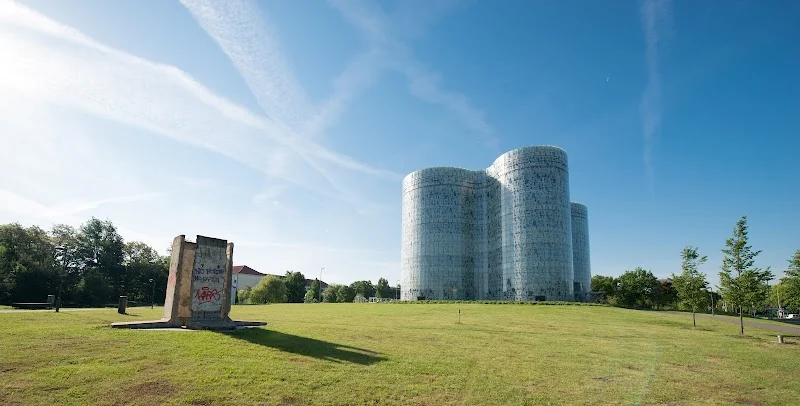
Architecturally, the IKMZ is a building that can be recognized at a glance. The BTU describes its curved, sinuous exterior form, which means there is no classic front and back. The building appears as a response in several directions at once, namely towards the university, the city, and Sielower Straße. With a height of around 32 meters, it is a striking eye-catcher. Additionally, the reinforced concrete construction with a double-skin glass facade enhances the impression of openness and transparency. Inside, different levels, galleries, and large air spaces create generous spatial situations. The magazine is located in the underground, windowless area, while the reading areas and workspaces are arranged in the light-flooded upper levels. The design of the building thus follows not only an aesthetic but also a functional concept that connects sight relationships, orientation, and usability. ([b-tu.de](https://www.b-tu.de/ikmz/praesentationen/ikmz-neubau/gebaeudebeschreibung))
Particularly exciting is also the connection between architecture and outdoor space. The building planning originally provided for two underground levels, but during construction, the building was raised by one floor, so it now seems to stand on an artificial hill. The BTU also describes that the design of the park area around the IKMZ was revised with terrain modeling and adapted planting, while the path layout was largely preserved. It is precisely this transition from building, landscape, and campus that makes the place so distinctive. The awards further emphasize its significance: in 2006, the IKMZ was awarded Library of the Year and recognized as a place in the Land of Ideas; in 2007, it received the Große Nike of the BDA and an award for the German Architecture Prize. For its perception as a landmark, it is also important that the Goethe-Institut describes the IKMZ as a spectacular university building that attracted visitors from the architecture world shortly after its opening. ([b-tu.de](https://www.b-tu.de/ikmz/praesentationen/ikmz-neubau/gebaeudebeschreibung))
Library, Workspaces, and Digital Equipment
The IKMZ is not only a beautiful building but above all a highly integrated infrastructure. According to the Goethe-Institut and the BTU, it consolidates the library, multimedia center, computing center or IT services, and administrative data processing under one roof. This consolidation makes the place so practical for campus life: here one finds not only media and reading rooms but also technical and digital support for learning, teaching, and research. In the BTU description, the IKMZ is referred to as a central institution that efficiently and user-oriented organizes the information, communication, and media supply of the university. For many users, the IKMZ is therefore not just a single room but a functioning service ecosystem. ([b-tu.de](https://www.b-tu.de/ikmz))
The collections are also impressive. The Goethe-Institut mentions, among other things, 1.3 million monographs and bound journals, 107,000 other printed works such as maps and standards, more than 133,000 other non-electronic materials, 465 print journals on subscription, nearly 66,000 electronic journals, 378 databases, and over 272,000 e-books. Additionally, the first underground floor houses the Ulrich-Conrads-Archive with texts and documents from the journalistic work of the architecture critic. For students, researchers, and anyone looking for a powerful scientific learning place in Cottbus, these numbers are important because they show that the IKMZ goes far beyond a purely local library function. It is a fully-fledged knowledge repository with a strong professional breadth. ([goethe.de](https://www.goethe.de/ins/ba/de/kul/sup/sch/das-lernzentrum-btucottbus.html))
In terms of workspaces, it becomes particularly clear that the IKMZ was designed as a learning place for different needs. The Goethe-Institut mentions 370 fixed and wireless networked reading workspaces, 15 carrels as retreat or work cabins, 18 PC workstations in the learning pool, and 85 places for e-exams in the eAssessment center. From these published numbers, at least 488 usable seating and workspaces result. This offer is complemented by the multimedia center with soundproof cabins for video editing and sound recording, as well as workspaces for internet, multimedia, and e-learning. Therefore, those specifically searching for IKMZ Cottbus, university library Cottbus-Senftenberg, or library Cottbus find a place that supports both quiet academic work and digital production. ([goethe.de](https://www.goethe.de/ins/ba/de/kul/sup/sch/das-lernzentrum-btucottbus.html))
The digital and technical equipment also includes a powerful data network with fiber optic connection, complemented by WLAN. The official building description also emphasizes that the lighting, signage, and orientation within the house were deliberately planned. For practice, this means: visitors can work in an open, connected environment that does not feel like a classic reading room but like a modern campus building. Especially in the context of learning spaces, group work, and e-learning, this is a significant advantage. The IKMZ is thus not only a destination for research and study but also an example of how university architecture can make functional infrastructure visible. ([b-tu.de](https://www.b-tu.de/ikmz/praesentationen/ikmz-neubau/gebaeudebeschreibung))
Reviews, Photos, and the First Impression on Site
The search queries for photos, images, and reviews of the IKMZ are no coincidence. The building has long been a well-known eye-catcher in Cottbus, and even without prior knowledge, its unique shape immediately stands out. The official representation speaks of an amorphous, sculptural shape, of a high, tower-like appearance, and of a facade made of 5,133 glass panes, which were printed with letters using screen printing. This makes the house almost seem like an object between a work of art and a knowledge machine. The strong visual presence explains why so many people search for images of the IKMZ and why it often appears as a photographic motif in the context of architecture and urban perception. ([goethe.de](https://www.goethe.de/ins/ba/de/kul/sup/sch/das-lernzentrum-btucottbus.html))
Inside, the building also offers many motifs that repeatedly appear in photos and impressions: the main staircase winding over seven floors, the strong colors reminiscent of a television test pattern, the open reading rooms, and the extensive sight lines over the city and the Lower Lusatia. The Goethe-Institut emphasizes that the high reading rooms provide extensive views and that the building possesses a public character due to its openness. Therefore, those searching for IKMZ photos, images of IKMZ BTU Cottbus-Senftenberg, or IKMZ reviews are often not just looking for a library but a place with a strong atmosphere that remains in memory. This interplay of use and staging is precisely what makes the charm of the house. ([goethe.de](https://www.goethe.de/ins/ba/de/kul/sup/sch/das-lernzentrum-btucottbus.html))
The provided local data also show a rating of 4.7 stars from 152 reviews. Although such values only represent a snapshot of perception, they indicate that the IKMZ is very positively received in everyday life. This fits well with the overall architectural and functional picture: a building that generates attention while being perceived as a helpful, accessible, and modern learning place. For SEO searches for reviews, it is therefore relevant not only how the IKMZ looks but also that it is perceived as a well-functioning, inspiring address. Thus, a location with high recognizability emerges from the combination of architecture, service, and use. ([goethe.de](https://www.goethe.de/ins/ba/de/kul/sup/sch/das-lernzentrum-btucottbus.html))
Additionally, the BTU documents the building in its own image galleries and construction impressions. On the page for the image galleries and on the photo series about the construction history, there are images of the IKMZ in different phases and perspectives. This is particularly helpful for visitors as it provides a preview of the facade, stairwell, reading rooms, and urban impact. Therefore, those specifically searching for IKMZ photos or images of IKMZ Cottbus find not only external representations but also official materials from the university. This strengthens the serious impression and makes orientation before a visit easier. ([b-tu.de](https://www.b-tu.de/ikmz/praesentationen/ikmz-neubau/impressionen?utm_source=openai))
Events, Exhibitions, and Visitor Experience in Everyday Life
The IKMZ is not only a place for reading but also a place for communication and knowledge transfer. The BTU explicitly describes that the building is intended as a public physical space for learning, working, and communicating. In the foyer, there is the Science Gallery or the Innovation Hub 13, which opened in October 2021 and presents technological innovations in an engaging way. Visitors can discover prototypes and exhibits and even take 360-degree tours into laboratory and workshop worlds. This makes the IKMZ a place that combines classic library use with experimental science communication. ([goethe.de](https://www.goethe.de/ins/ba/de/kul/sup/sch/das-lernzentrum-btucottbus.html))
Additionally, it is used as an exhibition space. The BTU reports, for example, of an exhibition on architectural photography in May 2025 and an interactive exhibition on artificial intelligence that opened in December 2024 at the IKMZ. Such formats show that the building is regularly used for changing presentations, thus creating new reasons for visits time and again. For people who want to experience not only reading but also current topics, science, and design, this is an important plus point. The IKMZ is therefore not a static library building but an active cultural and knowledge space on campus. ([b-tu.de](https://www.b-tu.de/en/news/article/28880-exhibition-on-architectural-photography-opens-at-btu-on-5-may-2025?utm_source=openai))
Thus, visiting the IKMZ offers a mix of architecture, learning environment, and public use. The building form is open and inviting, the library is accessible, the connections to bus, tram, and footpaths are clearly described, and the house is regularly enlivened by exhibitions and events. This is precisely why it works both for students with fixed workspaces and for guests visiting the building out of cultural or architectural interest. In sum, a place emerges that rightly stands as a landmark in Cottbus: scientifically useful, architecturally extraordinary, and surprisingly versatile in everyday life. ([b-tu.de](https://www.b-tu.de/bibliothek/wir-ueber-uns/zentralcampus-cottbus/anfahrt-ikmz-gebaeude))
Sources:
Show moreShow less
IKMZ - BTU Cottbus-Senftenberg | Opening Hours & Directions
The IKMZ of BTU Cottbus-Senftenberg is a building that is not only visited but experienced. It combines library, IT services, and multimedia center into a central learning, working, and service location on the central campus in Cottbus. Those searching for photos, reviews, opening hours, or directions quickly find an address that stands out architecturally and simultaneously fulfills an important function in the daily life of the university. The building was opened in 2005 after a lengthy planning and construction phase and has since become much more than a classic university library: it is an open knowledge space, a landmark of the campus, and a prominent meeting point for students, researchers, and guests. The official BTU description emphasizes the joint management of information, communication, and media supply as well as user-oriented support for research, teaching, studies, and administration. ([b-tu.de](https://www.b-tu.de/ikmz))
Opening Hours, Directions, and Parking at IKMZ
For visitors, the question of opening hours is usually one of the most important inquiries. The official BTU page for the central campus Cottbus currently displays the following hours: Monday to Thursday from 9:00 AM to 10:00 PM, closed on Friday, and Saturday and Sunday from 9:00 AM to 6:00 PM. The service hours are separate and are Monday to Thursday from 9:00 AM to 8:00 PM, Friday until 7:00 PM, and Saturday until 1:00 PM; there is no service on Sundays. The page also explicitly points out shortened opening hours and closure days. Those planning to use the IKMZ for research, studying, or a short visit should therefore take a look at the current daily information in advance to ensure that travel and stay fit well together. ([b-tu.de](https://www.b-tu.de/bibliothek/wir-ueber-uns/zentralcampus-cottbus))
The BTU also provides concrete and practical tips for directions. According to the official directions, Cottbus is easily accessible by train; from the main train station, bus lines 44 and 47 go directly to the university library, while line 16 leads to the university stop. By tram, guests can take lines 1 or 4 from the main station to the Zimmerstraße stop and then walk via Hubertstraße, Sielower Straße, and Nordstraße to the building. Walking from the main station takes about 20 to 30 minutes along Bahnhofstraße and Karl-Marx-Straße to Platz der Deutschen Einheit. By car, one can reach the IKMZ via the A15 and the signs towards the university; the BTU explicitly recommends the parking spaces in the campus area, as there are only a few parking spaces directly at the building. A disabled parking space is available. ([b-tu.de](https://www.b-tu.de/bibliothek/wir-ueber-uns/zentralcampus-cottbus/anfahrt-ikmz-gebaeude))
The address itself is clear and easy to remember: Platz der Deutschen Einheit 2 in 03044 Cottbus. For orientation, it is also important that the university library in the IKMZ is described as accessible. This is a relevant plus point for many visitors, as accessibility plays a significant role in a building with multiple levels, open air spaces, and intensive use in daily student life. Therefore, those searching for IKMZ directions, IKMZ parking, or IKMZ opening hours find not only a location but also a well-structured service offering. ([b-tu.de](https://www.b-tu.de/bibliothek/wir-ueber-uns/zentralcampus-cottbus))
Architecture, History, and Awards of the IKMZ
The history of the IKMZ begins much earlier than its opening in 2005. The BTU already mentioned the urgently needed new construction of the university library in its framework planning in 1991. In 1993, a competition was held by the state of Brandenburg, in 1994 the location was determined on the site of the former university stadium, and in 1998, the Basel architectural firm Jacques Herzog & Pierre de Meuron was commissioned for the design planning. The first groundbreaking took place on December 17, 2001, the topping-out ceremony was celebrated on May 15, 2003, the handover of the new building to the BTU took place on October 29, 2004, and after a trial operation and the ceremonial opening on February 4, 2005, the history of the building as a fully functional center for knowledge, media, and communication began. This chronological development explains why the building is still perceived today as carefully planned and at the same time very distinctive university architecture. ([b-tu.de](https://www.b-tu.de/ikmz/praesentationen/ikmz-neubau?utm_source=openai))
Architecturally, the IKMZ is a building that can be recognized at a glance. The BTU describes its curved, sinuous exterior form, which means there is no classic front and back. The building appears as a response in several directions at once, namely towards the university, the city, and Sielower Straße. With a height of around 32 meters, it is a striking eye-catcher. Additionally, the reinforced concrete construction with a double-skin glass facade enhances the impression of openness and transparency. Inside, different levels, galleries, and large air spaces create generous spatial situations. The magazine is located in the underground, windowless area, while the reading areas and workspaces are arranged in the light-flooded upper levels. The design of the building thus follows not only an aesthetic but also a functional concept that connects sight relationships, orientation, and usability. ([b-tu.de](https://www.b-tu.de/ikmz/praesentationen/ikmz-neubau/gebaeudebeschreibung))
Particularly exciting is also the connection between architecture and outdoor space. The building planning originally provided for two underground levels, but during construction, the building was raised by one floor, so it now seems to stand on an artificial hill. The BTU also describes that the design of the park area around the IKMZ was revised with terrain modeling and adapted planting, while the path layout was largely preserved. It is precisely this transition from building, landscape, and campus that makes the place so distinctive. The awards further emphasize its significance: in 2006, the IKMZ was awarded Library of the Year and recognized as a place in the Land of Ideas; in 2007, it received the Große Nike of the BDA and an award for the German Architecture Prize. For its perception as a landmark, it is also important that the Goethe-Institut describes the IKMZ as a spectacular university building that attracted visitors from the architecture world shortly after its opening. ([b-tu.de](https://www.b-tu.de/ikmz/praesentationen/ikmz-neubau/gebaeudebeschreibung))
Library, Workspaces, and Digital Equipment
The IKMZ is not only a beautiful building but above all a highly integrated infrastructure. According to the Goethe-Institut and the BTU, it consolidates the library, multimedia center, computing center or IT services, and administrative data processing under one roof. This consolidation makes the place so practical for campus life: here one finds not only media and reading rooms but also technical and digital support for learning, teaching, and research. In the BTU description, the IKMZ is referred to as a central institution that efficiently and user-oriented organizes the information, communication, and media supply of the university. For many users, the IKMZ is therefore not just a single room but a functioning service ecosystem. ([b-tu.de](https://www.b-tu.de/ikmz))
The collections are also impressive. The Goethe-Institut mentions, among other things, 1.3 million monographs and bound journals, 107,000 other printed works such as maps and standards, more than 133,000 other non-electronic materials, 465 print journals on subscription, nearly 66,000 electronic journals, 378 databases, and over 272,000 e-books. Additionally, the first underground floor houses the Ulrich-Conrads-Archive with texts and documents from the journalistic work of the architecture critic. For students, researchers, and anyone looking for a powerful scientific learning place in Cottbus, these numbers are important because they show that the IKMZ goes far beyond a purely local library function. It is a fully-fledged knowledge repository with a strong professional breadth. ([goethe.de](https://www.goethe.de/ins/ba/de/kul/sup/sch/das-lernzentrum-btucottbus.html))
In terms of workspaces, it becomes particularly clear that the IKMZ was designed as a learning place for different needs. The Goethe-Institut mentions 370 fixed and wireless networked reading workspaces, 15 carrels as retreat or work cabins, 18 PC workstations in the learning pool, and 85 places for e-exams in the eAssessment center. From these published numbers, at least 488 usable seating and workspaces result. This offer is complemented by the multimedia center with soundproof cabins for video editing and sound recording, as well as workspaces for internet, multimedia, and e-learning. Therefore, those specifically searching for IKMZ Cottbus, university library Cottbus-Senftenberg, or library Cottbus find a place that supports both quiet academic work and digital production. ([goethe.de](https://www.goethe.de/ins/ba/de/kul/sup/sch/das-lernzentrum-btucottbus.html))
The digital and technical equipment also includes a powerful data network with fiber optic connection, complemented by WLAN. The official building description also emphasizes that the lighting, signage, and orientation within the house were deliberately planned. For practice, this means: visitors can work in an open, connected environment that does not feel like a classic reading room but like a modern campus building. Especially in the context of learning spaces, group work, and e-learning, this is a significant advantage. The IKMZ is thus not only a destination for research and study but also an example of how university architecture can make functional infrastructure visible. ([b-tu.de](https://www.b-tu.de/ikmz/praesentationen/ikmz-neubau/gebaeudebeschreibung))
Reviews, Photos, and the First Impression on Site
The search queries for photos, images, and reviews of the IKMZ are no coincidence. The building has long been a well-known eye-catcher in Cottbus, and even without prior knowledge, its unique shape immediately stands out. The official representation speaks of an amorphous, sculptural shape, of a high, tower-like appearance, and of a facade made of 5,133 glass panes, which were printed with letters using screen printing. This makes the house almost seem like an object between a work of art and a knowledge machine. The strong visual presence explains why so many people search for images of the IKMZ and why it often appears as a photographic motif in the context of architecture and urban perception. ([goethe.de](https://www.goethe.de/ins/ba/de/kul/sup/sch/das-lernzentrum-btucottbus.html))
Inside, the building also offers many motifs that repeatedly appear in photos and impressions: the main staircase winding over seven floors, the strong colors reminiscent of a television test pattern, the open reading rooms, and the extensive sight lines over the city and the Lower Lusatia. The Goethe-Institut emphasizes that the high reading rooms provide extensive views and that the building possesses a public character due to its openness. Therefore, those searching for IKMZ photos, images of IKMZ BTU Cottbus-Senftenberg, or IKMZ reviews are often not just looking for a library but a place with a strong atmosphere that remains in memory. This interplay of use and staging is precisely what makes the charm of the house. ([goethe.de](https://www.goethe.de/ins/ba/de/kul/sup/sch/das-lernzentrum-btucottbus.html))
The provided local data also show a rating of 4.7 stars from 152 reviews. Although such values only represent a snapshot of perception, they indicate that the IKMZ is very positively received in everyday life. This fits well with the overall architectural and functional picture: a building that generates attention while being perceived as a helpful, accessible, and modern learning place. For SEO searches for reviews, it is therefore relevant not only how the IKMZ looks but also that it is perceived as a well-functioning, inspiring address. Thus, a location with high recognizability emerges from the combination of architecture, service, and use. ([goethe.de](https://www.goethe.de/ins/ba/de/kul/sup/sch/das-lernzentrum-btucottbus.html))
Additionally, the BTU documents the building in its own image galleries and construction impressions. On the page for the image galleries and on the photo series about the construction history, there are images of the IKMZ in different phases and perspectives. This is particularly helpful for visitors as it provides a preview of the facade, stairwell, reading rooms, and urban impact. Therefore, those specifically searching for IKMZ photos or images of IKMZ Cottbus find not only external representations but also official materials from the university. This strengthens the serious impression and makes orientation before a visit easier. ([b-tu.de](https://www.b-tu.de/ikmz/praesentationen/ikmz-neubau/impressionen?utm_source=openai))
Events, Exhibitions, and Visitor Experience in Everyday Life
The IKMZ is not only a place for reading but also a place for communication and knowledge transfer. The BTU explicitly describes that the building is intended as a public physical space for learning, working, and communicating. In the foyer, there is the Science Gallery or the Innovation Hub 13, which opened in October 2021 and presents technological innovations in an engaging way. Visitors can discover prototypes and exhibits and even take 360-degree tours into laboratory and workshop worlds. This makes the IKMZ a place that combines classic library use with experimental science communication. ([goethe.de](https://www.goethe.de/ins/ba/de/kul/sup/sch/das-lernzentrum-btucottbus.html))
Additionally, it is used as an exhibition space. The BTU reports, for example, of an exhibition on architectural photography in May 2025 and an interactive exhibition on artificial intelligence that opened in December 2024 at the IKMZ. Such formats show that the building is regularly used for changing presentations, thus creating new reasons for visits time and again. For people who want to experience not only reading but also current topics, science, and design, this is an important plus point. The IKMZ is therefore not a static library building but an active cultural and knowledge space on campus. ([b-tu.de](https://www.b-tu.de/en/news/article/28880-exhibition-on-architectural-photography-opens-at-btu-on-5-may-2025?utm_source=openai))
Thus, visiting the IKMZ offers a mix of architecture, learning environment, and public use. The building form is open and inviting, the library is accessible, the connections to bus, tram, and footpaths are clearly described, and the house is regularly enlivened by exhibitions and events. This is precisely why it works both for students with fixed workspaces and for guests visiting the building out of cultural or architectural interest. In sum, a place emerges that rightly stands as a landmark in Cottbus: scientifically useful, architecturally extraordinary, and surprisingly versatile in everyday life. ([b-tu.de](https://www.b-tu.de/bibliothek/wir-ueber-uns/zentralcampus-cottbus/anfahrt-ikmz-gebaeude))
Sources:
IKMZ - BTU Cottbus-Senftenberg | Opening Hours & Directions
The IKMZ of BTU Cottbus-Senftenberg is a building that is not only visited but experienced. It combines library, IT services, and multimedia center into a central learning, working, and service location on the central campus in Cottbus. Those searching for photos, reviews, opening hours, or directions quickly find an address that stands out architecturally and simultaneously fulfills an important function in the daily life of the university. The building was opened in 2005 after a lengthy planning and construction phase and has since become much more than a classic university library: it is an open knowledge space, a landmark of the campus, and a prominent meeting point for students, researchers, and guests. The official BTU description emphasizes the joint management of information, communication, and media supply as well as user-oriented support for research, teaching, studies, and administration. ([b-tu.de](https://www.b-tu.de/ikmz))
Opening Hours, Directions, and Parking at IKMZ
For visitors, the question of opening hours is usually one of the most important inquiries. The official BTU page for the central campus Cottbus currently displays the following hours: Monday to Thursday from 9:00 AM to 10:00 PM, closed on Friday, and Saturday and Sunday from 9:00 AM to 6:00 PM. The service hours are separate and are Monday to Thursday from 9:00 AM to 8:00 PM, Friday until 7:00 PM, and Saturday until 1:00 PM; there is no service on Sundays. The page also explicitly points out shortened opening hours and closure days. Those planning to use the IKMZ for research, studying, or a short visit should therefore take a look at the current daily information in advance to ensure that travel and stay fit well together. ([b-tu.de](https://www.b-tu.de/bibliothek/wir-ueber-uns/zentralcampus-cottbus))
The BTU also provides concrete and practical tips for directions. According to the official directions, Cottbus is easily accessible by train; from the main train station, bus lines 44 and 47 go directly to the university library, while line 16 leads to the university stop. By tram, guests can take lines 1 or 4 from the main station to the Zimmerstraße stop and then walk via Hubertstraße, Sielower Straße, and Nordstraße to the building. Walking from the main station takes about 20 to 30 minutes along Bahnhofstraße and Karl-Marx-Straße to Platz der Deutschen Einheit. By car, one can reach the IKMZ via the A15 and the signs towards the university; the BTU explicitly recommends the parking spaces in the campus area, as there are only a few parking spaces directly at the building. A disabled parking space is available. ([b-tu.de](https://www.b-tu.de/bibliothek/wir-ueber-uns/zentralcampus-cottbus/anfahrt-ikmz-gebaeude))
The address itself is clear and easy to remember: Platz der Deutschen Einheit 2 in 03044 Cottbus. For orientation, it is also important that the university library in the IKMZ is described as accessible. This is a relevant plus point for many visitors, as accessibility plays a significant role in a building with multiple levels, open air spaces, and intensive use in daily student life. Therefore, those searching for IKMZ directions, IKMZ parking, or IKMZ opening hours find not only a location but also a well-structured service offering. ([b-tu.de](https://www.b-tu.de/bibliothek/wir-ueber-uns/zentralcampus-cottbus))
Architecture, History, and Awards of the IKMZ
The history of the IKMZ begins much earlier than its opening in 2005. The BTU already mentioned the urgently needed new construction of the university library in its framework planning in 1991. In 1993, a competition was held by the state of Brandenburg, in 1994 the location was determined on the site of the former university stadium, and in 1998, the Basel architectural firm Jacques Herzog & Pierre de Meuron was commissioned for the design planning. The first groundbreaking took place on December 17, 2001, the topping-out ceremony was celebrated on May 15, 2003, the handover of the new building to the BTU took place on October 29, 2004, and after a trial operation and the ceremonial opening on February 4, 2005, the history of the building as a fully functional center for knowledge, media, and communication began. This chronological development explains why the building is still perceived today as carefully planned and at the same time very distinctive university architecture. ([b-tu.de](https://www.b-tu.de/ikmz/praesentationen/ikmz-neubau?utm_source=openai))
Architecturally, the IKMZ is a building that can be recognized at a glance. The BTU describes its curved, sinuous exterior form, which means there is no classic front and back. The building appears as a response in several directions at once, namely towards the university, the city, and Sielower Straße. With a height of around 32 meters, it is a striking eye-catcher. Additionally, the reinforced concrete construction with a double-skin glass facade enhances the impression of openness and transparency. Inside, different levels, galleries, and large air spaces create generous spatial situations. The magazine is located in the underground, windowless area, while the reading areas and workspaces are arranged in the light-flooded upper levels. The design of the building thus follows not only an aesthetic but also a functional concept that connects sight relationships, orientation, and usability. ([b-tu.de](https://www.b-tu.de/ikmz/praesentationen/ikmz-neubau/gebaeudebeschreibung))
Particularly exciting is also the connection between architecture and outdoor space. The building planning originally provided for two underground levels, but during construction, the building was raised by one floor, so it now seems to stand on an artificial hill. The BTU also describes that the design of the park area around the IKMZ was revised with terrain modeling and adapted planting, while the path layout was largely preserved. It is precisely this transition from building, landscape, and campus that makes the place so distinctive. The awards further emphasize its significance: in 2006, the IKMZ was awarded Library of the Year and recognized as a place in the Land of Ideas; in 2007, it received the Große Nike of the BDA and an award for the German Architecture Prize. For its perception as a landmark, it is also important that the Goethe-Institut describes the IKMZ as a spectacular university building that attracted visitors from the architecture world shortly after its opening. ([b-tu.de](https://www.b-tu.de/ikmz/praesentationen/ikmz-neubau/gebaeudebeschreibung))
Library, Workspaces, and Digital Equipment
The IKMZ is not only a beautiful building but above all a highly integrated infrastructure. According to the Goethe-Institut and the BTU, it consolidates the library, multimedia center, computing center or IT services, and administrative data processing under one roof. This consolidation makes the place so practical for campus life: here one finds not only media and reading rooms but also technical and digital support for learning, teaching, and research. In the BTU description, the IKMZ is referred to as a central institution that efficiently and user-oriented organizes the information, communication, and media supply of the university. For many users, the IKMZ is therefore not just a single room but a functioning service ecosystem. ([b-tu.de](https://www.b-tu.de/ikmz))
The collections are also impressive. The Goethe-Institut mentions, among other things, 1.3 million monographs and bound journals, 107,000 other printed works such as maps and standards, more than 133,000 other non-electronic materials, 465 print journals on subscription, nearly 66,000 electronic journals, 378 databases, and over 272,000 e-books. Additionally, the first underground floor houses the Ulrich-Conrads-Archive with texts and documents from the journalistic work of the architecture critic. For students, researchers, and anyone looking for a powerful scientific learning place in Cottbus, these numbers are important because they show that the IKMZ goes far beyond a purely local library function. It is a fully-fledged knowledge repository with a strong professional breadth. ([goethe.de](https://www.goethe.de/ins/ba/de/kul/sup/sch/das-lernzentrum-btucottbus.html))
In terms of workspaces, it becomes particularly clear that the IKMZ was designed as a learning place for different needs. The Goethe-Institut mentions 370 fixed and wireless networked reading workspaces, 15 carrels as retreat or work cabins, 18 PC workstations in the learning pool, and 85 places for e-exams in the eAssessment center. From these published numbers, at least 488 usable seating and workspaces result. This offer is complemented by the multimedia center with soundproof cabins for video editing and sound recording, as well as workspaces for internet, multimedia, and e-learning. Therefore, those specifically searching for IKMZ Cottbus, university library Cottbus-Senftenberg, or library Cottbus find a place that supports both quiet academic work and digital production. ([goethe.de](https://www.goethe.de/ins/ba/de/kul/sup/sch/das-lernzentrum-btucottbus.html))
The digital and technical equipment also includes a powerful data network with fiber optic connection, complemented by WLAN. The official building description also emphasizes that the lighting, signage, and orientation within the house were deliberately planned. For practice, this means: visitors can work in an open, connected environment that does not feel like a classic reading room but like a modern campus building. Especially in the context of learning spaces, group work, and e-learning, this is a significant advantage. The IKMZ is thus not only a destination for research and study but also an example of how university architecture can make functional infrastructure visible. ([b-tu.de](https://www.b-tu.de/ikmz/praesentationen/ikmz-neubau/gebaeudebeschreibung))
Reviews, Photos, and the First Impression on Site
The search queries for photos, images, and reviews of the IKMZ are no coincidence. The building has long been a well-known eye-catcher in Cottbus, and even without prior knowledge, its unique shape immediately stands out. The official representation speaks of an amorphous, sculptural shape, of a high, tower-like appearance, and of a facade made of 5,133 glass panes, which were printed with letters using screen printing. This makes the house almost seem like an object between a work of art and a knowledge machine. The strong visual presence explains why so many people search for images of the IKMZ and why it often appears as a photographic motif in the context of architecture and urban perception. ([goethe.de](https://www.goethe.de/ins/ba/de/kul/sup/sch/das-lernzentrum-btucottbus.html))
Inside, the building also offers many motifs that repeatedly appear in photos and impressions: the main staircase winding over seven floors, the strong colors reminiscent of a television test pattern, the open reading rooms, and the extensive sight lines over the city and the Lower Lusatia. The Goethe-Institut emphasizes that the high reading rooms provide extensive views and that the building possesses a public character due to its openness. Therefore, those searching for IKMZ photos, images of IKMZ BTU Cottbus-Senftenberg, or IKMZ reviews are often not just looking for a library but a place with a strong atmosphere that remains in memory. This interplay of use and staging is precisely what makes the charm of the house. ([goethe.de](https://www.goethe.de/ins/ba/de/kul/sup/sch/das-lernzentrum-btucottbus.html))
The provided local data also show a rating of 4.7 stars from 152 reviews. Although such values only represent a snapshot of perception, they indicate that the IKMZ is very positively received in everyday life. This fits well with the overall architectural and functional picture: a building that generates attention while being perceived as a helpful, accessible, and modern learning place. For SEO searches for reviews, it is therefore relevant not only how the IKMZ looks but also that it is perceived as a well-functioning, inspiring address. Thus, a location with high recognizability emerges from the combination of architecture, service, and use. ([goethe.de](https://www.goethe.de/ins/ba/de/kul/sup/sch/das-lernzentrum-btucottbus.html))
Additionally, the BTU documents the building in its own image galleries and construction impressions. On the page for the image galleries and on the photo series about the construction history, there are images of the IKMZ in different phases and perspectives. This is particularly helpful for visitors as it provides a preview of the facade, stairwell, reading rooms, and urban impact. Therefore, those specifically searching for IKMZ photos or images of IKMZ Cottbus find not only external representations but also official materials from the university. This strengthens the serious impression and makes orientation before a visit easier. ([b-tu.de](https://www.b-tu.de/ikmz/praesentationen/ikmz-neubau/impressionen?utm_source=openai))
Events, Exhibitions, and Visitor Experience in Everyday Life
The IKMZ is not only a place for reading but also a place for communication and knowledge transfer. The BTU explicitly describes that the building is intended as a public physical space for learning, working, and communicating. In the foyer, there is the Science Gallery or the Innovation Hub 13, which opened in October 2021 and presents technological innovations in an engaging way. Visitors can discover prototypes and exhibits and even take 360-degree tours into laboratory and workshop worlds. This makes the IKMZ a place that combines classic library use with experimental science communication. ([goethe.de](https://www.goethe.de/ins/ba/de/kul/sup/sch/das-lernzentrum-btucottbus.html))
Additionally, it is used as an exhibition space. The BTU reports, for example, of an exhibition on architectural photography in May 2025 and an interactive exhibition on artificial intelligence that opened in December 2024 at the IKMZ. Such formats show that the building is regularly used for changing presentations, thus creating new reasons for visits time and again. For people who want to experience not only reading but also current topics, science, and design, this is an important plus point. The IKMZ is therefore not a static library building but an active cultural and knowledge space on campus. ([b-tu.de](https://www.b-tu.de/en/news/article/28880-exhibition-on-architectural-photography-opens-at-btu-on-5-may-2025?utm_source=openai))
Thus, visiting the IKMZ offers a mix of architecture, learning environment, and public use. The building form is open and inviting, the library is accessible, the connections to bus, tram, and footpaths are clearly described, and the house is regularly enlivened by exhibitions and events. This is precisely why it works both for students with fixed workspaces and for guests visiting the building out of cultural or architectural interest. In sum, a place emerges that rightly stands as a landmark in Cottbus: scientifically useful, architecturally extraordinary, and surprisingly versatile in everyday life. ([b-tu.de](https://www.b-tu.de/bibliothek/wir-ueber-uns/zentralcampus-cottbus/anfahrt-ikmz-gebaeude))
Sources:
Upcoming Events
No events found
Frequently Asked Questions
Reviews
Ali Kasiri
14. January 2026
a bit far from the student dorms—likely to serve as a central hub for both the university and the city—the experience it offers is worth the walk. One of its best features is the well-structured, discipline-specific archives, making it easy to find academic resources for any field of study. The building features an impressive automated shading system that adjusts the indoor lighting perfectly. As a student, you have full access to high-speed internet and printing/copying facilities. However, keep in mind that the information desk staff generally handle library-related inquiries; for technical issues like connecting to the Wi-Fi or operating the copy machines, you are expected to be self-reliant or ask fellow students for help. For convenience, restrooms are available on every floor. If you need a break, there is a vending machine right at the entrance offering snacks, soup, and coffee. Please note that eating and drinking are best kept to the designated lounge area near the entrance to maintain the study environment.
Md. Shimul Hossain
19. April 2024
The university library offers extensive resources, quiet study spaces, and helpful staff. It's a haven for research and learning. Highly recommended for students and scholars alike!
Stepan Stepanenko
16. March 2025
Very open plan and modern. The very top has a lovely space for a conference or presentations. All very user friendly, and with great people who work there.
Dami
17. January 2026
A very good library in the heart of the city.
Sanjida Hasan
19. August 2023
Very well equipped & temperature controlled. Comfortable to work in summer and winter. Has something for everyone. Such as: co-working space, private cubicle, group discussion area etc. The best part is its rich collection of books on various topics both offline and online resources. Can't recommend it enough as a university library. ❤️