
Cottbus
Dorfstraße 2, 03051 Cottbus, Deutschland
Groß Gaglower Village Church | Service & History
The Groß Gaglower Village Church in Cottbus is much more than a quiet monument. It is a visible center of the district of Groß Gaglow, a place for worship, music, encounters, and remembrance, and it naturally connects village history with the present. The church is located at Dorfstraße 2, is listed in the monument register of the state of Brandenburg, and is supported by the Evangelical Church Community Cottbus-Süd. For this reason, it is equally interesting for visitors as it is for people specifically looking for worship, community life, history, or a special village church atmosphere. Those who come here do not experience an interchangeable sacred building, but a place with a grown identity, where the traces of centuries, war destruction, restoration, and community work come together. For SEO searches related to Groß Gaglow, church, and events, this is a clear advantage: This church is present in the city and remains strongly anchored in the local village core. ([bldam-brandenburg.de](https://bldam-brandenburg.de/wp-content/uploads/2026/03/02_CB_Internet-25.pdf))
Worship and Community Life in Groß Gaglow
Today's community life is not limited to Sunday services but is significantly broader. On the official pages of the community, there are women's circles, brass choirs, music groups, children's meetings, and other formats that show that the church functions as a social place and addresses people in different life phases. The women's circle meets monthly on a Thursday at the community house, the brass choir rehearses on Wednesday evenings and consists of about five to seven members according to the community, and the Evangelical children's meeting is designed for grades 1 to 6. This is important because it makes the church visible not as an isolated building, but as part of a vibrant community system. For visitors searching for orientation with keywords like Groß Gaglow church, community life, or events, this is the central message: There is not only a beautiful facade here, but also an active use that remains palpable throughout the year. ([kirche-cottbus-sued.de](https://kirche-cottbus-sued.de/gross-gaglow))
The practical processes are also clearly regulated and give the Groß Gaglower Village Church a reliable profile. Baptisms, weddings, and funerals are registered at the community office in Madlow according to the church bulletin; appointments with the pastor are possible by arrangement. This is an important note for all those who want to get to know the church not just as visitors but as a place for life celebrations, personal accompaniment, or musical contributions. Additionally, the church regularly appears in the event calendar of the city of Cottbus, which underscores its ongoing use for services. This makes it clear that the village church does not remain in a museum-like state but remains present in the everyday life of the community. Those who visit the region quickly realize that liturgy, pastoral care, and local community belong together. This also explains why the church remains so strongly associated with Groß Gaglow in public perception and is seen not just as an architectural sight but as a lived community space. ([kirche-cottbus-sued.de](https://kirche-cottbus-sued.de/fileadmin/Download/Kirchenblatt/2025/2025.03%20-%20Kirchenblatt%20M%C3%A4rz.pdf))
History of the Groß Gaglower Village Church
The history of the Groß Gaglower Village Church goes back a long way and does not begin with the current brick building. The oldest mention of the village and the church is found in the register of the Diocese of Meißen around 1346. For the place itself, the community page mentions a small half-timbered church, presumably from 1688, which was demolished in February 1891 due to its dilapidated condition. This sequence already shows that the church was never just a static structure but had to be repeatedly adapted to the needs of the place. Still in the same year, the new building took shape: The foundation stone was laid in March 1891, on August 10, 1891, the 42-meter-high tower with a knob and cross was completed, and on December 22, 1891, the new church was ceremoniously consecrated. Thus, not only was a replacement for the old building created, but a conscious new beginning that permanently changed the village's appearance and continues to shape Groß Gaglow architecturally to this day. ([gross-gaglow-cottbus.de](https://www.gross-gaglow-cottbus.de/ortsleben/kirche/wir-ueber-uns.html?fontsize=big))
The initiative for the new building, according to the community page, came from the church's patron, the manor owner Carl Otto Malin, and the pastor Ernst Julius Gierth, who had been active in Groß Gaglow since 1884. Both are remembered in the epitaph and in a portrait painting under the gallery. This personal anchoring is significant because it shows how closely the manor lordship, the parish office, and the village community were intertwined in the 19th century. The financing was jointly borne by the manor and the church community, which makes the village church appear from the very beginning as a community project. The war history is also visible: In 1945, a shell hit the tower, damaging the roof and east gable, and the repairs could only be gradually completed by 1950. In the 1980s, further reinforcements and restorations followed, including securing the tower cap, re-cladding and re-roofing, as well as work on the masonry and the roof of the church nave. Thus, the building tells not only of its origin but also of resilience and care over generations. For a village church, this is particularly valuable because here history does not remain abstract but becomes readable in the masonry and visible traces. ([gross-gaglow-cottbus.de](https://www.gross-gaglow-cottbus.de/ortsleben/kirche/wir-ueber-uns.html?fontsize=big))
Architecture, Space, and Acoustics
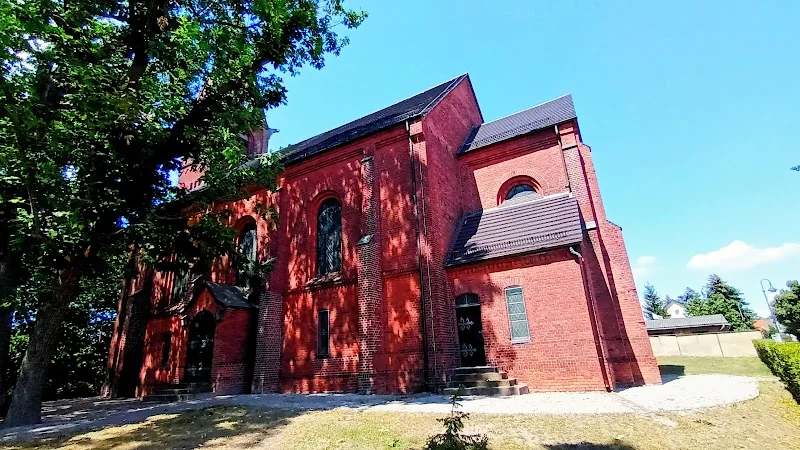
Architecturally, the Groß Gaglower Village Church is a convincing example of neo-Gothic brick architecture in Lower Lusatia. The church was built as a red brick structure, the tower is slender, articulated, and topped with gables and an octagonal roof. At about 42 meters high, it is visible from afar and continues to shape the historical village center to this day. Inside, the building features a wooden gallery, transverse benches, and an altar and pulpit area tailored to the space. The wooden ceiling, cleverly connected to the roof structure, ensures good acoustics according to the community and enhances the special atmosphere of the church space. For visitors, this creates not only a historical impression but also an acoustically pleasant space that equally supports music and word. Especially when choirs or brass players perform, the character of the building becomes particularly palpable. The church thus does not feel cramped or strict, but open enough to accommodate larger groups, and at the same time intimate enough to create closeness during worship and preaching. ([gross-gaglow-cottbus.de](https://www.gross-gaglow-cottbus.de/ortsleben/kirche/wir-ueber-uns.html?fontsize=big))
The official community page states around 500 seats, which makes the church unusually spacious for a village church. This is not just a number for technical data sheets but an indication of the practical significance of the building in community life. At special services, concerts, holidays, or family events, more people can participate without the space losing its impact. At the same time, the community notes that later installations like the organ prospect and heating do not harmonize as well as the original space. This honest assessment is interesting because it shows that the church is not a museum-like frozen object but a living space that has been repeatedly adapted to new needs over time. This is part of its charm: The Groß Gaglower Village Church is not perfectly smooth but historically grown. This makes it as exciting for architecture enthusiasts as it is for those seeking an authentic, unpretentious church atmosphere. Upon entering the space, one feels the mix of brick, wood, height, and history very directly. ([gross-gaglow-cottbus.de](https://www.gross-gaglow-cottbus.de/ortsleben/kirche/wir-ueber-uns.html?fontsize=big))
Address, Directions, and Parking in the Historic Village Center
The Groß Gaglower Village Church is located at Dorfstraße 2 in 03051 Cottbus, right in the historic village area of Groß Gaglow. For visitors, this is a real advantage because the way to the church is clearly traceable, and the location makes orientation easier. The church is not a remote object on the edge but part of a village core that can still be read as a grown center. Official pages do not indicate a separate large parking lot directly at the church. In the village center, it becomes clear that Dorfstraße and Chausseestraße are perceived as a historically shaped area where public spaces and the street environment play an important role. For access, this means: Those coming for a service, wedding, or concert should plan their visit so that there is some time for parking in the vicinity. This is not a weakness but typical for a village center where the church is closely connected to the village's appearance and does not stand isolated in a park landscape. The charm lies precisely in the fact that the arrival becomes part of the experience. ([cottbus.de](https://cottbus.de/veranstaltungen/gottesdienst-in-gross-gaglow-2/?utm_source=openai))
Practically important is also that the Evangelical Church Community Cottbus-Süd operates its parish office at Alte Poststraße 7 in Cottbus. There, organizational matters are bundled, and contacts for the community also come together. Therefore, anyone planning a baptism, wedding, or funeral or has questions about appointments should keep an eye on not only the local church itself but also the community office. This is particularly relevant for user expectations in the digital space because search queries regarding directions, contact, or parking usually seek concrete orientation. For the Groß Gaglower Village Church, the answer is twofold: The church is very easy to find via Dorfstraße, and the church organization is centrally reachable, even if the actual parking spaces on site are more likely to be found in the public environment rather than on a clearly designated church area. Those arriving by car, on foot, or through short paths in the village experience a classic village church situation where the surroundings are just as important as the building itself. ([evkirche-grossgaglow.de](https://evkirche-grossgaglow.de/pfarramt/))
Events, Choir, and Festival Culture Around the Church
The Groß Gaglower Village Church regularly serves as a stage for music and special occasions. The official pages provide information on services, family services, choir rehearsals, brass choir dates, and other community events, and the village page reports that the singing club Liederkranz has repeatedly used the church for concerts and festival programs in recent years. For 2025, there is talk of a spring concert with more than 200 guests. Such numbers are remarkable for a village church and show that the space is suitable not only for quiet devotions but also for larger audience moments. Especially during holidays, choir performances, or harvest festivals, the church shows itself as a place where village life and spiritual use come together. Those searching for Groß Gaglow village festival, events, or church quickly recognize that culture does not take place next to the church but within it and with it. This gives the place a special liveliness and makes it particularly attractive for visitors. ([gross-gaglow-cottbus.de](https://www.gross-gaglow-cottbus.de/))
The surrounding environment also speaks for a close connection between church and village culture. The community page mentions the women's circle in the community house, the brass choir with regular rehearsals, and the children's meeting, while the village page shows a lively event calendar with senior meetings, creative circles, and maypole raising. This creates a multifaceted picture: The church is not isolated but embedded in a community that cultivates religious, musical, and neighborly forms side by side. Users searching for terms like village festival, community house, or Groß Gaglow events thus find more than just a liturgical address. The Groß Gaglower Village Church is part of a local network that ranges from confirmation work to choir music to village actions, making it attractive for different target groups. This mix is particularly crucial for families and culture enthusiasts because it shows the church as a genuine meeting point. Thus, a monument becomes a place of exchange, a church building becomes a center of everyday life, and a search term becomes a vibrant experiential space. ([kirche-cottbus-sued.de](https://kirche-cottbus-sued.de/gross-gaglow))
Groß Gaglow as a District of Cottbus and Church Center
Groß Gaglow itself is today a district of Cottbus and is referred to as Lower Sorbian Gogolow on the local village page. The incorporation took place on March 10, 2005, and since then, the place has been even more closely integrated into the city structure. At the same time, the historic village center with the church, Dorfstraße, and the surrounding houses remains its own, clearly readable space. For SEO searches, this is important because terms like Groß Gaglow church, Groß Gaglow village festival, or village church Cottbus specifically target this tension between district, village history, and the present. The village church is thus not just a single architectural monument but an anchor point for the perception of the entire district. Those visiting the church also experience a piece of Cottbus district history, ranging from the medieval parish to the neo-Gothic new building to today's community structure. The fact that the Evangelical Church Community Cottbus-Süd brings together several local churches further emphasizes that Groß Gaglow is part of a larger church network while still maintaining its own identity. ([gross-gaglow-cottbus.de](https://www.gross-gaglow-cottbus.de/?utm_source=openai))
For everyday perception, it is also crucial that the church functions as a landmark. The tower makes the place visible, the monument list confirms its cultural value, and the community work ensures that the building is not only observed but used. This is precisely the strength of the Groß Gaglower Village Church: It connects history with the present, sacred space with community practice, and village appearance with regional identity. Those searching for the church often look for a mood, a place of tranquility, or an encounter with village culture. This expectation is not disappointed here because the church is memorable both architecturally and socially. For visitors wanting to experience an authentic village church in Cottbus, Groß Gaglow is thus a strong point of contact. And for the community, the building is much more than a beautiful image: It is a house of faith, music, and remembrance that continues to visibly hold the place together. ([bldam-brandenburg.de](https://bldam-brandenburg.de/wp-content/uploads/2026/03/02_CB_Internet-25.pdf))
Sources:
- Groß-Gaglow-Cottbus.de - Local Church Groß Gaglow and History ([gross-gaglow-cottbus.de](https://www.gross-gaglow-cottbus.de/ortsleben/kirche/wir-ueber-uns.html?fontsize=big))
- Ev. Church Community Cottbus-Süd - Local Church Groß Gaglow ([kirche-cottbus-sued.de](https://kirche-cottbus-sued.de/gross-gaglow))
- BLDAM - Monument List of the State of Brandenburg, City of Cottbus ([bldam-brandenburg.de](https://bldam-brandenburg.de/wp-content/uploads/2026/03/02_CB_Internet-25.pdf))
- City of Cottbus - Service in Groß Gaglow ([cottbus.de](https://cottbus.de/veranstaltungen/gottesdienst-in-gross-gaglow-2/?utm_source=openai))
- Groß-Gaglow-Cottbus.de - Welcome to Groß Gaglow ([gross-gaglow-cottbus.de](https://www.gross-gaglow-cottbus.de/))
Show moreShow less
Groß Gaglower Village Church | Service & History
The Groß Gaglower Village Church in Cottbus is much more than a quiet monument. It is a visible center of the district of Groß Gaglow, a place for worship, music, encounters, and remembrance, and it naturally connects village history with the present. The church is located at Dorfstraße 2, is listed in the monument register of the state of Brandenburg, and is supported by the Evangelical Church Community Cottbus-Süd. For this reason, it is equally interesting for visitors as it is for people specifically looking for worship, community life, history, or a special village church atmosphere. Those who come here do not experience an interchangeable sacred building, but a place with a grown identity, where the traces of centuries, war destruction, restoration, and community work come together. For SEO searches related to Groß Gaglow, church, and events, this is a clear advantage: This church is present in the city and remains strongly anchored in the local village core. ([bldam-brandenburg.de](https://bldam-brandenburg.de/wp-content/uploads/2026/03/02_CB_Internet-25.pdf))
Worship and Community Life in Groß Gaglow
Today's community life is not limited to Sunday services but is significantly broader. On the official pages of the community, there are women's circles, brass choirs, music groups, children's meetings, and other formats that show that the church functions as a social place and addresses people in different life phases. The women's circle meets monthly on a Thursday at the community house, the brass choir rehearses on Wednesday evenings and consists of about five to seven members according to the community, and the Evangelical children's meeting is designed for grades 1 to 6. This is important because it makes the church visible not as an isolated building, but as part of a vibrant community system. For visitors searching for orientation with keywords like Groß Gaglow church, community life, or events, this is the central message: There is not only a beautiful facade here, but also an active use that remains palpable throughout the year. ([kirche-cottbus-sued.de](https://kirche-cottbus-sued.de/gross-gaglow))
The practical processes are also clearly regulated and give the Groß Gaglower Village Church a reliable profile. Baptisms, weddings, and funerals are registered at the community office in Madlow according to the church bulletin; appointments with the pastor are possible by arrangement. This is an important note for all those who want to get to know the church not just as visitors but as a place for life celebrations, personal accompaniment, or musical contributions. Additionally, the church regularly appears in the event calendar of the city of Cottbus, which underscores its ongoing use for services. This makes it clear that the village church does not remain in a museum-like state but remains present in the everyday life of the community. Those who visit the region quickly realize that liturgy, pastoral care, and local community belong together. This also explains why the church remains so strongly associated with Groß Gaglow in public perception and is seen not just as an architectural sight but as a lived community space. ([kirche-cottbus-sued.de](https://kirche-cottbus-sued.de/fileadmin/Download/Kirchenblatt/2025/2025.03%20-%20Kirchenblatt%20M%C3%A4rz.pdf))
History of the Groß Gaglower Village Church
The history of the Groß Gaglower Village Church goes back a long way and does not begin with the current brick building. The oldest mention of the village and the church is found in the register of the Diocese of Meißen around 1346. For the place itself, the community page mentions a small half-timbered church, presumably from 1688, which was demolished in February 1891 due to its dilapidated condition. This sequence already shows that the church was never just a static structure but had to be repeatedly adapted to the needs of the place. Still in the same year, the new building took shape: The foundation stone was laid in March 1891, on August 10, 1891, the 42-meter-high tower with a knob and cross was completed, and on December 22, 1891, the new church was ceremoniously consecrated. Thus, not only was a replacement for the old building created, but a conscious new beginning that permanently changed the village's appearance and continues to shape Groß Gaglow architecturally to this day. ([gross-gaglow-cottbus.de](https://www.gross-gaglow-cottbus.de/ortsleben/kirche/wir-ueber-uns.html?fontsize=big))
The initiative for the new building, according to the community page, came from the church's patron, the manor owner Carl Otto Malin, and the pastor Ernst Julius Gierth, who had been active in Groß Gaglow since 1884. Both are remembered in the epitaph and in a portrait painting under the gallery. This personal anchoring is significant because it shows how closely the manor lordship, the parish office, and the village community were intertwined in the 19th century. The financing was jointly borne by the manor and the church community, which makes the village church appear from the very beginning as a community project. The war history is also visible: In 1945, a shell hit the tower, damaging the roof and east gable, and the repairs could only be gradually completed by 1950. In the 1980s, further reinforcements and restorations followed, including securing the tower cap, re-cladding and re-roofing, as well as work on the masonry and the roof of the church nave. Thus, the building tells not only of its origin but also of resilience and care over generations. For a village church, this is particularly valuable because here history does not remain abstract but becomes readable in the masonry and visible traces. ([gross-gaglow-cottbus.de](https://www.gross-gaglow-cottbus.de/ortsleben/kirche/wir-ueber-uns.html?fontsize=big))
Architecture, Space, and Acoustics
Architecturally, the Groß Gaglower Village Church is a convincing example of neo-Gothic brick architecture in Lower Lusatia. The church was built as a red brick structure, the tower is slender, articulated, and topped with gables and an octagonal roof. At about 42 meters high, it is visible from afar and continues to shape the historical village center to this day. Inside, the building features a wooden gallery, transverse benches, and an altar and pulpit area tailored to the space. The wooden ceiling, cleverly connected to the roof structure, ensures good acoustics according to the community and enhances the special atmosphere of the church space. For visitors, this creates not only a historical impression but also an acoustically pleasant space that equally supports music and word. Especially when choirs or brass players perform, the character of the building becomes particularly palpable. The church thus does not feel cramped or strict, but open enough to accommodate larger groups, and at the same time intimate enough to create closeness during worship and preaching. ([gross-gaglow-cottbus.de](https://www.gross-gaglow-cottbus.de/ortsleben/kirche/wir-ueber-uns.html?fontsize=big))
The official community page states around 500 seats, which makes the church unusually spacious for a village church. This is not just a number for technical data sheets but an indication of the practical significance of the building in community life. At special services, concerts, holidays, or family events, more people can participate without the space losing its impact. At the same time, the community notes that later installations like the organ prospect and heating do not harmonize as well as the original space. This honest assessment is interesting because it shows that the church is not a museum-like frozen object but a living space that has been repeatedly adapted to new needs over time. This is part of its charm: The Groß Gaglower Village Church is not perfectly smooth but historically grown. This makes it as exciting for architecture enthusiasts as it is for those seeking an authentic, unpretentious church atmosphere. Upon entering the space, one feels the mix of brick, wood, height, and history very directly. ([gross-gaglow-cottbus.de](https://www.gross-gaglow-cottbus.de/ortsleben/kirche/wir-ueber-uns.html?fontsize=big))
Address, Directions, and Parking in the Historic Village Center
The Groß Gaglower Village Church is located at Dorfstraße 2 in 03051 Cottbus, right in the historic village area of Groß Gaglow. For visitors, this is a real advantage because the way to the church is clearly traceable, and the location makes orientation easier. The church is not a remote object on the edge but part of a village core that can still be read as a grown center. Official pages do not indicate a separate large parking lot directly at the church. In the village center, it becomes clear that Dorfstraße and Chausseestraße are perceived as a historically shaped area where public spaces and the street environment play an important role. For access, this means: Those coming for a service, wedding, or concert should plan their visit so that there is some time for parking in the vicinity. This is not a weakness but typical for a village center where the church is closely connected to the village's appearance and does not stand isolated in a park landscape. The charm lies precisely in the fact that the arrival becomes part of the experience. ([cottbus.de](https://cottbus.de/veranstaltungen/gottesdienst-in-gross-gaglow-2/?utm_source=openai))
Practically important is also that the Evangelical Church Community Cottbus-Süd operates its parish office at Alte Poststraße 7 in Cottbus. There, organizational matters are bundled, and contacts for the community also come together. Therefore, anyone planning a baptism, wedding, or funeral or has questions about appointments should keep an eye on not only the local church itself but also the community office. This is particularly relevant for user expectations in the digital space because search queries regarding directions, contact, or parking usually seek concrete orientation. For the Groß Gaglower Village Church, the answer is twofold: The church is very easy to find via Dorfstraße, and the church organization is centrally reachable, even if the actual parking spaces on site are more likely to be found in the public environment rather than on a clearly designated church area. Those arriving by car, on foot, or through short paths in the village experience a classic village church situation where the surroundings are just as important as the building itself. ([evkirche-grossgaglow.de](https://evkirche-grossgaglow.de/pfarramt/))
Events, Choir, and Festival Culture Around the Church
The Groß Gaglower Village Church regularly serves as a stage for music and special occasions. The official pages provide information on services, family services, choir rehearsals, brass choir dates, and other community events, and the village page reports that the singing club Liederkranz has repeatedly used the church for concerts and festival programs in recent years. For 2025, there is talk of a spring concert with more than 200 guests. Such numbers are remarkable for a village church and show that the space is suitable not only for quiet devotions but also for larger audience moments. Especially during holidays, choir performances, or harvest festivals, the church shows itself as a place where village life and spiritual use come together. Those searching for Groß Gaglow village festival, events, or church quickly recognize that culture does not take place next to the church but within it and with it. This gives the place a special liveliness and makes it particularly attractive for visitors. ([gross-gaglow-cottbus.de](https://www.gross-gaglow-cottbus.de/))
The surrounding environment also speaks for a close connection between church and village culture. The community page mentions the women's circle in the community house, the brass choir with regular rehearsals, and the children's meeting, while the village page shows a lively event calendar with senior meetings, creative circles, and maypole raising. This creates a multifaceted picture: The church is not isolated but embedded in a community that cultivates religious, musical, and neighborly forms side by side. Users searching for terms like village festival, community house, or Groß Gaglow events thus find more than just a liturgical address. The Groß Gaglower Village Church is part of a local network that ranges from confirmation work to choir music to village actions, making it attractive for different target groups. This mix is particularly crucial for families and culture enthusiasts because it shows the church as a genuine meeting point. Thus, a monument becomes a place of exchange, a church building becomes a center of everyday life, and a search term becomes a vibrant experiential space. ([kirche-cottbus-sued.de](https://kirche-cottbus-sued.de/gross-gaglow))
Groß Gaglow as a District of Cottbus and Church Center
Groß Gaglow itself is today a district of Cottbus and is referred to as Lower Sorbian Gogolow on the local village page. The incorporation took place on March 10, 2005, and since then, the place has been even more closely integrated into the city structure. At the same time, the historic village center with the church, Dorfstraße, and the surrounding houses remains its own, clearly readable space. For SEO searches, this is important because terms like Groß Gaglow church, Groß Gaglow village festival, or village church Cottbus specifically target this tension between district, village history, and the present. The village church is thus not just a single architectural monument but an anchor point for the perception of the entire district. Those visiting the church also experience a piece of Cottbus district history, ranging from the medieval parish to the neo-Gothic new building to today's community structure. The fact that the Evangelical Church Community Cottbus-Süd brings together several local churches further emphasizes that Groß Gaglow is part of a larger church network while still maintaining its own identity. ([gross-gaglow-cottbus.de](https://www.gross-gaglow-cottbus.de/?utm_source=openai))
For everyday perception, it is also crucial that the church functions as a landmark. The tower makes the place visible, the monument list confirms its cultural value, and the community work ensures that the building is not only observed but used. This is precisely the strength of the Groß Gaglower Village Church: It connects history with the present, sacred space with community practice, and village appearance with regional identity. Those searching for the church often look for a mood, a place of tranquility, or an encounter with village culture. This expectation is not disappointed here because the church is memorable both architecturally and socially. For visitors wanting to experience an authentic village church in Cottbus, Groß Gaglow is thus a strong point of contact. And for the community, the building is much more than a beautiful image: It is a house of faith, music, and remembrance that continues to visibly hold the place together. ([bldam-brandenburg.de](https://bldam-brandenburg.de/wp-content/uploads/2026/03/02_CB_Internet-25.pdf))
Sources:
- Groß-Gaglow-Cottbus.de - Local Church Groß Gaglow and History ([gross-gaglow-cottbus.de](https://www.gross-gaglow-cottbus.de/ortsleben/kirche/wir-ueber-uns.html?fontsize=big))
- Ev. Church Community Cottbus-Süd - Local Church Groß Gaglow ([kirche-cottbus-sued.de](https://kirche-cottbus-sued.de/gross-gaglow))
- BLDAM - Monument List of the State of Brandenburg, City of Cottbus ([bldam-brandenburg.de](https://bldam-brandenburg.de/wp-content/uploads/2026/03/02_CB_Internet-25.pdf))
- City of Cottbus - Service in Groß Gaglow ([cottbus.de](https://cottbus.de/veranstaltungen/gottesdienst-in-gross-gaglow-2/?utm_source=openai))
- Groß-Gaglow-Cottbus.de - Welcome to Groß Gaglow ([gross-gaglow-cottbus.de](https://www.gross-gaglow-cottbus.de/))
Groß Gaglower Village Church | Service & History
The Groß Gaglower Village Church in Cottbus is much more than a quiet monument. It is a visible center of the district of Groß Gaglow, a place for worship, music, encounters, and remembrance, and it naturally connects village history with the present. The church is located at Dorfstraße 2, is listed in the monument register of the state of Brandenburg, and is supported by the Evangelical Church Community Cottbus-Süd. For this reason, it is equally interesting for visitors as it is for people specifically looking for worship, community life, history, or a special village church atmosphere. Those who come here do not experience an interchangeable sacred building, but a place with a grown identity, where the traces of centuries, war destruction, restoration, and community work come together. For SEO searches related to Groß Gaglow, church, and events, this is a clear advantage: This church is present in the city and remains strongly anchored in the local village core. ([bldam-brandenburg.de](https://bldam-brandenburg.de/wp-content/uploads/2026/03/02_CB_Internet-25.pdf))
Worship and Community Life in Groß Gaglow
Today's community life is not limited to Sunday services but is significantly broader. On the official pages of the community, there are women's circles, brass choirs, music groups, children's meetings, and other formats that show that the church functions as a social place and addresses people in different life phases. The women's circle meets monthly on a Thursday at the community house, the brass choir rehearses on Wednesday evenings and consists of about five to seven members according to the community, and the Evangelical children's meeting is designed for grades 1 to 6. This is important because it makes the church visible not as an isolated building, but as part of a vibrant community system. For visitors searching for orientation with keywords like Groß Gaglow church, community life, or events, this is the central message: There is not only a beautiful facade here, but also an active use that remains palpable throughout the year. ([kirche-cottbus-sued.de](https://kirche-cottbus-sued.de/gross-gaglow))
The practical processes are also clearly regulated and give the Groß Gaglower Village Church a reliable profile. Baptisms, weddings, and funerals are registered at the community office in Madlow according to the church bulletin; appointments with the pastor are possible by arrangement. This is an important note for all those who want to get to know the church not just as visitors but as a place for life celebrations, personal accompaniment, or musical contributions. Additionally, the church regularly appears in the event calendar of the city of Cottbus, which underscores its ongoing use for services. This makes it clear that the village church does not remain in a museum-like state but remains present in the everyday life of the community. Those who visit the region quickly realize that liturgy, pastoral care, and local community belong together. This also explains why the church remains so strongly associated with Groß Gaglow in public perception and is seen not just as an architectural sight but as a lived community space. ([kirche-cottbus-sued.de](https://kirche-cottbus-sued.de/fileadmin/Download/Kirchenblatt/2025/2025.03%20-%20Kirchenblatt%20M%C3%A4rz.pdf))
History of the Groß Gaglower Village Church
The history of the Groß Gaglower Village Church goes back a long way and does not begin with the current brick building. The oldest mention of the village and the church is found in the register of the Diocese of Meißen around 1346. For the place itself, the community page mentions a small half-timbered church, presumably from 1688, which was demolished in February 1891 due to its dilapidated condition. This sequence already shows that the church was never just a static structure but had to be repeatedly adapted to the needs of the place. Still in the same year, the new building took shape: The foundation stone was laid in March 1891, on August 10, 1891, the 42-meter-high tower with a knob and cross was completed, and on December 22, 1891, the new church was ceremoniously consecrated. Thus, not only was a replacement for the old building created, but a conscious new beginning that permanently changed the village's appearance and continues to shape Groß Gaglow architecturally to this day. ([gross-gaglow-cottbus.de](https://www.gross-gaglow-cottbus.de/ortsleben/kirche/wir-ueber-uns.html?fontsize=big))
The initiative for the new building, according to the community page, came from the church's patron, the manor owner Carl Otto Malin, and the pastor Ernst Julius Gierth, who had been active in Groß Gaglow since 1884. Both are remembered in the epitaph and in a portrait painting under the gallery. This personal anchoring is significant because it shows how closely the manor lordship, the parish office, and the village community were intertwined in the 19th century. The financing was jointly borne by the manor and the church community, which makes the village church appear from the very beginning as a community project. The war history is also visible: In 1945, a shell hit the tower, damaging the roof and east gable, and the repairs could only be gradually completed by 1950. In the 1980s, further reinforcements and restorations followed, including securing the tower cap, re-cladding and re-roofing, as well as work on the masonry and the roof of the church nave. Thus, the building tells not only of its origin but also of resilience and care over generations. For a village church, this is particularly valuable because here history does not remain abstract but becomes readable in the masonry and visible traces. ([gross-gaglow-cottbus.de](https://www.gross-gaglow-cottbus.de/ortsleben/kirche/wir-ueber-uns.html?fontsize=big))
Architecture, Space, and Acoustics
Architecturally, the Groß Gaglower Village Church is a convincing example of neo-Gothic brick architecture in Lower Lusatia. The church was built as a red brick structure, the tower is slender, articulated, and topped with gables and an octagonal roof. At about 42 meters high, it is visible from afar and continues to shape the historical village center to this day. Inside, the building features a wooden gallery, transverse benches, and an altar and pulpit area tailored to the space. The wooden ceiling, cleverly connected to the roof structure, ensures good acoustics according to the community and enhances the special atmosphere of the church space. For visitors, this creates not only a historical impression but also an acoustically pleasant space that equally supports music and word. Especially when choirs or brass players perform, the character of the building becomes particularly palpable. The church thus does not feel cramped or strict, but open enough to accommodate larger groups, and at the same time intimate enough to create closeness during worship and preaching. ([gross-gaglow-cottbus.de](https://www.gross-gaglow-cottbus.de/ortsleben/kirche/wir-ueber-uns.html?fontsize=big))
The official community page states around 500 seats, which makes the church unusually spacious for a village church. This is not just a number for technical data sheets but an indication of the practical significance of the building in community life. At special services, concerts, holidays, or family events, more people can participate without the space losing its impact. At the same time, the community notes that later installations like the organ prospect and heating do not harmonize as well as the original space. This honest assessment is interesting because it shows that the church is not a museum-like frozen object but a living space that has been repeatedly adapted to new needs over time. This is part of its charm: The Groß Gaglower Village Church is not perfectly smooth but historically grown. This makes it as exciting for architecture enthusiasts as it is for those seeking an authentic, unpretentious church atmosphere. Upon entering the space, one feels the mix of brick, wood, height, and history very directly. ([gross-gaglow-cottbus.de](https://www.gross-gaglow-cottbus.de/ortsleben/kirche/wir-ueber-uns.html?fontsize=big))
Address, Directions, and Parking in the Historic Village Center
The Groß Gaglower Village Church is located at Dorfstraße 2 in 03051 Cottbus, right in the historic village area of Groß Gaglow. For visitors, this is a real advantage because the way to the church is clearly traceable, and the location makes orientation easier. The church is not a remote object on the edge but part of a village core that can still be read as a grown center. Official pages do not indicate a separate large parking lot directly at the church. In the village center, it becomes clear that Dorfstraße and Chausseestraße are perceived as a historically shaped area where public spaces and the street environment play an important role. For access, this means: Those coming for a service, wedding, or concert should plan their visit so that there is some time for parking in the vicinity. This is not a weakness but typical for a village center where the church is closely connected to the village's appearance and does not stand isolated in a park landscape. The charm lies precisely in the fact that the arrival becomes part of the experience. ([cottbus.de](https://cottbus.de/veranstaltungen/gottesdienst-in-gross-gaglow-2/?utm_source=openai))
Practically important is also that the Evangelical Church Community Cottbus-Süd operates its parish office at Alte Poststraße 7 in Cottbus. There, organizational matters are bundled, and contacts for the community also come together. Therefore, anyone planning a baptism, wedding, or funeral or has questions about appointments should keep an eye on not only the local church itself but also the community office. This is particularly relevant for user expectations in the digital space because search queries regarding directions, contact, or parking usually seek concrete orientation. For the Groß Gaglower Village Church, the answer is twofold: The church is very easy to find via Dorfstraße, and the church organization is centrally reachable, even if the actual parking spaces on site are more likely to be found in the public environment rather than on a clearly designated church area. Those arriving by car, on foot, or through short paths in the village experience a classic village church situation where the surroundings are just as important as the building itself. ([evkirche-grossgaglow.de](https://evkirche-grossgaglow.de/pfarramt/))
Events, Choir, and Festival Culture Around the Church
The Groß Gaglower Village Church regularly serves as a stage for music and special occasions. The official pages provide information on services, family services, choir rehearsals, brass choir dates, and other community events, and the village page reports that the singing club Liederkranz has repeatedly used the church for concerts and festival programs in recent years. For 2025, there is talk of a spring concert with more than 200 guests. Such numbers are remarkable for a village church and show that the space is suitable not only for quiet devotions but also for larger audience moments. Especially during holidays, choir performances, or harvest festivals, the church shows itself as a place where village life and spiritual use come together. Those searching for Groß Gaglow village festival, events, or church quickly recognize that culture does not take place next to the church but within it and with it. This gives the place a special liveliness and makes it particularly attractive for visitors. ([gross-gaglow-cottbus.de](https://www.gross-gaglow-cottbus.de/))
The surrounding environment also speaks for a close connection between church and village culture. The community page mentions the women's circle in the community house, the brass choir with regular rehearsals, and the children's meeting, while the village page shows a lively event calendar with senior meetings, creative circles, and maypole raising. This creates a multifaceted picture: The church is not isolated but embedded in a community that cultivates religious, musical, and neighborly forms side by side. Users searching for terms like village festival, community house, or Groß Gaglow events thus find more than just a liturgical address. The Groß Gaglower Village Church is part of a local network that ranges from confirmation work to choir music to village actions, making it attractive for different target groups. This mix is particularly crucial for families and culture enthusiasts because it shows the church as a genuine meeting point. Thus, a monument becomes a place of exchange, a church building becomes a center of everyday life, and a search term becomes a vibrant experiential space. ([kirche-cottbus-sued.de](https://kirche-cottbus-sued.de/gross-gaglow))
Groß Gaglow as a District of Cottbus and Church Center
Groß Gaglow itself is today a district of Cottbus and is referred to as Lower Sorbian Gogolow on the local village page. The incorporation took place on March 10, 2005, and since then, the place has been even more closely integrated into the city structure. At the same time, the historic village center with the church, Dorfstraße, and the surrounding houses remains its own, clearly readable space. For SEO searches, this is important because terms like Groß Gaglow church, Groß Gaglow village festival, or village church Cottbus specifically target this tension between district, village history, and the present. The village church is thus not just a single architectural monument but an anchor point for the perception of the entire district. Those visiting the church also experience a piece of Cottbus district history, ranging from the medieval parish to the neo-Gothic new building to today's community structure. The fact that the Evangelical Church Community Cottbus-Süd brings together several local churches further emphasizes that Groß Gaglow is part of a larger church network while still maintaining its own identity. ([gross-gaglow-cottbus.de](https://www.gross-gaglow-cottbus.de/?utm_source=openai))
For everyday perception, it is also crucial that the church functions as a landmark. The tower makes the place visible, the monument list confirms its cultural value, and the community work ensures that the building is not only observed but used. This is precisely the strength of the Groß Gaglower Village Church: It connects history with the present, sacred space with community practice, and village appearance with regional identity. Those searching for the church often look for a mood, a place of tranquility, or an encounter with village culture. This expectation is not disappointed here because the church is memorable both architecturally and socially. For visitors wanting to experience an authentic village church in Cottbus, Groß Gaglow is thus a strong point of contact. And for the community, the building is much more than a beautiful image: It is a house of faith, music, and remembrance that continues to visibly hold the place together. ([bldam-brandenburg.de](https://bldam-brandenburg.de/wp-content/uploads/2026/03/02_CB_Internet-25.pdf))
Sources:
- Groß-Gaglow-Cottbus.de - Local Church Groß Gaglow and History ([gross-gaglow-cottbus.de](https://www.gross-gaglow-cottbus.de/ortsleben/kirche/wir-ueber-uns.html?fontsize=big))
- Ev. Church Community Cottbus-Süd - Local Church Groß Gaglow ([kirche-cottbus-sued.de](https://kirche-cottbus-sued.de/gross-gaglow))
- BLDAM - Monument List of the State of Brandenburg, City of Cottbus ([bldam-brandenburg.de](https://bldam-brandenburg.de/wp-content/uploads/2026/03/02_CB_Internet-25.pdf))
- City of Cottbus - Service in Groß Gaglow ([cottbus.de](https://cottbus.de/veranstaltungen/gottesdienst-in-gross-gaglow-2/?utm_source=openai))
- Groß-Gaglow-Cottbus.de - Welcome to Groß Gaglow ([gross-gaglow-cottbus.de](https://www.gross-gaglow-cottbus.de/))
Upcoming Events
No events found
Frequently Asked Questions
Reviews
No reviews found