
Luckau
Stöbritz, 15926 Luckau, Deutschland
Village Church Willmersdorf-Stöbritz | History & Fieldstone Church
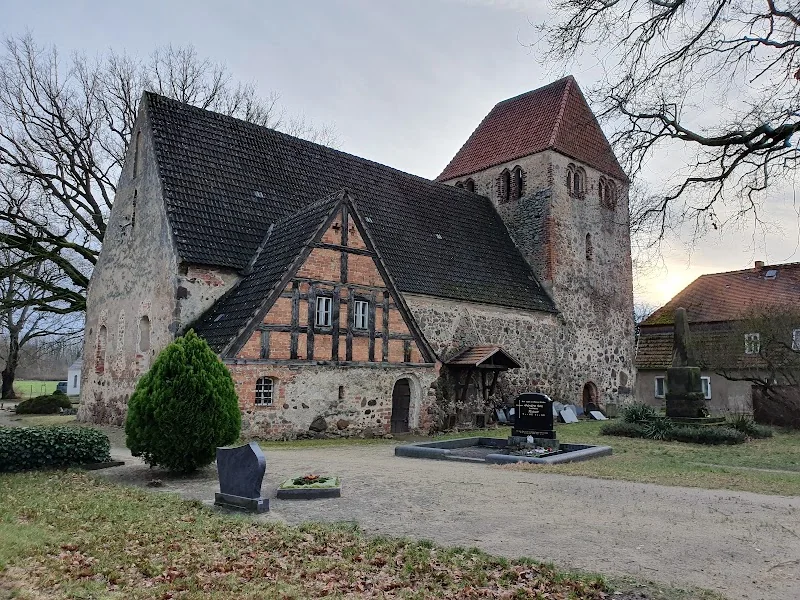
The Village Church Willmersdorf-Stöbritz, officially referred to as the Village Church Stöbritz, is one of the most impressive rural sacral buildings in Lower Lusatia. It is located in the district of Willmersdorf-Stöbritz in the town of Luckau in Brandenburg, closely tied to a landscape where village history, church construction, and settlement development have been intertwined for centuries. The official description places Willmersdorf-Stöbritz between Lübbenau and Luckau, east of Luckau, on the L 526 and just before the district border to Oberspreewald-Lausitz. For visitors, this place appears calm and unremarkable, but for building and regional history, it is very significant: Here, an early fieldstone church meets the memory of two formerly independent villages that were merged only after the Congress of Vienna. Willmersdorf was first mentioned in 1397, Stöbritz as early as 1346. It is precisely from this long, multifaceted development that the church derives its special significance, as it is not just a building but a visible anchor of local identity. ([luckau.de](https://luckau.de/de/buergerportal/luckau-ortsteile/artikel-ortsteil-willmersdorf-stoebritz.html))
History of the Village Church Stöbritz and the Place Willmersdorf-Stöbritz
To understand the Village Church Stöbritz, one must first understand the place in which it stands. Willmersdorf and Stöbritz are historically independent settlements with very different traditions. The town of Luckau cites the first documentary mention of Willmersdorf in 1397 and for Stöbritz even as early as 1346. The names also tell a story: Willmersdorf derives from the name Wilhelm, while Stöbritz has a Sorbian root, which can be interpreted as a settlement with fences. The fact that both places were merged after the Congress of Vienna shows how long political and administrative development lines can influence Brandenburg. Thus, the church does not simply stand in any village but in a district whose identity consists of several historical layers. This makes the church location particularly interesting, as it reflects the development of rural life from the Middle Ages through modern times to the present. The village church is one of the few structures that has visibly preserved this continuity over the centuries. ([luckau.de](https://luckau.de/de/buergerportal/luckau-ortsteile/artikel-ortsteil-willmersdorf-stoebritz.html))
Therefore, the church is also a key to local memory culture. In small rural places, churches are often the oldest preserved buildings and thus bearers of history that otherwise remains hardly visible in the construction. This is especially true for Willmersdorf-Stöbritz, as the two village centers only merged comparatively late, but their roots reach deep into the 14th century. The Village Church Stöbritz marks this historical core not only spatially but also symbolically. It refers to permanence, to the role of faith in village life, and to the craftsmanship quality of early medieval building forms that have been preserved in fieldstone to this day. Therefore, anyone passing through the village encounters not just a church but a piece of regional biography. The interplay of local history, name development, and sacred building explains why the church is described in official representations not only as a building but as an essential part of the district. ([luckau.de](https://luckau.de/de/buergerportal/luckau-ortsteile/artikel-ortsteil-willmersdorf-stoebritz.html))
Location in Willmersdorf-Stöbritz and Access to the Church
The location of the Village Church Stöbritz is important for understanding the building, as it is strongly shaped by the village character. According to the official village page, Willmersdorf-Stöbritz is located between Lübbenau and Luckau, east of Luckau, on the state road L 526 and about 10 kilometers southeast of the town. Thus, the church is situated in a typical Brandenburg cultural landscape, where paths, fields, small settlement cores, and historical village centers are closely intertwined. The church is not designed as an urban destination with a large square or event character, but as a village church that must be understood from a rural scale. This embedding is an essential part of its charm: The approach does not lead to a densely built center but to a district where tranquility, openness, and historical continuity prevail. This is an important added value for visitors who want to experience church spaces in Brandenburg as part of the landscape. ([luckau.de](https://luckau.de/de/buergerportal/luckau-ortsteile/artikel-ortsteil-willmersdorf-stoebritz.html))
Additional orientation is provided by the topographical classification of the historical village core. According to the traditional village description, the church stands in the historical center of Stöbritz and south of the village street on a slightly elevated, enclosed property. This location is typical for many village churches in the region and explains why the building appears so prominent in the surroundings: It is not placed randomly but deliberately forms the spiritual and spatial center of the place. Even if no separate official parking description has been published, the location on the L 526 and the short distance to Luckau provide a generally understandable accessibility by car or regional transport network. Therefore, for a visit, the classic approach to a small Brandenburg village church destination is recommended: drive slowly, perceive the village structure, and view the church as part of the entire village image. This way, the location unfolds its actual value, namely as a quiet point within a historically grown settlement landscape. ([de.wikipedia.org](https://de.wikipedia.org/wiki/Dorfkirche_St%C3%B6britz?utm_source=openai))
Medieval Construction Phases, Fieldstone, and the Church Tower
The most exciting insights into the Village Church Stöbritz come from building research. The Brandenburg State Office for Monument Preservation and Archaeological State Museum describes the building no longer as a uniform work of the early 15th century but as the result of several medieval stages. Particularly important is the evidence that the current structure made of fieldstone with brick openings was created in four medieval phases. The oldest part was a hall building that originally apparently managed without a west entrance and had two accesses in the windowless north wall. The roof covering with monk and nun tiles also points to older building practices. Later additions involved the tower and a northern extension, which presumably served as a sacristy. Thus, the church vividly demonstrates how rural sacral architecture develops not in a single building act but through renovations, extensions, and technical adaptations. For monument-interested visitors, this layering is the great attraction because it makes the construction history visible in the masonry itself. ([bldam-brandenburg.de](https://bldam-brandenburg.de/wp-content/uploads/2020/08/BLDAM-Denkmalreport-2017-18.pdf))
Particularly revealing are the dating clues that the BLDAM derives from the woods and structural traces. According to this, the first tower was completed around or after 1450, while the bell chamber with twin windows and the bell frame were added only around or after 1500. At the same time, individual fieldstones on the west gable suggest that the hall building may be even older than originally assumed, possibly dating back to the 13th century. Whether this early dating can be definitively secured remains open, but the findings clearly show: The church is older and more complex than a simple classification in the early 15th century would suggest. It is precisely this mixture of secured observation and cautious scientific interpretation that makes the Village Church Stöbritz so interesting for building research. It connects regional church architecture with methodological monument preservation and shows how much knowledge can be extracted from a seemingly simple fieldstone church. The result is a building that is not only old but literally preserves the history of its creation process in layers. ([bldam-brandenburg.de](https://bldam-brandenburg.de/wp-content/uploads/2020/08/BLDAM-Denkmalreport-2017-18.pdf))
Interior, Furnishings, and the Organ from 1889
Inside the Village Church Stöbritz, a different layer of time is revealed than on the outside. The town of Luckau describes the church furnishings as modern and dates them to the 1960s. Thus, there is no museum-like frozen inventory from the Middle Ages in the space, but an interior that reflects the needs of a later community phase. This mixture is quite typical for village churches in Brandenburg: The building structure remains historical, while furnishings, furniture, and liturgical use are renewed multiple times. This creates an exciting contrast. Outside, the fieldstone speaks of medieval building culture, while inside, the furnishings refer to the 20th century and a time when many rural churches were simplified, renewed, or functionally adapted. Therefore, visitors to the church experience not only monument preservation but also religious and usage history. ([luckau.de](https://luckau.de/de/buergerportal/luckau-ortsteile/artikel-ortsteil-willmersdorf-stoebritz.html))
A special highlight is the organ, which, according to the official village page, dates from 1889. This instrument is older than the other furnishings and thus forms an important link between the historical building and its later use. An organ from the late 19th century often gives a rural church space a very own sound character, as it belongs technically and musically to a different era while still shaping the space today. Even if the town page does not provide a detailed disposition, the mere preservation of such an instrument is already remarkable. Together with the modern inventory and the medieval masonry, a multi-layered interior emerges that has not only religious but also cultural-historical significance. For visitors who pay attention to more than just architecture in a village church, this connection between building, furnishings, and sound history is crucial. It explains why the church, despite its small size, has developed such a strong presence in the village. ([luckau.de](https://luckau.de/de/buergerportal/luckau-ortsteile/artikel-ortsteil-willmersdorf-stoebritz.html))
Monument Value, Protection, and Significance for Lower Lusatia
The Village Church Stöbritz is not only an old church building but also a monument-relevant object in the inventory of the state of Brandenburg. In the monument list of the state, Stöbritz near Luckau is explicitly listed under Willmersdorf-Stöbritz, which underscores its official classification in the protected cultural inventory. This is particularly important for the Lower Lusatia region, as village churches here are among the central bearers of historical identity. They not only mark the religious center of a place but also preserve building forms, materials, and spatial structures that would have long since disappeared in many settlements. The fieldstone construction in Stöbritz thus stands as a representative for a whole group of rural churches that continue to shape the image of the cultural landscape in Brandenburg to this day. The fact that the church is additionally located in the church district of Lower Lusatia shows its continued spiritual affiliation and its integration into the regional community structure. ([bldam-brandenburg.de](https://bldam-brandenburg.de/wp-content/uploads/2025/03/06_LDS_Internet-24.pdf?utm_source=openai))
However, the monument value arises not only from its age. Crucial is the readability of the building. In Stöbritz, the medieval core, later renovations, modern furnishings, and the 19th-century organ can be read in a single building. This makes the church a vivid example of how rural sacral spaces change over centuries without losing their identity. For the community, it remains a place of continuity, for visitors a place of discovery, and for monument preservation a research object with rarely clearly recognizable layers. Especially in a small district, whose independence has historically grown from two villages, such a building has a special integrative function. It tells of belonging, change, and regional memory. Therefore, anyone visiting the Village Church Stöbritz sees not just a monument but a piece of lived Lower Lusatia that moves between research, community life, and landscape image. This multiple role explains why the building is significant for the town of Luckau and the entire region far beyond its small size. ([bldam-brandenburg.de](https://bldam-brandenburg.de/wp-content/uploads/2020/08/BLDAM-Denkmalreport-2017-18.pdf))
Village Church Willmersdorf-Stöbritz for Visitors, Culture Enthusiasts, and Local Explorers
For visitors interested in church architecture, village history, or quiet cultural places, the Village Church Willmersdorf-Stöbritz is a rewarding destination. The place is small, the paths are short, and the church can be experienced as part of a historical village core, not as an isolated monument. This is precisely what makes its special charm: One does not come for a large event operation but for an authentic, grown place. Those driving along the L 526, noticing the location between Luckau and Lübbenau, and opening their eyes to the rural topography will quickly understand why such churches are so formative in Brandenburg. They are not spectacular solitary structures but quiet central buildings around which the life of a place has oriented itself over generations. The Village Church Stöbritz embodies this principle very clearly. Its fieldstone walls, the medieval core, and the later additions together create an image that can only be fully read upon closer inspection. ([luckau.de](https://luckau.de/de/buergerportal/luckau-ortsteile/artikel-ortsteil-willmersdorf-stoebritz.html))
Precisely for this reason, the church is also suitable for a conscious short visit with a cultural-historical focus. It is advisable not to view the place merely as a transit station but as part of the Luckau Lower Lusatia with its own character. The combination of the old village core, the historical fieldstone church, the organ from 1889, and the monument status of the building makes Stöbritz a good example of how much regional history is contained in a small village. Those traveling in the area can use the church as a starting point to better understand the rural church landscapes around Luckau. The strength of this place lies precisely in its unpretentiousness: no grand staging, but a credible, quiet, and enduring presence. Thus, a brief stop becomes a content-rich impression that makes the Village Church Willmersdorf-Stöbritz visible as a historical, cultural, and landscape reference point of the region. ([luckau.de](https://luckau.de/de/buergerportal/luckau-ortsteile/artikel-ortsteil-willmersdorf-stoebritz.html))
Sources:
Show moreShow less
Village Church Willmersdorf-Stöbritz | History & Fieldstone Church
The Village Church Willmersdorf-Stöbritz, officially referred to as the Village Church Stöbritz, is one of the most impressive rural sacral buildings in Lower Lusatia. It is located in the district of Willmersdorf-Stöbritz in the town of Luckau in Brandenburg, closely tied to a landscape where village history, church construction, and settlement development have been intertwined for centuries. The official description places Willmersdorf-Stöbritz between Lübbenau and Luckau, east of Luckau, on the L 526 and just before the district border to Oberspreewald-Lausitz. For visitors, this place appears calm and unremarkable, but for building and regional history, it is very significant: Here, an early fieldstone church meets the memory of two formerly independent villages that were merged only after the Congress of Vienna. Willmersdorf was first mentioned in 1397, Stöbritz as early as 1346. It is precisely from this long, multifaceted development that the church derives its special significance, as it is not just a building but a visible anchor of local identity. ([luckau.de](https://luckau.de/de/buergerportal/luckau-ortsteile/artikel-ortsteil-willmersdorf-stoebritz.html))
History of the Village Church Stöbritz and the Place Willmersdorf-Stöbritz
To understand the Village Church Stöbritz, one must first understand the place in which it stands. Willmersdorf and Stöbritz are historically independent settlements with very different traditions. The town of Luckau cites the first documentary mention of Willmersdorf in 1397 and for Stöbritz even as early as 1346. The names also tell a story: Willmersdorf derives from the name Wilhelm, while Stöbritz has a Sorbian root, which can be interpreted as a settlement with fences. The fact that both places were merged after the Congress of Vienna shows how long political and administrative development lines can influence Brandenburg. Thus, the church does not simply stand in any village but in a district whose identity consists of several historical layers. This makes the church location particularly interesting, as it reflects the development of rural life from the Middle Ages through modern times to the present. The village church is one of the few structures that has visibly preserved this continuity over the centuries. ([luckau.de](https://luckau.de/de/buergerportal/luckau-ortsteile/artikel-ortsteil-willmersdorf-stoebritz.html))
Therefore, the church is also a key to local memory culture. In small rural places, churches are often the oldest preserved buildings and thus bearers of history that otherwise remains hardly visible in the construction. This is especially true for Willmersdorf-Stöbritz, as the two village centers only merged comparatively late, but their roots reach deep into the 14th century. The Village Church Stöbritz marks this historical core not only spatially but also symbolically. It refers to permanence, to the role of faith in village life, and to the craftsmanship quality of early medieval building forms that have been preserved in fieldstone to this day. Therefore, anyone passing through the village encounters not just a church but a piece of regional biography. The interplay of local history, name development, and sacred building explains why the church is described in official representations not only as a building but as an essential part of the district. ([luckau.de](https://luckau.de/de/buergerportal/luckau-ortsteile/artikel-ortsteil-willmersdorf-stoebritz.html))
Location in Willmersdorf-Stöbritz and Access to the Church
The location of the Village Church Stöbritz is important for understanding the building, as it is strongly shaped by the village character. According to the official village page, Willmersdorf-Stöbritz is located between Lübbenau and Luckau, east of Luckau, on the state road L 526 and about 10 kilometers southeast of the town. Thus, the church is situated in a typical Brandenburg cultural landscape, where paths, fields, small settlement cores, and historical village centers are closely intertwined. The church is not designed as an urban destination with a large square or event character, but as a village church that must be understood from a rural scale. This embedding is an essential part of its charm: The approach does not lead to a densely built center but to a district where tranquility, openness, and historical continuity prevail. This is an important added value for visitors who want to experience church spaces in Brandenburg as part of the landscape. ([luckau.de](https://luckau.de/de/buergerportal/luckau-ortsteile/artikel-ortsteil-willmersdorf-stoebritz.html))
Additional orientation is provided by the topographical classification of the historical village core. According to the traditional village description, the church stands in the historical center of Stöbritz and south of the village street on a slightly elevated, enclosed property. This location is typical for many village churches in the region and explains why the building appears so prominent in the surroundings: It is not placed randomly but deliberately forms the spiritual and spatial center of the place. Even if no separate official parking description has been published, the location on the L 526 and the short distance to Luckau provide a generally understandable accessibility by car or regional transport network. Therefore, for a visit, the classic approach to a small Brandenburg village church destination is recommended: drive slowly, perceive the village structure, and view the church as part of the entire village image. This way, the location unfolds its actual value, namely as a quiet point within a historically grown settlement landscape. ([de.wikipedia.org](https://de.wikipedia.org/wiki/Dorfkirche_St%C3%B6britz?utm_source=openai))
Medieval Construction Phases, Fieldstone, and the Church Tower
The most exciting insights into the Village Church Stöbritz come from building research. The Brandenburg State Office for Monument Preservation and Archaeological State Museum describes the building no longer as a uniform work of the early 15th century but as the result of several medieval stages. Particularly important is the evidence that the current structure made of fieldstone with brick openings was created in four medieval phases. The oldest part was a hall building that originally apparently managed without a west entrance and had two accesses in the windowless north wall. The roof covering with monk and nun tiles also points to older building practices. Later additions involved the tower and a northern extension, which presumably served as a sacristy. Thus, the church vividly demonstrates how rural sacral architecture develops not in a single building act but through renovations, extensions, and technical adaptations. For monument-interested visitors, this layering is the great attraction because it makes the construction history visible in the masonry itself. ([bldam-brandenburg.de](https://bldam-brandenburg.de/wp-content/uploads/2020/08/BLDAM-Denkmalreport-2017-18.pdf))
Particularly revealing are the dating clues that the BLDAM derives from the woods and structural traces. According to this, the first tower was completed around or after 1450, while the bell chamber with twin windows and the bell frame were added only around or after 1500. At the same time, individual fieldstones on the west gable suggest that the hall building may be even older than originally assumed, possibly dating back to the 13th century. Whether this early dating can be definitively secured remains open, but the findings clearly show: The church is older and more complex than a simple classification in the early 15th century would suggest. It is precisely this mixture of secured observation and cautious scientific interpretation that makes the Village Church Stöbritz so interesting for building research. It connects regional church architecture with methodological monument preservation and shows how much knowledge can be extracted from a seemingly simple fieldstone church. The result is a building that is not only old but literally preserves the history of its creation process in layers. ([bldam-brandenburg.de](https://bldam-brandenburg.de/wp-content/uploads/2020/08/BLDAM-Denkmalreport-2017-18.pdf))
Interior, Furnishings, and the Organ from 1889
Inside the Village Church Stöbritz, a different layer of time is revealed than on the outside. The town of Luckau describes the church furnishings as modern and dates them to the 1960s. Thus, there is no museum-like frozen inventory from the Middle Ages in the space, but an interior that reflects the needs of a later community phase. This mixture is quite typical for village churches in Brandenburg: The building structure remains historical, while furnishings, furniture, and liturgical use are renewed multiple times. This creates an exciting contrast. Outside, the fieldstone speaks of medieval building culture, while inside, the furnishings refer to the 20th century and a time when many rural churches were simplified, renewed, or functionally adapted. Therefore, visitors to the church experience not only monument preservation but also religious and usage history. ([luckau.de](https://luckau.de/de/buergerportal/luckau-ortsteile/artikel-ortsteil-willmersdorf-stoebritz.html))
A special highlight is the organ, which, according to the official village page, dates from 1889. This instrument is older than the other furnishings and thus forms an important link between the historical building and its later use. An organ from the late 19th century often gives a rural church space a very own sound character, as it belongs technically and musically to a different era while still shaping the space today. Even if the town page does not provide a detailed disposition, the mere preservation of such an instrument is already remarkable. Together with the modern inventory and the medieval masonry, a multi-layered interior emerges that has not only religious but also cultural-historical significance. For visitors who pay attention to more than just architecture in a village church, this connection between building, furnishings, and sound history is crucial. It explains why the church, despite its small size, has developed such a strong presence in the village. ([luckau.de](https://luckau.de/de/buergerportal/luckau-ortsteile/artikel-ortsteil-willmersdorf-stoebritz.html))
Monument Value, Protection, and Significance for Lower Lusatia
The Village Church Stöbritz is not only an old church building but also a monument-relevant object in the inventory of the state of Brandenburg. In the monument list of the state, Stöbritz near Luckau is explicitly listed under Willmersdorf-Stöbritz, which underscores its official classification in the protected cultural inventory. This is particularly important for the Lower Lusatia region, as village churches here are among the central bearers of historical identity. They not only mark the religious center of a place but also preserve building forms, materials, and spatial structures that would have long since disappeared in many settlements. The fieldstone construction in Stöbritz thus stands as a representative for a whole group of rural churches that continue to shape the image of the cultural landscape in Brandenburg to this day. The fact that the church is additionally located in the church district of Lower Lusatia shows its continued spiritual affiliation and its integration into the regional community structure. ([bldam-brandenburg.de](https://bldam-brandenburg.de/wp-content/uploads/2025/03/06_LDS_Internet-24.pdf?utm_source=openai))
However, the monument value arises not only from its age. Crucial is the readability of the building. In Stöbritz, the medieval core, later renovations, modern furnishings, and the 19th-century organ can be read in a single building. This makes the church a vivid example of how rural sacral spaces change over centuries without losing their identity. For the community, it remains a place of continuity, for visitors a place of discovery, and for monument preservation a research object with rarely clearly recognizable layers. Especially in a small district, whose independence has historically grown from two villages, such a building has a special integrative function. It tells of belonging, change, and regional memory. Therefore, anyone visiting the Village Church Stöbritz sees not just a monument but a piece of lived Lower Lusatia that moves between research, community life, and landscape image. This multiple role explains why the building is significant for the town of Luckau and the entire region far beyond its small size. ([bldam-brandenburg.de](https://bldam-brandenburg.de/wp-content/uploads/2020/08/BLDAM-Denkmalreport-2017-18.pdf))
Village Church Willmersdorf-Stöbritz for Visitors, Culture Enthusiasts, and Local Explorers
For visitors interested in church architecture, village history, or quiet cultural places, the Village Church Willmersdorf-Stöbritz is a rewarding destination. The place is small, the paths are short, and the church can be experienced as part of a historical village core, not as an isolated monument. This is precisely what makes its special charm: One does not come for a large event operation but for an authentic, grown place. Those driving along the L 526, noticing the location between Luckau and Lübbenau, and opening their eyes to the rural topography will quickly understand why such churches are so formative in Brandenburg. They are not spectacular solitary structures but quiet central buildings around which the life of a place has oriented itself over generations. The Village Church Stöbritz embodies this principle very clearly. Its fieldstone walls, the medieval core, and the later additions together create an image that can only be fully read upon closer inspection. ([luckau.de](https://luckau.de/de/buergerportal/luckau-ortsteile/artikel-ortsteil-willmersdorf-stoebritz.html))
Precisely for this reason, the church is also suitable for a conscious short visit with a cultural-historical focus. It is advisable not to view the place merely as a transit station but as part of the Luckau Lower Lusatia with its own character. The combination of the old village core, the historical fieldstone church, the organ from 1889, and the monument status of the building makes Stöbritz a good example of how much regional history is contained in a small village. Those traveling in the area can use the church as a starting point to better understand the rural church landscapes around Luckau. The strength of this place lies precisely in its unpretentiousness: no grand staging, but a credible, quiet, and enduring presence. Thus, a brief stop becomes a content-rich impression that makes the Village Church Willmersdorf-Stöbritz visible as a historical, cultural, and landscape reference point of the region. ([luckau.de](https://luckau.de/de/buergerportal/luckau-ortsteile/artikel-ortsteil-willmersdorf-stoebritz.html))
Sources:
Village Church Willmersdorf-Stöbritz | History & Fieldstone Church
The Village Church Willmersdorf-Stöbritz, officially referred to as the Village Church Stöbritz, is one of the most impressive rural sacral buildings in Lower Lusatia. It is located in the district of Willmersdorf-Stöbritz in the town of Luckau in Brandenburg, closely tied to a landscape where village history, church construction, and settlement development have been intertwined for centuries. The official description places Willmersdorf-Stöbritz between Lübbenau and Luckau, east of Luckau, on the L 526 and just before the district border to Oberspreewald-Lausitz. For visitors, this place appears calm and unremarkable, but for building and regional history, it is very significant: Here, an early fieldstone church meets the memory of two formerly independent villages that were merged only after the Congress of Vienna. Willmersdorf was first mentioned in 1397, Stöbritz as early as 1346. It is precisely from this long, multifaceted development that the church derives its special significance, as it is not just a building but a visible anchor of local identity. ([luckau.de](https://luckau.de/de/buergerportal/luckau-ortsteile/artikel-ortsteil-willmersdorf-stoebritz.html))
History of the Village Church Stöbritz and the Place Willmersdorf-Stöbritz
To understand the Village Church Stöbritz, one must first understand the place in which it stands. Willmersdorf and Stöbritz are historically independent settlements with very different traditions. The town of Luckau cites the first documentary mention of Willmersdorf in 1397 and for Stöbritz even as early as 1346. The names also tell a story: Willmersdorf derives from the name Wilhelm, while Stöbritz has a Sorbian root, which can be interpreted as a settlement with fences. The fact that both places were merged after the Congress of Vienna shows how long political and administrative development lines can influence Brandenburg. Thus, the church does not simply stand in any village but in a district whose identity consists of several historical layers. This makes the church location particularly interesting, as it reflects the development of rural life from the Middle Ages through modern times to the present. The village church is one of the few structures that has visibly preserved this continuity over the centuries. ([luckau.de](https://luckau.de/de/buergerportal/luckau-ortsteile/artikel-ortsteil-willmersdorf-stoebritz.html))
Therefore, the church is also a key to local memory culture. In small rural places, churches are often the oldest preserved buildings and thus bearers of history that otherwise remains hardly visible in the construction. This is especially true for Willmersdorf-Stöbritz, as the two village centers only merged comparatively late, but their roots reach deep into the 14th century. The Village Church Stöbritz marks this historical core not only spatially but also symbolically. It refers to permanence, to the role of faith in village life, and to the craftsmanship quality of early medieval building forms that have been preserved in fieldstone to this day. Therefore, anyone passing through the village encounters not just a church but a piece of regional biography. The interplay of local history, name development, and sacred building explains why the church is described in official representations not only as a building but as an essential part of the district. ([luckau.de](https://luckau.de/de/buergerportal/luckau-ortsteile/artikel-ortsteil-willmersdorf-stoebritz.html))
Location in Willmersdorf-Stöbritz and Access to the Church
The location of the Village Church Stöbritz is important for understanding the building, as it is strongly shaped by the village character. According to the official village page, Willmersdorf-Stöbritz is located between Lübbenau and Luckau, east of Luckau, on the state road L 526 and about 10 kilometers southeast of the town. Thus, the church is situated in a typical Brandenburg cultural landscape, where paths, fields, small settlement cores, and historical village centers are closely intertwined. The church is not designed as an urban destination with a large square or event character, but as a village church that must be understood from a rural scale. This embedding is an essential part of its charm: The approach does not lead to a densely built center but to a district where tranquility, openness, and historical continuity prevail. This is an important added value for visitors who want to experience church spaces in Brandenburg as part of the landscape. ([luckau.de](https://luckau.de/de/buergerportal/luckau-ortsteile/artikel-ortsteil-willmersdorf-stoebritz.html))
Additional orientation is provided by the topographical classification of the historical village core. According to the traditional village description, the church stands in the historical center of Stöbritz and south of the village street on a slightly elevated, enclosed property. This location is typical for many village churches in the region and explains why the building appears so prominent in the surroundings: It is not placed randomly but deliberately forms the spiritual and spatial center of the place. Even if no separate official parking description has been published, the location on the L 526 and the short distance to Luckau provide a generally understandable accessibility by car or regional transport network. Therefore, for a visit, the classic approach to a small Brandenburg village church destination is recommended: drive slowly, perceive the village structure, and view the church as part of the entire village image. This way, the location unfolds its actual value, namely as a quiet point within a historically grown settlement landscape. ([de.wikipedia.org](https://de.wikipedia.org/wiki/Dorfkirche_St%C3%B6britz?utm_source=openai))
Medieval Construction Phases, Fieldstone, and the Church Tower
The most exciting insights into the Village Church Stöbritz come from building research. The Brandenburg State Office for Monument Preservation and Archaeological State Museum describes the building no longer as a uniform work of the early 15th century but as the result of several medieval stages. Particularly important is the evidence that the current structure made of fieldstone with brick openings was created in four medieval phases. The oldest part was a hall building that originally apparently managed without a west entrance and had two accesses in the windowless north wall. The roof covering with monk and nun tiles also points to older building practices. Later additions involved the tower and a northern extension, which presumably served as a sacristy. Thus, the church vividly demonstrates how rural sacral architecture develops not in a single building act but through renovations, extensions, and technical adaptations. For monument-interested visitors, this layering is the great attraction because it makes the construction history visible in the masonry itself. ([bldam-brandenburg.de](https://bldam-brandenburg.de/wp-content/uploads/2020/08/BLDAM-Denkmalreport-2017-18.pdf))
Particularly revealing are the dating clues that the BLDAM derives from the woods and structural traces. According to this, the first tower was completed around or after 1450, while the bell chamber with twin windows and the bell frame were added only around or after 1500. At the same time, individual fieldstones on the west gable suggest that the hall building may be even older than originally assumed, possibly dating back to the 13th century. Whether this early dating can be definitively secured remains open, but the findings clearly show: The church is older and more complex than a simple classification in the early 15th century would suggest. It is precisely this mixture of secured observation and cautious scientific interpretation that makes the Village Church Stöbritz so interesting for building research. It connects regional church architecture with methodological monument preservation and shows how much knowledge can be extracted from a seemingly simple fieldstone church. The result is a building that is not only old but literally preserves the history of its creation process in layers. ([bldam-brandenburg.de](https://bldam-brandenburg.de/wp-content/uploads/2020/08/BLDAM-Denkmalreport-2017-18.pdf))
Interior, Furnishings, and the Organ from 1889
Inside the Village Church Stöbritz, a different layer of time is revealed than on the outside. The town of Luckau describes the church furnishings as modern and dates them to the 1960s. Thus, there is no museum-like frozen inventory from the Middle Ages in the space, but an interior that reflects the needs of a later community phase. This mixture is quite typical for village churches in Brandenburg: The building structure remains historical, while furnishings, furniture, and liturgical use are renewed multiple times. This creates an exciting contrast. Outside, the fieldstone speaks of medieval building culture, while inside, the furnishings refer to the 20th century and a time when many rural churches were simplified, renewed, or functionally adapted. Therefore, visitors to the church experience not only monument preservation but also religious and usage history. ([luckau.de](https://luckau.de/de/buergerportal/luckau-ortsteile/artikel-ortsteil-willmersdorf-stoebritz.html))
A special highlight is the organ, which, according to the official village page, dates from 1889. This instrument is older than the other furnishings and thus forms an important link between the historical building and its later use. An organ from the late 19th century often gives a rural church space a very own sound character, as it belongs technically and musically to a different era while still shaping the space today. Even if the town page does not provide a detailed disposition, the mere preservation of such an instrument is already remarkable. Together with the modern inventory and the medieval masonry, a multi-layered interior emerges that has not only religious but also cultural-historical significance. For visitors who pay attention to more than just architecture in a village church, this connection between building, furnishings, and sound history is crucial. It explains why the church, despite its small size, has developed such a strong presence in the village. ([luckau.de](https://luckau.de/de/buergerportal/luckau-ortsteile/artikel-ortsteil-willmersdorf-stoebritz.html))
Monument Value, Protection, and Significance for Lower Lusatia
The Village Church Stöbritz is not only an old church building but also a monument-relevant object in the inventory of the state of Brandenburg. In the monument list of the state, Stöbritz near Luckau is explicitly listed under Willmersdorf-Stöbritz, which underscores its official classification in the protected cultural inventory. This is particularly important for the Lower Lusatia region, as village churches here are among the central bearers of historical identity. They not only mark the religious center of a place but also preserve building forms, materials, and spatial structures that would have long since disappeared in many settlements. The fieldstone construction in Stöbritz thus stands as a representative for a whole group of rural churches that continue to shape the image of the cultural landscape in Brandenburg to this day. The fact that the church is additionally located in the church district of Lower Lusatia shows its continued spiritual affiliation and its integration into the regional community structure. ([bldam-brandenburg.de](https://bldam-brandenburg.de/wp-content/uploads/2025/03/06_LDS_Internet-24.pdf?utm_source=openai))
However, the monument value arises not only from its age. Crucial is the readability of the building. In Stöbritz, the medieval core, later renovations, modern furnishings, and the 19th-century organ can be read in a single building. This makes the church a vivid example of how rural sacral spaces change over centuries without losing their identity. For the community, it remains a place of continuity, for visitors a place of discovery, and for monument preservation a research object with rarely clearly recognizable layers. Especially in a small district, whose independence has historically grown from two villages, such a building has a special integrative function. It tells of belonging, change, and regional memory. Therefore, anyone visiting the Village Church Stöbritz sees not just a monument but a piece of lived Lower Lusatia that moves between research, community life, and landscape image. This multiple role explains why the building is significant for the town of Luckau and the entire region far beyond its small size. ([bldam-brandenburg.de](https://bldam-brandenburg.de/wp-content/uploads/2020/08/BLDAM-Denkmalreport-2017-18.pdf))
Village Church Willmersdorf-Stöbritz for Visitors, Culture Enthusiasts, and Local Explorers
For visitors interested in church architecture, village history, or quiet cultural places, the Village Church Willmersdorf-Stöbritz is a rewarding destination. The place is small, the paths are short, and the church can be experienced as part of a historical village core, not as an isolated monument. This is precisely what makes its special charm: One does not come for a large event operation but for an authentic, grown place. Those driving along the L 526, noticing the location between Luckau and Lübbenau, and opening their eyes to the rural topography will quickly understand why such churches are so formative in Brandenburg. They are not spectacular solitary structures but quiet central buildings around which the life of a place has oriented itself over generations. The Village Church Stöbritz embodies this principle very clearly. Its fieldstone walls, the medieval core, and the later additions together create an image that can only be fully read upon closer inspection. ([luckau.de](https://luckau.de/de/buergerportal/luckau-ortsteile/artikel-ortsteil-willmersdorf-stoebritz.html))
Precisely for this reason, the church is also suitable for a conscious short visit with a cultural-historical focus. It is advisable not to view the place merely as a transit station but as part of the Luckau Lower Lusatia with its own character. The combination of the old village core, the historical fieldstone church, the organ from 1889, and the monument status of the building makes Stöbritz a good example of how much regional history is contained in a small village. Those traveling in the area can use the church as a starting point to better understand the rural church landscapes around Luckau. The strength of this place lies precisely in its unpretentiousness: no grand staging, but a credible, quiet, and enduring presence. Thus, a brief stop becomes a content-rich impression that makes the Village Church Willmersdorf-Stöbritz visible as a historical, cultural, and landscape reference point of the region. ([luckau.de](https://luckau.de/de/buergerportal/luckau-ortsteile/artikel-ortsteil-willmersdorf-stoebritz.html))
Sources:
Upcoming Events
No events found
Frequently Asked Questions
Reviews
No reviews found