Cottbus: A Train Station of Remembrance Makes National Socialism History Visible
Date and Time
Location
Price
About this Event
Mood
Venue Type
A train station becomes a poignant place of remembrance
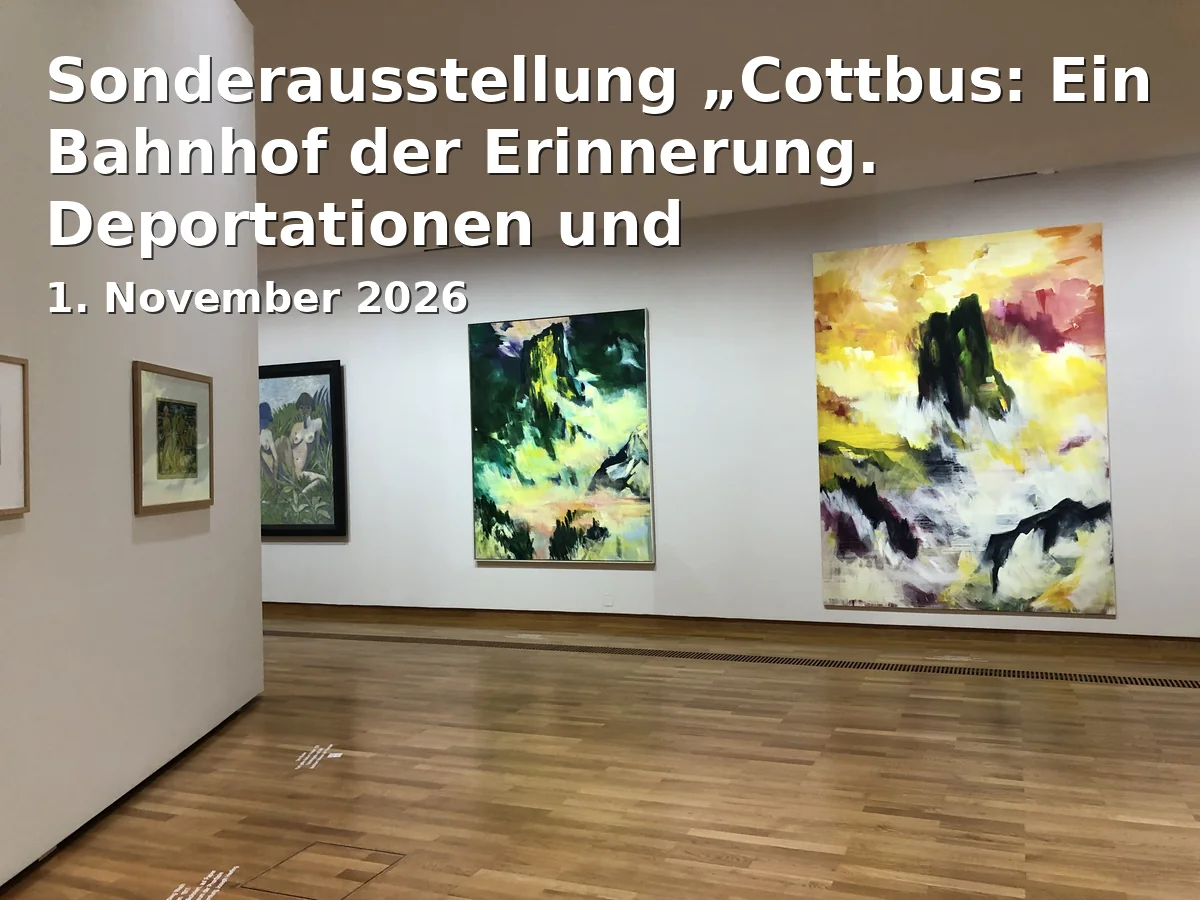
The special exhibition "Cottbus: A Train Station of Remembrance. Deportations and Forced Labor in National Socialism" highlights the role of the Cottbus train station during the Nazi era. The historical traffic hub is presented as a site of exclusion, deportation, prisoner transport, and forced labor.
Historical traces between tracks and memorial site
In 1938, Jewish individuals with Polish citizenship were expelled from Cottbus and the region to Poland. During World War II, deportation trains traveled over the Cottbus tracks to ghettos in occupied Poland and to Theresienstadt. Transport from cities in western and southern Germany, as well as from occupied Western European countries, also passed through the station.
The exhibition also focuses on prisoner transports to and from the women's penitentiary in Cottbus. At the same time, thousands of people came to the city as forced laborers, working in industrial companies, for the Reichsbahn, in municipal facilities, and on farms.
Documentary installation instead of decorative distance
At the center is a temporary presentation featuring a media installation reminiscent of historical departure boards. Names, deportation locations, and biographical traces bring the examination of works close to individual fates. The exhibition does not work with classical painting or sculpture but instead with documents, text, spatial impact, and media staging.
The reduced design creates a concentrated exhibition atmosphere. Light, forms, and the impression of a train station create an aesthetic experience that connects historical information and personal reflection. Anonymous transports become concrete life stories, numbers become human fates.
Culture of remembrance and political education
The project emerged as part of the program "MemoRails – Stop! Here the history of National Socialism is remembered" by the Foundation for Remembrance, Responsibility, and Future and is funded by the Federal Government Commissioner for Culture and Media. The project carrier is the Cottbus Human Rights Center e. V. in cooperation with exhibeo e. V., the Stolpersteine Cottbus Working Group, and the Cottbus Municipal Collections.
The curation connects historical research, memorial work, and cultural education. The exhibition not only remembers the victims but also questions the current threats to democracy, the rule of law, and human rights. Thus, a visit to the museum becomes an artistic experience with social responsibility.
Conclusion: Experiencing history in space
Visitors can expect an objectively precise, emotionally concentrated exhibition about deportations, prisoner transports, and forced labor in Cottbus. The combination of historical site, documentary installation, and personal memory opens new perspectives on city history and culture of remembrance. Those who wish to not only read history but experience it in its spatial impact should definitely visit this exhibition live.
Official channels of the Cottbus Human Rights Center e. V.:
- Instagram: no official profile found
- Facebook: no official profile found
- YouTube: no official profile found
- Website: https://www.menschenrechtszentrum-cottbus.de/