Cottbus: A Station of Remembrance – Experience NS History Urgently
Date and Time
Location
Price
About this Event
Mood
Venue Type
A station becomes an urgent place of remembrance
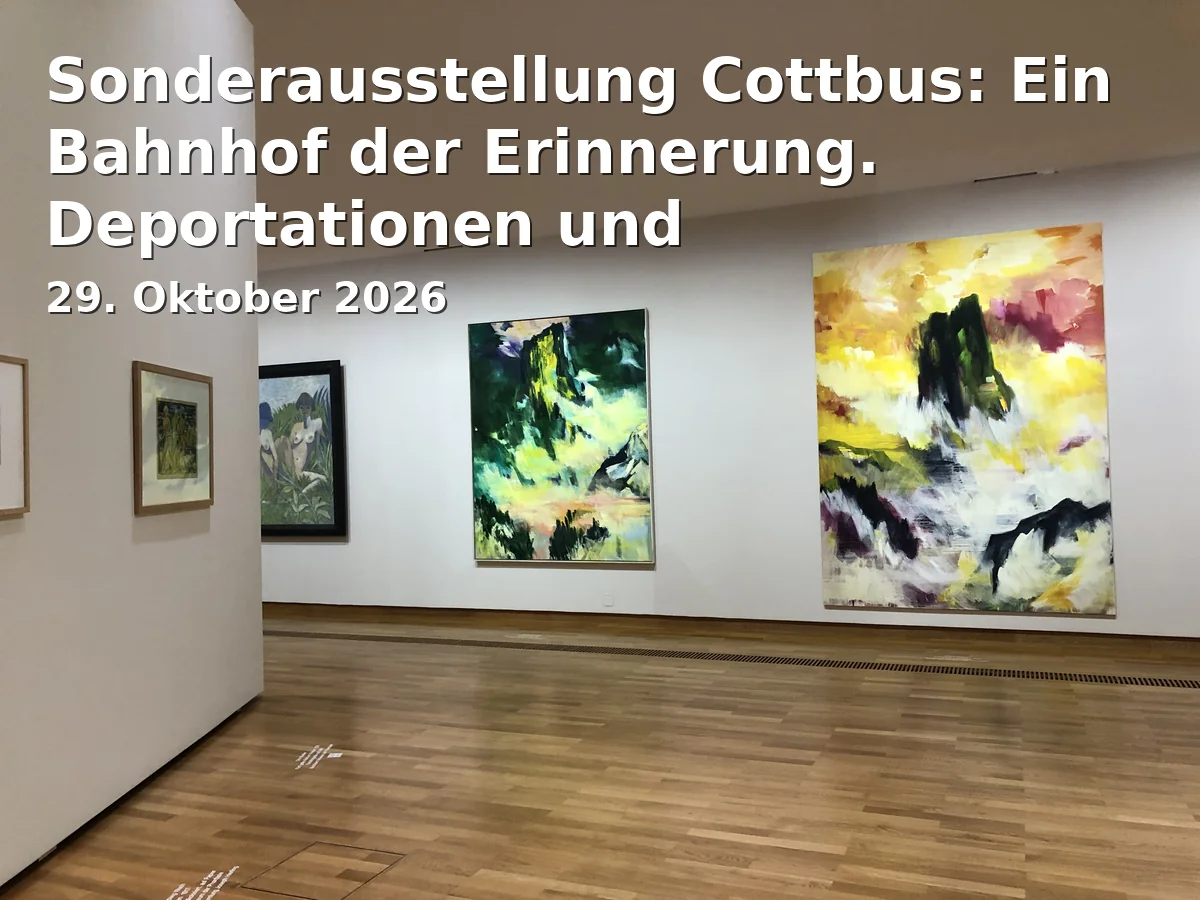
The special exhibition Cottbus: A Station of Remembrance. Deportations and Forced Labor during National Socialism makes visible how closely the Cottbus station was associated with exclusion, deportation, political incarceration, and forced labor during the Nazi era. At the Cottbus Human Rights Center, local city history, European persecution history, and cultural education intersect.
Transport Infrastructure as a Stage for State Violence
The Cottbus station was far more than a regular transportation hub during National Socialism. In 1938, Jewish people with Polish citizenship were expelled from Cottbus and the region to Poland. During World War II, deportation trains passed through Cottbus to ghettos in occupied Poland and to Theresienstadt. Transport from western and southern German cities, as well as from the occupied countries of Western Europe, also crossed the Cottbus tracks.
Four Narrative Threads of the Exhibition
The curation connects four intertwined thematic areas: the exclusion and disenfranchisement of the Jewish population, the station as a transit point for deportation trains, the women's penitentiary in Cottbus as a site of political incarceration, and the everyday life of forced labor in Cottbus businesses and institutions.
Historical documents, biographical references, and information about the German Reichsbahn focus the examination of the works on specific life paths. The exhibition shows how thousands of people were brought to industrial enterprises, the Reichsbahn, municipal facilities, and farms to be forced to perform labor.
Names, Routes, and Fates
A central element is a media installation that recalls historical departure boards. It names individuals, deportation sites, and transport routes, giving the victims an individual visibility. Writing, light, spatial effects, and historical information create a concentrated exhibition atmosphere. The aesthetic experience remains closely linked to historical responsibility.
Historical Education and Responsibility
The project was created under the program MemoRails – Stop! Here we remember NS history of the Foundation for Remembrance, Responsibility, and Future and is funded by the Federal Government Commissioner for Culture and Media. Participants include the Cottbus Human Rights Center e. V., exhibeo e. V., the Stolpersteine Working Group Cottbus, and the Municipal Collections Cottbus.
Students develop peer-to-peer tours, thereby creating a cross-generational access to historical research, museum education, and civic education. The exhibition commemorates the victims of National Socialist crimes while also questioning the significance of democracy, the rule of law, human rights, and social cohesion in the present.
Conclusion: Remembrance becomes directly experienced at the historical location
Visitors can expect a powerful artistic experience with historical depth: a precisely curated exhibition, a striking media installation, and a nuanced engagement with deportation, political incarceration, and forced labor. Those wishing to connect Cottbus city history, remembrance culture, and cultural education should visit this exhibition live and take the time for an intensive examination of the works and aesthetic experience.
Official Channels of Cottbus Human Rights Center e. V.:
- Website: https://www.menschenrechtszentrum-cottbus.de
- Instagram: no official profile found
- Facebook: no official profile found
- YouTube: no official profile found
Sources:
- City of Cottbus/Chóśebuz – Special Exhibition Cottbus: A Station of Remembrance
- Station of Remembrance – Project Information and Historical Themes
- Brandenburg State Center for Political Education – Cottbus: A Station of Remembrance
- Cottbus Human Rights Center – Information on the culture of remembrance at the station