
Hugo Harrer
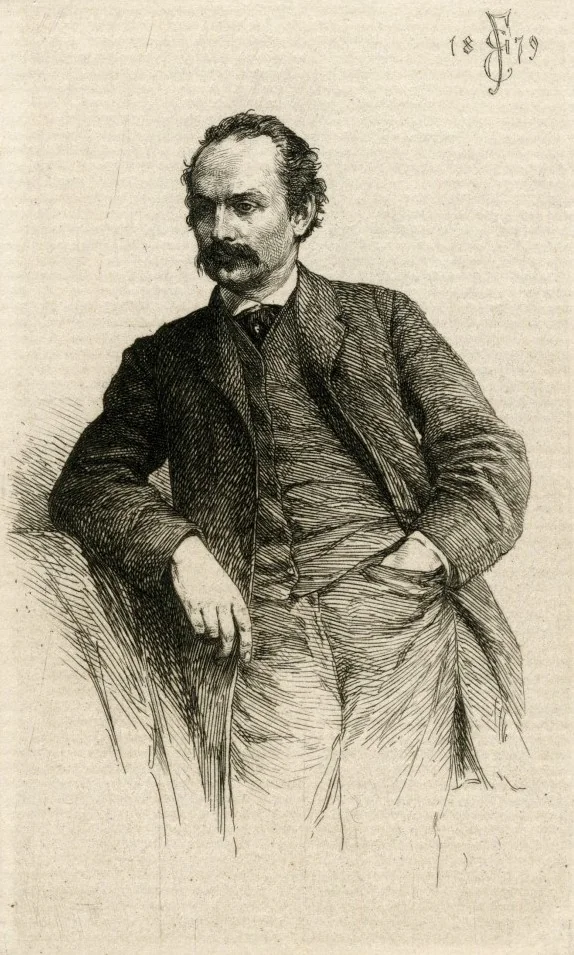
Image from Wikipedia
Image from Wikipedia
Hugo Harrer: Landscapes, Architecture, and the Quiet Realism of the Düsseldorf School
A Painter Between Nuremberg, Rome, and Düsseldorf
Hugo Paul Harrer was a German landscape and architecture painter of the Düsseldorf School, born in 1836 and died in 1876 in Rome. His artistic career represents that generation of 19th-century painters who arrived at their own visual language not through the classical academy path, but through observation, travel, and the study of nature. Harrer's work combines architectural painting, vedute, and landscape into a precise, atmospheric realism. ([de.wikipedia.org](https://de.wikipedia.org/wiki/Hugo_Harrer?utm_source=openai))
The sources already indicate how complex his biography is: While the Wikipedia biography cites Eberswalde as the birthplace, the Deutsche Biographie notes Hirschberg in Silesia as differing; the date of death is also given differently there. These discrepancies are part of the reception of many 19th-century artists and show that while Harrer's life is historically tangible, it has not been clearly documented in all details. ([de.wikipedia.org](https://de.wikipedia.org/wiki/Hugo_Harrer?utm_source=openai))
From Architecture Student to Self-Taught Painter
Harrer began a course in architecture but soon turned to painting. Crucial to this was not a long stay in a master class but a self-determined learning path: independent study, careful observation of nature, and visits to the studios of friends shaped his development. The Deutsche Biographie explicitly describes him as an artist who never worked permanently at an art academy or in a master's studio. ([deutsche-biographie.de](https://www.deutsche-biographie.de/sfz26126.html?utm_source=openai))
His first paintings were created in Nuremberg, where the architectural forms of the city inspired his early attempts at architectural painting. He then moved to Munich to orient himself towards the painting of Carl Theodor von Piloty before going to Rome in 1861 or 1862. There, he joined Ludwig Passini and increasingly worked from nature, which became important for his later precision in depicting street scenes, ruins, and coastal landscapes. ([de.wikipedia.org](https://de.wikipedia.org/wiki/Hugo_Harrer?utm_source=openai))
Düsseldorf, Malkasten, and the Influence of the School
In the years 1867/1868, Harrer stayed in Düsseldorf and studied in the landscape class of Oswald Achenbach at the art academy. Between 1868 and 1872, he was a member of the Düsseldorf Artists' Association Malkasten. This established him in one of the most significant artistic milieus of the 19th century in the German-speaking world, whose international outreach made the Düsseldorf School of painting well-known far beyond its hometown. ([de.wikipedia.org](https://de.wikipedia.org/wiki/Hugo_Harrer?utm_source=openai))
The Düsseldorf School was not a stylistically unified system but a widely branched network of landscape, genre, animal, and architectural painters. In this environment, Harrer could develop his inclination for precise vedute and atmospheric landscapes without committing to a single, rigid formula. This openness explains why his paintings possess both topographical accuracy and poetic effect. ([de.wikipedia.org](https://de.wikipedia.org/wiki/D%C3%BCsseldorfer_Malerschule?utm_source=openai))
Rome as Workshop: Studies, Sketches, and Italian Motifs
After his time in Düsseldorf, Harrer returned to Rome and worked there with a substantial collection of studies and sketches that served as a basis for oil paintings. With these works, he participated in German art exhibitions. His compositions frequently depict street scenes, ruins, and Italian coastal landscapes, motifs where architecture and nature engage in a dynamic dialogue. ([de.wikipedia.org](https://de.wikipedia.org/wiki/Hugo_Harrer?utm_source=openai))
The connection between Italian imagery and realistic observation is central to Harrer's profile. His paintings unite clear perspective, careful handling of light, and an almost architectural thought process in the composition. It becomes evident in these works that he emerged from architecture: space, construction, and guiding the viewer's gaze are not mere background but essential elements of his visual language. ([deutsche-biographie.de](https://www.deutsche-biographie.de/sfz26126.html?utm_source=openai))
Important Works and Art Historical Classification
Among the preserved works are Alte Hanse from 1868, View of the Coast of Amalfi at Sunset from 1871, At the Theatre of Marcellus in Rome from 1876, and Theatre of Marcellus in Rome from 1876. These titles indicate a consistent interest in historical architecture, urban spaces, and Italian atmosphere. Even a work like A Jewish Street Vendor in a Street in Siena reflects Harrer's eye for everyday scenes in urban space. ([de.wikipedia.org](https://de.wikipedia.org/wiki/Hugo_Harrer?utm_source=openai))
Art historically, Harrer can be described as a modern realist who captured things as accurately as possible. The Deutsche Biographie expressly emphasizes his orientation towards the exact reproduction of the visible. This is where his strength lies: not in dramatic pathos but in the credible condensing of light, space, and detail. ([deutsche-biographie.de](https://www.deutsche-biographie.de/sfz26126.html?utm_source=openai))
Style, Technique, and Artistic Development
Harrer's style is characterized by a calm, observational painting technique. His visual world thrives on the combination of drawing, perspective order, and atmospheric color. Architectural and landscape motifs particularly benefit from this precise hand: façades, ruins, streetscapes, and coastal parts appear not as mere backdrops but as spatially experienceable places with historical and emotional depth. ([de.wikipedia.org](https://de.wikipedia.org/wiki/Hugo_Harrer?utm_source=openai))
His artistic development follows no spectacular turn but rather a consistent deepening. From his early interest in Nuremberg architecture through the Munich stimuli, Roman practice, and Düsseldorf training to further work in Rome, a cohesive profile emerges. This is typical for painters whose work arises more from precise practice than from programmatic manifestos. ([de.wikipedia.org](https://de.wikipedia.org/wiki/Hugo_Harrer?utm_source=openai))
Later Years, Death, and Influence
Harrer died in 1876 in Rome and was buried in the Protestant Cemetery in Rome. Thus ends a biography that remains closely connected to Italy, even though it began in Germany and received important formal shaping in Düsseldorf. His career serves as an example of the transnational mobility of 19th-century artists who traveled between German art centers and Rome. ([de.wikipedia.org](https://de.wikipedia.org/wiki/Hugo_Harrer?utm_source=openai))
His current profile remains particularly interesting for the art history of the Düsseldorf School. Although he is not among the most popular names of the century, his works provide an important example of the connection between architectural painting and realistic landscape representation. Harrer thus embodies those quiet yet substantial positions that often make an era visible only in detail. ([de.wikipedia.org](https://de.wikipedia.org/wiki/D%C3%BCsseldorfer_Malerschule?utm_source=openai))
Current Projects and Publications
As Hugo Harrer lived in the 19th century, there are no current projects, albums, singles, or tours in the contemporary sense. The available information is limited to historical sources, art historical classifications, and catalogs of works. For a serious artist's page, this classification is particularly important because it emphasizes the historical context rather than an artificial updating. ([de.wikipedia.org](https://de.wikipedia.org/wiki/Hugo_Harrer?utm_source=openai))
Discography, Hits, and Musical Reception
There is no discography, hit singles, or chart successes for Hugo Harrer, as he was not a musician but a painter. Relevant sources instead document works of painting and their art historical classification. Therefore, the examination of his works replaces any form of musical reception and places visual art at the center. ([de.wikipedia.org](https://de.wikipedia.org/wiki/Hugo_Harrer?utm_source=openai))
Conclusion: An Artist of Quiet Precision
Hugo Harrer fascinates with his calm consistency, realistic gaze, and ability to translate architecture, landscape, and atmosphere into concise images. His career illustrates how strongly self-study, observation of nature, and international movement could shape an artistic profile. Anyone wanting to understand the Düsseldorf School cannot overlook Harrer. ([de.wikipedia.org](https://de.wikipedia.org/wiki/Hugo_Harrer?utm_source=openai))
In an art world that often seeks the monumental, Harrer convinces with accuracy, tranquility, and discipline in his imaging. His works invite viewers to see details anew and consider historical spaces with contemporary attention. A live experience in a museum or collection is worthwhile because only there does the subtle strength of his painting truly become visible. ([de.wikipedia.org](https://de.wikipedia.org/wiki/Hugo_Harrer?utm_source=openai))
Official Channels of Hugo Harrer:
- Instagram: no official profile found
- Facebook: no official profile found
- YouTube: no official profile found
- Spotify: no official profile found
- TikTok: no official profile found