
Hugo Harrer
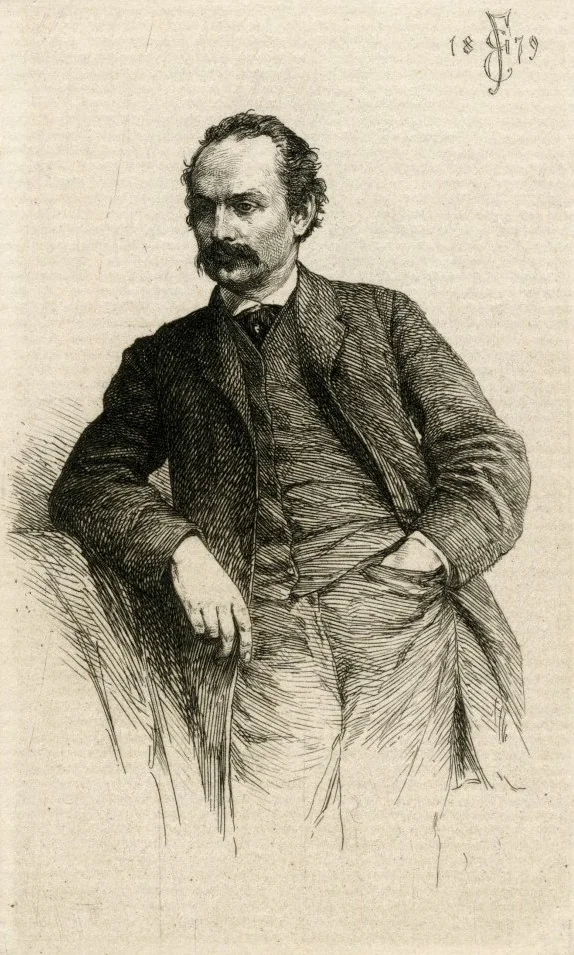
Image from Wikipedia
Image from Wikipedia
Hugo Harrer: The Quiet Realist of the Düsseldorf School Between Landscape and Architecture
An Artist Between Nature Observation, Architectural Art, and Precise Visual Language
Hugo Paul Harrer (* February 6, 1836 in Eberswalde; † December 10, 1876 in Rome) is one of those German painters of the 19th century whose work is convincing not through loud self-promotion, but through craftsmanship and accurate perception. As a landscape and architectural painter of the Düsseldorf School, he combined nature study with architectural clarity and developed a visual language marked by factual precision and a realistic perspective. His artistic development exemplifies a generation that asserted itself between academic tradition, private study, and independent observation.
Biographical Beginnings: From Planned Architect to Self-Taught Painter
According to available records, Harrer initially began training as an architect but soon turned away from this path and decided to pursue painting. The crucial factor was not the classical academy, but independent learning: he worked as a self-taught artist, studied privately in the studios of friends, and sharpened his view through careful observation of nature. This biographical constellation shaped his entire oeuvre, as it combined discipline with an unusually direct perception of the visible world.
Sources about his life also contain differing information regarding his place of birth and date of death. Some biographical literature cites Hirschberg in Silesia as his birthplace, and discrepancies also arise concerning the date of death. However, it is certain that Harrer died in Rome in 1876 and was buried in the Protestant Cemetery in Rome. Thus ends a life path that spatially navigated between Prussia, the German art scene, and the Italian capital as a place of artistic presence.
Düsseldorf School: Between Realistic Precision and Compositional Order
Hugo Harrer is associated with the Düsseldorf School, an environment renowned in the 19th century for its careful drawing, clear composition, and narrative image organization. In this context, Harrer established himself as a painter who sought to "depict objects and scenes exactly as he saw them." His attitude, according to biographical tradition, was that of a thoroughly modern realist who did not idealize visible reality but captured it with observational fidelity.
Especially in landscape and architectural painting, this attitude proves particularly effective. Landscape demands sensitivity to light, space, and mood; architecture demands discipline, perspective, and structural thinking. Harrer combined both demands into a painting that unfolds both atmospheric effect and constructive order. This is the true strength of his artistic profile: he translated perception into image structure.
Artistic Development: Autonomy Instead of Academic Routine
The fact that Harrer did not attend an art academy and did not work permanently in a master's studio makes his career particularly interesting for art history. His education did not follow the closed logic of a school but rather occurred in an open learning process, where observation, exchange, and self-correction were the decisive tools. This independence gave his work a unique consistency and explains why his painting can be described as sober, controlled, and at the same time vibrant.
The path through private study and close orientation to nature also meant a conscious distance from stylistic exaggerations. Instead of dramatic effects, Harrer prioritized accuracy. This made him a painter whose work lies in the quiet authority of execution. For art lovers, this attitude is particularly appealing: it reveals how strongly a precise gaze and consistent effort can shape an individual oeuvre.
Character of the Work and Visual Language: Landscape, Architecture, and the Art of Accurate Seeing
As a landscape and architectural painter, Harrer operated in a tension between natural surroundings and built space. Landscapes offered him the chance to capture atmosphere and expanse, while architectural motifs made his preference for structure and order visible. The combination of both image worlds points to an artistic personality that did not romantically idealize the visible but precisely organized it.
The tradition emphasizes his realism and accurate perception. From this, it can be inferred that composition and drawing played a central role in his work. Such a painting style requires not only technique but also concentration and intellectual clarity. Harrer thereby aligns with that art historical line in which the observation of reality becomes the actual benchmark of artistic quality.
Rome as a Place of Life and the European Dimension of His Work
Harrer's death in Rome points to the international mobility of many German artists in the 19th century. The city was a place of exchange, inspiration, and engagement with the art tradition of Europe for numerous painters. Although only a few details about Harrer's years in Rome are preserved, the place of death marks a biographical signature: his life path ended in one of the most significant art metropolises of the time.
This European perspective broadens the view of his career. Harrer was not merely a regional painter but part of a larger network of artists who operated between the German art scene, travel, and foreign experiences. Especially in the 19th century, this movement was important as it expanded the horizons of motifs, techniques, and image ideas. Harrer's career thus also stands for the internationality of the artist biographies of that era.
Cultural Influence and Art Historical Classification
Harrer's cultural influence lies less in great public fame than in the typical quality of his artistic type. He embodies the meticulous, realistically working painter who, within the Düsseldorf School, focused on accuracy, fidelity to nature, and solid composition. Such artists form the backbone of the art history of the 19th century, even if they do not count among the most popular names today. Their contribution lies in refining the gaze at reality.
This restraint is particularly interesting for contemporary reception. Harrer's work appeals to art enthusiasts who value the importance of observation, discipline, and formal order. His painting does not speak of pathos but of attitude. This is where its lasting allure lies: it demonstrates how an artist could take a clear position in the art landscape of the 19th century without academic glamour and without loud self-narration.
Classification for Art Lovers and Seekers of the Special
Those who are interested in Hugo Harrer discover an artist with a precise signature and remarkable independence. His biography offers the rare combination of architectural thinking, self-taught education, and realistic painting. It is precisely this mixture that makes him an exciting figure in German art history, as it shows how diverse artistic development can occur beyond institutional pathways.
Harrer's work invites viewers to take a slower look and to regard the quality of seeing itself as an artistic achievement. His images represent concentration, precision, and respect for the subject. Those who engage with this quiet yet powerful art encounter a painter whose significance lies precisely in the unobtrusive consistency of his work.
Conclusion: A Quiet Master of Observation with Lasting Impact
Hugo Harrer captivates not through spectacular breaks but through the consistency of his artistic attitude. As a landscape and architectural painter of the Düsseldorf School, he developed a realistic visual language that thrives on discipline, nature observation, and compositional clarity. His career demonstrates how strong independence and careful work can produce an unmistakable artistic profile.
Those who delve into Harrer's work meet a painter who captured reality with a clear gaze and steady hand. Precisely for this reason, he remains compelling: because his art does not need to be loud to be convincing. An encounter with his work is worthwhile for all who appreciate depth, precision, and historical substance in art.
Official Channels of Hugo Harrer:
- Instagram: No official profile found
- Facebook: No official profile found
- YouTube: No official profile found
- Spotify: No official profile found
- TikTok: No official profile found