
Hugo Harrer
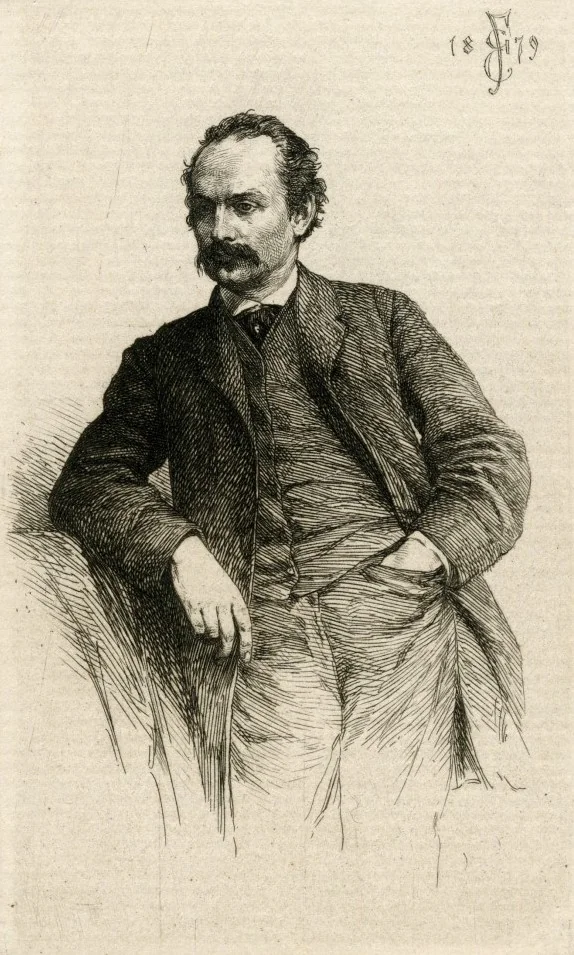
Image from Wikipedia
Image from Wikipedia
Hugo Harrer – Landscapes, Architecture, and the Perspective of Düsseldorf Realism
A distinctive painter between nature observation, urban imagery, and Italian atmosphere
Hugo Paul Harrer was a German landscape and architectural painter of the Düsseldorf School, whose work stemmed from precise nature observation, drawing discipline, and a pronounced sense for spatial effects. Born on February 6, 1836, in Eberswalde and died on December 10, 1876, in Rome, he belongs to that generation of 19th-century artists who navigated between academic tradition, realistic perception, and fascination with southern lighting conditions. His biography reveals an artist who did not bind himself to a classical academic career but instead found his way through persistent self-study and practice.
It is precisely this combination of self-taught skill and stylistic precision that makes Harrer intriguing. He began training in architecture but soon turned to painting, developing into a skilled representative of the landscape and architectural painting that, in the 19th century, unfolded its unique appeal between documentary accuracy and atmospheric intensity. In his works, urban views, ruin motifs, and Italian coastal landscapes combine to create a visual world that is now regarded as a characteristic expression of the Düsseldorf School.
Early Years and Artistic Influence
Regarding Harrer's early education, it can be said with certainty that he was initially intended for architecture. However, his interest quickly shifted from the constructive order of building to the free observation of landscape, city, and light. According to available biographical information, he developed his artistic quality through self-study, careful studies of nature, and exchange in the studios of friends. This form of development points to an artist who did not see himself as a mere imitator but as an exact observer of his surroundings.
The biography of Rudolf Bergau in the Allgemeine Deutschen Biographie also mentions differing information regarding Harrer's place of birth and date of death, noting him as being born in Hirschberg in Silesia, while other sources cite Eberswalde. Such discrepancies are common in many 19th-century artist biographies and demonstrate how incomplete archival records can be in individual cases. For understanding his work, it remains crucial that Harrer early on liberated himself from architecture to pursue painting, thus following a personal artistic impulse.
The Path to Painting and the Düsseldorf School
Hugo Harrer worked as a painter of the Düsseldorf School in an environment known for careful drawing, narrative image logic, and precise composition. The Düsseldorf painting of the 19th century emphasized controlled composition and illustrative representation of reality. It is in this tradition that Harrer is located, yet with an individual touch: His images not only depict places but also convey the characteristic atmosphere of those places.
The Deutsche Biographie describes him as "an essentially modern realist" who sought to depict things as he saw them. This sentence is central to Harrer's artistic profile. Realism here does not mean dry objectivity, but a serious commitment to the visible. His painting engages with observation, accuracy, and light management without losing the poetic substance of the motifs. This is precisely where the charm of his landscape and architectural views lies.
Nuremberg, Rome, and the Discovery of Themes
His first paintings were created in Nuremberg, where the architecture inspired him to early attempts in architectural painting. This choice of motif was no coincidence, but an expression of a perspective that understood building forms as aesthetic and historical carriers of atmosphere. Facades, alleys, and architectural structures became artistic opportunities for Harrer, not merely factual templates. From architecture, he developed a sensitive understanding of perspective, spatial layering, and the effect of lines in the image.
Later, he moved back to Rome. There, he created a vast collection of studies and sketches that served as templates for oil paintings. With this work, he contributed to German art exhibitions, particularly showcasing street scenes, ruins, and Italian coastal landscapes. His stay in Rome linked the city's classical heritage with the immediate experience of light and atmosphere. During this phase, Harrer's style condensed into a connection between topographic accuracy and painterly ambiance.
Imagery: Ruins, Street Scenes, and Italian Coasts
Harrer's preferred motifs reveal much about his artistic horizons. Ruins in his works appear not merely as signs of decay, but as historically charged forms that embody past, present, and memory. Street scenes, on the other hand, open a view on life in urban spaces, revealing both closeness and expansiveness, order and movement. It is in such motifs that the proximity between architectural painting and cultural observation becomes evident.
Italian coastal landscapes expand this spectrum with an element of light and open space. Here, the landscape does not function merely as a decorative background, but stands as a self-contained theme with atmospheric presence. The combination of southern brightness, built forms, and precise nature observation makes Harrer's work appealing to art historians. He operates in that tension field where landscape painting transforms into a form of world description.
Reception, Classification, and Art Historical Significance
During his lifetime, Harrer was perceived primarily as a meticulous and technically skilled painter. The Deutsche Biographie emphasizes his independence from the Academy and his path through self-study. This endows his career with a special significance, as it demonstrates how an independent artistic position could develop outside of major educational institutions during the 19th century. His attitude was not rebellious but focused and observant.
From an art historical perspective, Harrer is interesting less as a spectacular innovator than as a precise representative of a realistic image conception that was significantly shaped by the Düsseldorf School in Germany. His works stand for a type of painter who connects composition, drawing, and nature study. This is where his value lies: He preserves a form of image culture in which atmosphere, locality, and craftsmanship converge.
Why Hugo Harrer is Still Fascinating Today
Hugo Harrer captivates because his painting sharpens the gaze. Those who look at his biography discover not a loud star of art history, but a serious, attentive, and independently working artist. His journey from architecture to painting, his self-study, and his focus on landscape and architectural views make him a remarkable figure in 19th-century German art. It is precisely this mix of discipline, observation, and atmospheric sensibility that gives his work lasting relevance.
Harrer represents a form of painting that not only depicts places but interprets them. His images provide insight into 19th-century Europe between city, ruin, and coast. Anyone interested in the Düsseldorf School, realism, and the poetic dimension of historical landscape painting will find in Hugo Harrer an artist with a distinct profile. His works deserve to be revisited in museums, catalogues, and art historical research.
Conclusion
Hugo Harrer is an exciting artist because he consistently made art out of observation. He combines the precision of architecture with the sensitivity of landscape imagery, creating a visual language that is both factual and atmospheric. Anyone interested in the Düsseldorf School and the development of German realism should perceive Harrer as an independent voice. His images invite close examination and offer a new exploration of the quiet power of historical places.
Official Channels for Hugo Harrer:
- Instagram: no official profile found
- Facebook: no official profile found
- YouTube: no official profile found
- Spotify: no official profile found
- TikTok: no official profile found