
Hugo Harrer
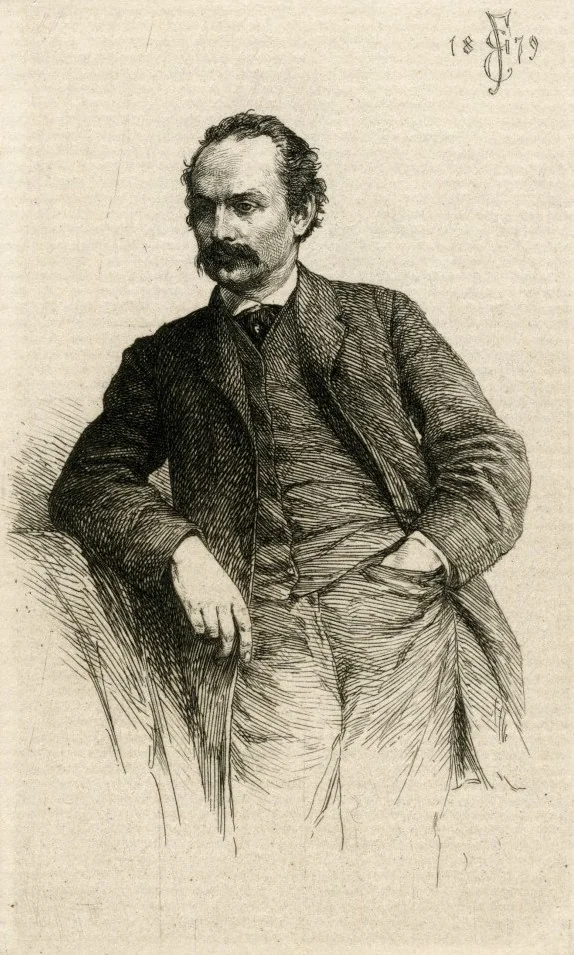
Image from Wikipedia
Image from Wikipedia
Hugo Harrer – the quiet master of architecture and landscape painting in the spirit of the Düsseldorfer Schule
An artist between Romanticism, Realism, and a love for built space
Hugo Paul Harrer is among those 19th-century painters whose work reveals itself not through loud self-promotion, but through observation, precision, and atmospheric density. Born on February 6, 1836, and deceased in Rome in 1876, the German landscape and architectural painter of the Düsseldorfer Schule developed an artistic signature that formed its own poetics of image from nature studies, cityscapes, and the charm of historical ruins. His biography shows an idiosyncratic, self-taught path that took him from Eberswalde to Nuremberg, Munich, Rome, and Düsseldorf, placing him in close contact with the European painting of his time. ([de.wikipedia.org](https://de.wikipedia.org/wiki/Hugo_Harrer))
Biography: From aspiring architect to painter of atmospheric details
Harrer initially began training as an architect but then turned to painting as a self-taught artist. According to the German Biography, he worked without a permanent academy attendance and without a fixed master studio, relying instead on his own study, careful observation of nature, and exchanges with friends in their studios. This independence significantly shaped his artistic development: from architecture, he did not emerge as a planner, but as a painter who captured building forms, perspectives, and urban spaces with particular sensitivity. ([deutsche-biographie.de](https://www.deutsche-biographie.de/sfz26126.html))
His first paintings were created in Nuremberg, where the picturesque architecture inspired him to early attempts at architectural painting. He then moved to Munich to be inspired by the realistic painting style of Carl Theodor von Piloty, which was seen as modern and pioneering at the time. In 1861 or 1862, Harrer went to Rome due to a chest ailment; there, he quickly connected with Ludwig Passini and worked intensively from nature. These stages show an artist who did not cling to a single school, but shaped himself from various centers of art life. ([deutsche-biographie.de](https://www.deutsche-biographie.de/sfz26126.html))
The Düsseldorf years and the influence of the landscape class
In 1867/1868, Harrer stayed in Düsseldorf and studied at the Academy of Fine Arts in Oswald Achenbach's landscape class. This brought him into immediate proximity to the Düsseldorfer Malerschule, whose international influence in the 19th century was largely based on a combination of academic discipline, sensitivity to landscapes, and narrative composition. Harrer also benefited from this environment: it sharpened his understanding of composition, lighting, and the dramatic structure of spaces. ([de.wikipedia.org](https://de.wikipedia.org/wiki/Hugo_Harrer))
From 1868 to 1872, he was a member of the Düsseldorf artist association Malkasten, an important networking hub for the Rhineland art scene. His return to Rome after this two-year stay in Düsseldorf marked not a break, but the continuation of a working model based on travel, studies, and enduring impressions. From Rome, Harrer continued to collect material, creating extensive collections of sketches and submitted oil paintings to German art exhibitions that were characterized by precision and mood alike. ([de.wikipedia.org](https://de.wikipedia.org/wiki/Hugo_Harrer))
Career trajectory: Cityscapes, ruins, and Italian coastal landscapes
Harrer’s artistic profile was primarily formed around motifs that intertwine architecture and landscape. The German Biography describes him as an artist who mostly painted architectural images with figures, but also small genre scenes, particularly favoring picturesque corners of decaying ruins in Rome. These themes fit a realism that does not merely depict correctly but reveals the poetic tension of a place. Harrer's painting does not seek the monumental for its own sake, but rather the quiet effect of wall, light, shadow, and human traces. ([deutsche-biographie.de](https://www.deutsche-biographie.de/sfz26126.html))
The Wikipedia account also emphasizes that he contributed to German art exhibitions with depictions of street scenes, ruins, and Italian coastal landscapes. His works thus move between vedute-like precision and atmospheric condensation. The artist died in 1876 in Rome and was buried in the Protestant cemetery in Rome. This concludes a career that remained closely connected to Italy while also being firmly embedded in the German art public. ([de.wikipedia.org](https://de.wikipedia.org/wiki/Hugo_Harrer))
Discography in a broader sense: Works, groups of works, and central motifs
Hugo Harrer does not have a classical discography, but his surviving works allow for a concise artistic classification. Among the mentioned works are Alte Hanse from 1868, View of the Amalfi Coast at Sunset from 1871, as well as At the Theatre of Marcellus in Rome and Theatre of Marcellus in Rome, both from 1876. These titles point to the core interests of his oeuvre: historical architecture, Mediterranean light moods, and places where history remains visible. ([de.wikipedia.org](https://de.wikipedia.org/wiki/Hugo_Harrer))
Additionally, the Wikipedia entry mentions a motif of a Jewish street vendor on a street in Siena. Such subjects show that Harrer not only perceived the grand ruin but also the incidental scene in urban space. In the art of his late work, observation and milieu description, architecture and figure, topographical precision and narrative moments come together. This mixture makes his work interesting for art historical consideration. ([de.wikipedia.org](https://de.wikipedia.org/wiki/Hugo_Harrer))
Style and artistic development: Modern realism with a sense of atmosphere
Rudolf Bergau explicitly describes Harrer as “a thoroughly modern realist” who sought to depict things as he saw them. This characterization is central because it precisely captures Harrer's position in the 19th century: he does not stand for pathetic elevation, but for perceptual fidelity, for the accurate capture of appearance, material, and light. At the same time, he placed great importance on the nature of the painterly representation, that is, on execution, surface, and atmosphere. ([deutsche-biographie.de](https://www.deutsche-biographie.de/sfz26126.html))
His architectural painting thrives on spatial depth, layering, and the conscious use of ruins, facades, and street layouts as bearers of mood. Here, a fine sensibility for the dialogical relationship between built form and natural space is evident. Harrer’s paintings belong to that line of the Düsseldorfer Schule that does not merely document the visible but translates it into a poetic, yet controlled pictorial order. This endows his works with a quiet authority that endures to this day. ([deutsche-biographie.de](https://www.deutsche-biographie.de/sfz26126.html))
Cultural influence and art historical classification
Harrer's significance lies less in spectacular market successes than in the consistent elaboration of a subject that was highly relevant in the 19th century: city, architecture, ruin, and landscape as a mirror of historical experience. In this way, he is closely connected to the Düsseldorfer Malerschule, whose international reach extended far beyond the Rhine through teaching, networks, and exhibitions. Harrer is an example of how strongly this school also influenced artists who moved between Italy and Germany. ([de.wikipedia.org](https://de.wikipedia.org/wiki/D%C3%BCsseldorfer_Malerschule?utm_source=openai))
His works have also remained relevant for collections and art historical documentation. Wikipedia notes the presence of individual works in the Gera Art Collection and the National Gallery in Berlin, underscoring the museum compatibility of his oeuvre. Furthermore, his entry in the Deutsche Biographie and the mention in the list of painters of the Düsseldorfer Malerschule confirm that Harrer is firmly anchored as part of this art historical context. ([de.wikipedia.org](https://de.wikipedia.org/wiki/Hugo_Harrer))
Conclusion: An artist for explorers of quiet seeing
Hugo Harrer fascinates through the connection of self-study, wanderlust, realistic precision, and a deep love for the pictorial space. Those who view his art discover not a loud style, but a concentrated painting that maintains balance between architecture, light, and mood. This is precisely where his strength lies: Harrer transforms cities, ruins, and coastal landscapes into not merely views but sensitive pictorial spaces with historical depth. Anyone wanting to understand the Düsseldorfer Schule and 19th-century art should not overlook Hugo Harrer. ([deutsche-biographie.de](https://www.deutsche-biographie.de/sfz26126.html))
A visit to his works is worthwhile for anyone who appreciates painterly precision and atmospheric density. Harrer invites viewers to look more closely, to read architecture as an experience, and to discover the quiet drama of the place. It is this delicate interplay of realism and poetic observation that makes him compelling even today. ([deutsche-biographie.de](https://www.deutsche-biographie.de/sfz26126.html))
Official channels of Hugo Harrer:
- Instagram: no official profile found
- Facebook: no official profile found
- YouTube: no official profile found
- Spotify: no official profile found
- TikTok: no official profile found