
Hugo Harrer
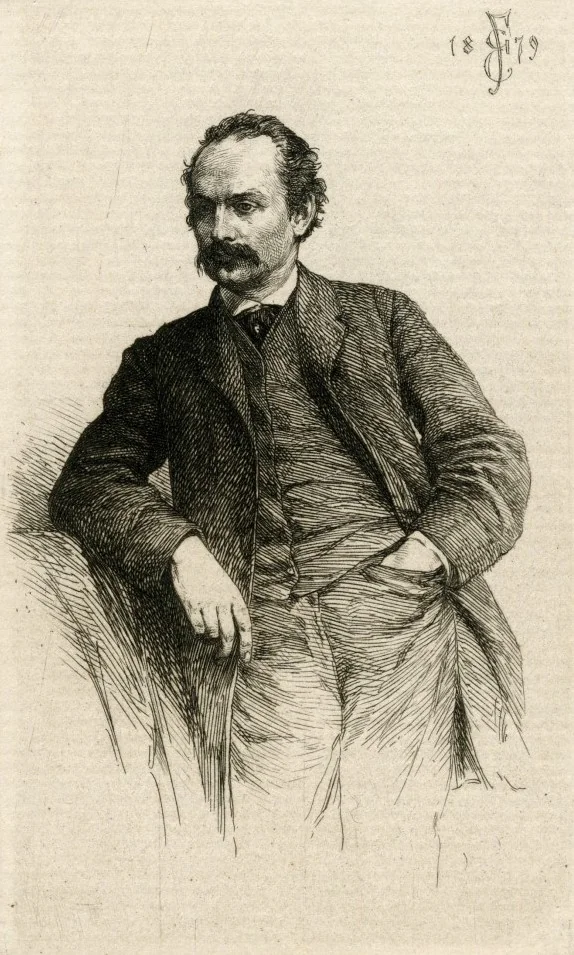
Image from Wikipedia
Image from Wikipedia
Hugo Harrer: The Quiet Realist of the Düsseldorf School Between Architecture and Landscape
An Artist's Life Marked by Nature Observation, Precision, and Quiet Painterly Power
Hugo Paul Harrer, born on February 6, 1836, and died on December 10, 1876, in Rome, is among those German painters of the 19th century whose work is characterized more by craftsmanship and observant accuracy than by loud self-presentation. The landscape and architectural painter of the Düsseldorf School began his journey into painting after training as an architect and developed, according to preserved biographies, into an artist who captured his motifs with sober attention and a confident eye for space, light, and structure. (de.wikipedia.org)
This connection between architectural thinking and painterly sensitivity makes Harrer remarkable even today. His biography reveals an artist who found a unique style without formal academic education or a permanent master workshop, focusing on precise nature observation, studies, sketches, and the elaboration of oil paintings. From an art historical perspective, Harrer represents a form of realistic seeing that expands the Düsseldorf School by an objective, location-bound dimension. (deutsche-biographie.de)
Biography: From Architect to Self-Taught Painter
The sources agree remarkably on the fundamental outlines of his career: Harrer was initially to become an architect but soon turned to painting. According to Deutsche Biographie, he acquired his skills primarily through self-study, complemented by meticulous nature observation and visits to the studios of friends. This self-taught path adds a special tension to his artist biography, as he emerged not from academic routine but from direct engagement with motive, material, and perception. (deutsche-biographie.de)
There is also some inconsistency in the historical sources regarding his origin; Wikipedia points to Eberswalde, while older biographical references mention his birthplace as Hirschberg in Silesia. What is certain is that Harrer died in Rome in 1876 and was buried in the Protestant cemetery there. The connection to Rome is more than a footnote: it points to an artistic milieu where many German-speaking painters of the 19th century developed studies of Italian antiquity, ruins, street scenes, and coastal views. (de.wikipedia.org)
Artistic Development: Architectural Painting, Landscape, and the School of Accurate Observation
Harrer’s work is described as a combination of landscape and architectural painting, a form of art where spaces are not merely depicted but constructively captured. The conventional characterization as a “modern realist” emphasizes that it was essential for him to reproduce the visible world as accurately as possible. This is where the strength of his painting lies: in the control of perspective, in sensitivity to structures, in the tranquility of arrangement, and in the observation of atmosphere, without dissolving the motif into pathos. (deutsche-biographie.de)
Wikipedia notes that after his stay in Rome, Harrer created a stock of studies and sketches from which he developed oil paintings that were exhibited at German art exhibitions. Among them, street scenes, ruins, and Italian coastal landscapes are particularly mentioned. This choice of motif fits an artist who sought the transition between topographical accuracy and poetic atmospheric landscape, thereby steering the visual language of the Düsseldorf School towards a quieter, more objective direction. (de.wikipedia.org)
Work and Reception: Between Exhibition Culture and Art Historical Marginality
Hugo Harrer did not leave behind a widely documented canon of famous masterpieces, but this is precisely what makes his art historical classification interesting. His presence at art exhibitions and mentions in biographical reference works indicate that he was considered a serious painter in the 19th century. However, today he belongs to those names that are presented more through archival traces, auction references, and art historical registers than through a popular memory of works. (de.wikipedia.org)
Deutsche Biographie supports this classification with a succinct but revealing judgment: Harrer was a capable painter who, without formal academic training, educated himself through personal study and meticulous nature observation. This is important for the art historical assessment, as it portrays Harrer not merely as a peripheral figure but as a representative of a serious, observant realism that navigated between academic tradition and individual autonomy in the 19th century. (deutsche-biographie.de)
Style, Technique, and Cultural Context of the Düsseldorf School
The Düsseldorf School represents a form of painting in the 19th century that values narrative clarity, careful composition, and precise execution. Harrer contributes an distinctly architectural perspective to this environment: building forms, street spaces, and ruins are not merely used decoratively but treated as structural components of the artwork. This connection between spatial discipline and nature observation allows his works to appear as quiet, thoughtfully composed image spaces. (de.wikipedia.org)
From a cultural historical perspective, Harrer belongs to that generation of artists who operate in the tension field between Romanticism and Realism. His motifs in Italy and along the coast indicate the period's typical desire for a southern atmosphere, yet the sources specifically highlight not dramatic exaggeration but the accuracy of observation. Thus, Harrer’s painting serves as a precise counterpoint to the spectacular gesture: quiet, observant, and technically disciplined. (de.wikipedia.org)
Current Projects, Publications, and Discography: Historically Non-Existent
Naturally, there are no current music projects, new albums, singles, or tours for Hugo Harrer. There is also no discography in the strict sense, since he was not a musician but a painter. The meaningful equivalent here would be a catalog of works, yet the available sources mainly reference exhibition activities, motif groups, and biographical stations. (de.wikipedia.org)
No official social media channels were found either. For a 19th-century artist, this is expected, and no verifiable Instagram, Facebook, YouTube, Spotify, or TikTok profiles clearly attributable to Hugo Harrer appeared in the search results. Therefore, there is also no section for fan voices. (deutsche-biographie.de)
Why Hugo Harrer Remains Interesting Today
Hugo Harrer is intriguing because his biography illustrates the path of an artist who developed a clear, realistic handwriting beyond academic conventions. He combines architectural thinking with painterly observation, experience in Rome with German exhibition culture, and personal autonomy with the pictorial tradition of the Düsseldorf School. This blend of discipline, restraint, and precise perception makes his art historically valuable. (deutsche-biographie.de)
Anyone interested in 19th-century German painting should discover Harrer as an elegant representative of quiet realism. His paintings do not invite quick impressions but rather careful observation, reading of space, light, and structure. This is where the enduring quality of an artist lies, whose work still serves as an invitation for concentrated viewing. (deutsche-biographie.de)
Official Channels of Hugo Harrer:
- Instagram: No official profile found
- Facebook: No official profile found
- YouTube: No official profile found
- Spotify: No official profile found
- TikTok: No official profile found