
Hugo Harrer
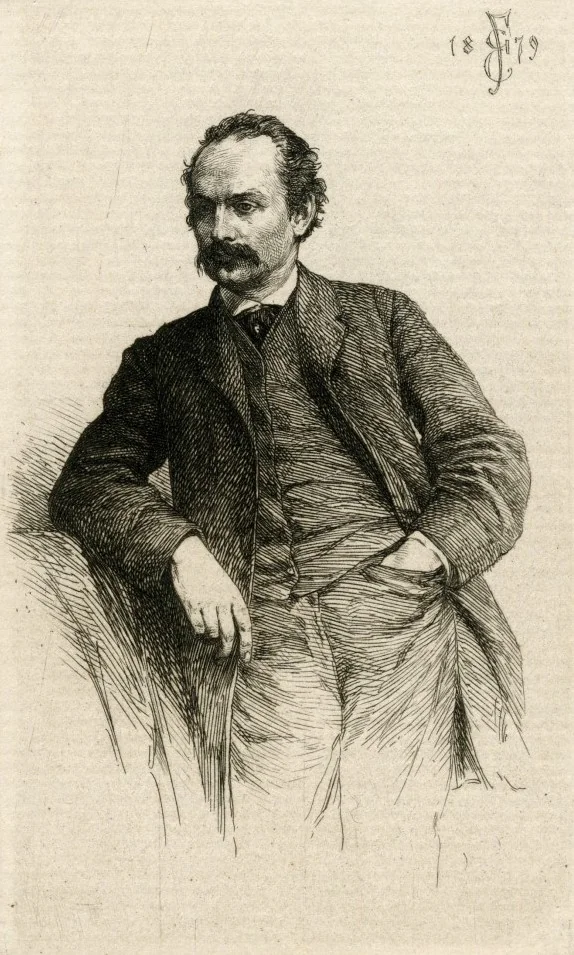
Image from Wikipedia
Image from Wikipedia
Hugo Harrer – Landscapes, Architecture, and the Perspective of the Modern Realist
A Painter Between Nuremberg, Munich, Düsseldorf, and Rome
Hugo Paul Harrer is one of those artists of the Düsseldorf School whose work captures the spirit of the 19th century with remarkable clarity. Born on February 6, 1836, and died in 1876 in Rome, he evolved from an aspiring architect to an independent painter, particularly known for his landscapes, architectural views, and Italian city motifs. His biography not only tells of a change of location but also of a consistent turn towards painting as a way of life and an artistic pathway to knowledge.
Harrer was not an academic in the classical sense but a self-taught artist with a keen eye for observation. It was this independence that shaped his artistic signature: precise, sober, committed to visible reality, yet sensitive to atmosphere, structure, and light. In the painting of the 19th century, his name stands for a modern realism that derives from careful observation of nature and extensive study practice.
From Architecture Student to Independent Artist
Hugo Harrer began an architecture education but turned to painting early on. He neither attended an art academy nor worked permanently in a master’s studio; instead, he shaped himself through self-study, careful observation of nature, and exchanges with fellow artists. This path made him an independent voice within the Düsseldorf School, whose influence in his work remains palpable but never devolves into mere imitation.
His first paintings were created in Nuremberg, where the picturesque architecture of the city particularly inspired him. Here, a central aspect of his work becomes evident: Harrer sought not the monumental for its own sake, but the pictorial space where architecture, everyday life, and mood come together. The early proximity to architectural motifs prepared the thematic axis that would later define his work.
Munich, Piloty, and the Path to Realism
After Nuremberg, Harrer moved to Munich to draw inspiration from the highly regarded realistic painting style of Carl Theodor von Piloty at that time. Munich was a place of artistic convergence during this phase, and Harrer absorbed the pictorial strategies discussed there with great sensitivity. For him, it was apparently not the representative historical painting that was crucial, but the accuracy of representation, focusing on visible forms and the believable depiction of space and material.
The German Biography describes him as “thoroughly a modern realist” who wanted to depict objects as he saw them. This formulation captures the core of his understanding of art. Harrer did not develop painting aimed at effect but rather a quiet, observant pictorial language, where truthfulness and painterly discipline are united. This is where his cultural-historical significance lies.
Rome as Artistic Center and Living Space
Due to a chest ailment, Harrer went to Rome in 1861 or 1862, where he joined Ludwig Passini and created studies from nature. Rome became not only a place of residence but the crucial workshop of his late work. The Italian capital offered him an abundance of architecture, ruins, street scenes, and coastal motifs, which opened up a new breadth to his perspective.
In Rome, Harrer worked with particular intensity, collected impressions on excursions, and built up a large stock of sketches and studies. He used these for oil paintings that he regularly sent to German art exhibitions. His motifs ranged from picturesque angles of decaying ruins to Italian coastal landscapes and street scenes, where history, everyday life, and the play of light come together into a harmonious whole.
Düsseldorf and the School of Precise Observation
In 1867/68, Harrer spent time in Düsseldorf, studying in the landscape class of Oswald Achenbach at the art academy. This phase is particularly important for his work because it connected him with one of the most influential landscape traditions of the 19th century. Thus, a tension field emerged between Rome and Düsseldorf that significantly determined Harrer's painting: Italian motifs on one side and the academically trained landscape perception of the Düsseldorf School on the other.
From 1868 to 1872, Harrer was a member of the Düsseldorf artists’ association Malkasten. His affiliation with this group points to his integration into the artistic network of the time. At the same time, he remained an independent observer who condensed what he saw with calm precision and refrained from decorative exaggeration. His work thus exemplifies a generation that understood realism as an attitude.
Image Themes: Ruins, Streets, Coasts, and Architectural Details
Harrer's preferred motifs lay in the interstices of great history. Decaying ruins, narrow street scenes, Italian cities, and coastal landscapes formed the core of his repertoire. These themes particularly reveal his eye for the poetic effect of the trivial: it is not the heroic narrative that interests him, but the atmospherically dense detail.
In his remaining works, titles such as Old Hanse, View of the Amalfi Coast at Sunset, At the Theatre of Marcellus in Rome, or Theatre of Marcellus in Rome appear. Such works illustrate how strongly Harrer intertwined architecture, history, and landscape. His paintings not only negotiate space but also memory; they show places as carriers of time and experience.
Stylistics and Artistic Development
Stylistically, Harrer's work is characterized by accuracy, clarity, and a sensitive approach to perception. The paintings do not follow a theatrical elevation but a disciplined pictorial order. Particularly important is the manner of painterly representation, which Harrer valued greatly: the object should not be over-shaped but accurately captured in its visible truth.
The closeness to realism does not exclude a poetic effect in his case. Rather, this effect arises precisely from the precise relationship of form, light, and space. Harrer's painting thus moves between documentary fidelity and atmospheric density. This makes it particularly interesting for the art history of the Düsseldorf School, as it expands their international impact with a nuanced, Italian-influenced perspective.
Reception, Classification, and Art Historical Significance
During his lifetime, Harrer’s nature studies received attention because they stood out for their great truth and fidelity. The art historical assessment that describes him as a modern realist underscores his rank within the 19th century. He was not a revolutionary innovator but a precise representative of that realistic painting, which gains its authority from observation, experience, and craftsmanship concentration.
The fact that he sent several larger paintings to German art exhibitions every year shows his presence in the art scene of the time. His works connect regional training with an international horizon, as Rome served as a lasting resonance chamber for him. This combination of German painting tradition and Italian motif world keeps his name relevant to collectors, art historians, and lovers of the Düsseldorf School to this day.
Final Years and Lasting Impact
After his renewed stay in Rome, Harrer undertook further excursions to gather studies and continued to work with great regularity. He died in 1876 in Rome and was buried in the Protestant Cemetery. His life's end in the city that had so significantly shaped his maturity seems almost inevitable in retrospect: Rome was for him not only a source of inspiration but also the place where his artistic thinking fully unfolded.
The lasting impact of Harrer primarily stems from his role within realistic landscape and architectural painting. Anyone wanting to understand the Düsseldorf School encounters a particularly clear example of how academic influences, personal vision, and localized motifs can combine into an independent pictorial language. It is precisely here that his quiet but enduring significance lies.
Conclusion: Why Hugo Harrer is Still Intriguing Today
Hugo Harrer fascinates as an artist of precise observation. His painting connects architecture, landscape, and urban experience into images that exude tranquility while also thriving on intense observation. Anyone interested in the Düsseldorf School, European realism, and art between Germany and Italy will discover in Harrer an underrated but highly rewarding name.
His work invites a closer look: at crumbling walls, at street lines, at coastlines, and at the quiet drama of light. This restraint grants him greatness. A visit to his works, whether in museums, collections, or art historical catalogs, is worthwhile because Harrer shows how powerfully precise observation can be transformed into painting.
Official Channels of Hugo Harrer:
- Instagram: no official profile found
- Facebook: no official profile found
- YouTube: no official profile found
- Spotify: no official profile found
- TikTok: no official profile found
Sources:
- German Biography – Harrer, Hugo
- Wikipedia – Hugo Harrer
- German Digital Library – Hugo Paul Harrer
- artnet – Hugo Paul Harrer, Auction Results
- Wikipedia: Image and Text Source