
Hugo Harrer
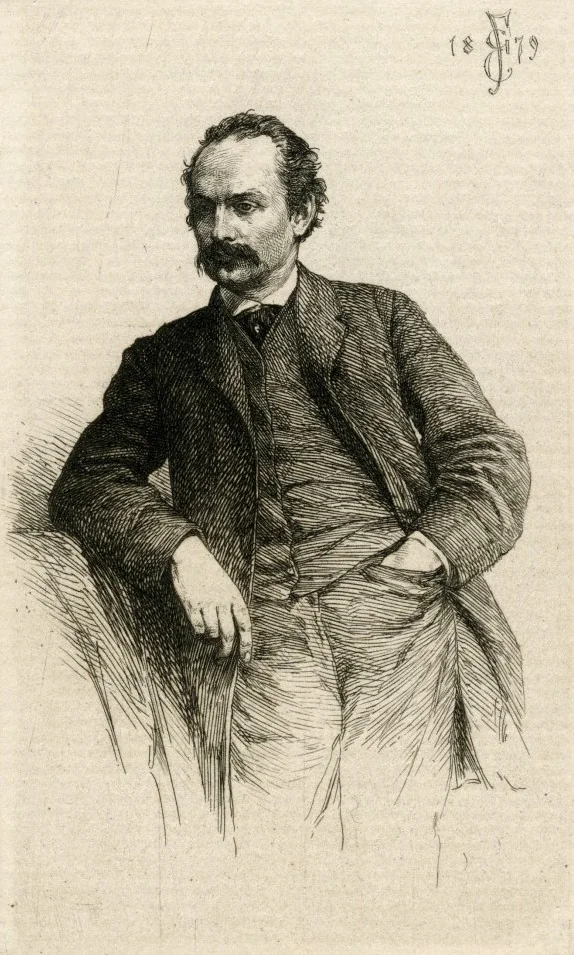
Image from Wikipedia
Image from Wikipedia
Hugo Harrer: Landscape, Architecture, and the Quiet Realism of the Düsseldorf School
A German Painter between Nature Observation, Architecture, and Rome
Hugo Paul Harrer, born on February 6, 1836, and died on December 10, 1876, in Rome, is one of the artistic personalities of the 19th century whose work is characterized less by loud self-presentation and more by craftsmanship and stylistic clarity. The German landscape and architectural painter is associated with the Düsseldorf School, placing him within an artistic tradition that emphasized careful nature observation, atmospheric accuracy, and strict image composition. His biography leads from an initially intended career as an architect to painting, which he mainly pursued in an autodidactic manner. (de.wikipedia.org)
Early Years and Artistic Self-Discovery
Sources depict Harrer as an artist who did not follow the classical path through an academy, but rather turned to the visual arts early on. According to the German Biography, he was originally intended for architectural studies but soon decided on painting, developing his skills through self-study, close observation of nature, and exchanges in friendly studios. This form of artistic education shaped his profile: a painter who does not emerge from the canon of great teachers but from direct engagement with motif, light, and space. (deutsche-biographie.de)
This very autonomy gives Harrer's life path a unique tension. He appears as a representative of a more realistic 19th century, where observation and technical discipline gain importance. The German Biography explicitly describes him as a “modern realist” who aimed to depict objects as accurately as possible. Thus, Harrer fits into that movement which marks the transition from romantic idealism to more precise representations of reality in German-speaking areas. (deutsche-biographie.de)
Düsseldorf, Academy, and Influence from Oswald Achenbach
In 1867 and 1868, Harrer stayed in Düsseldorf and studied at the Academy of Fine Arts in the landscape painting class of Oswald Achenbach. This phase is central to his artistic development, as the Düsseldorf School was considered one of the most important training grounds for landscape and genre painting in the 19th century. It combined academic precision with a strong interest in mood values, perspective, and a controlled yet vibrant image architecture. Harrer's proximity to this school explains the clear order of his motifs as well as the high value placed on spatial effect and atmospheric density. (de.wikipedia.org)
The Düsseldorf School influenced artists far beyond the German-speaking world and was internationally recognized in the 19th century. In this environment, Harrer operated as an artist of a generation navigating between academic tradition and naturalistic renewal. The combination of landscape and architecture points to a perspective that does not separate nature from building art, but rather unites both elements in a compositional order. This makes Harrer's work appealing to art lovers who appreciate the tension between realistic portrayal and formal discipline. (de.wikipedia.org)
Style, Technique, and Artistic Signature
Harrer's painting is primarily characterized by its realism in the available sources. Rather than relying on spectacular effects or drastic experiments, the exact reproduction of the visible takes center stage. His training without a permanent master workshop and without a traditional academic pathway reinforces this approach: Harrer clearly developed his means of representation through his own practice, which lends his art a sober, concentrated credibility. (deutsche-biographie.de)
As a landscape and architectural painter, he operates at an intersection that was particularly productive in the 19th century. Landscape requires a sensitivity to light, depth, and mood; architecture requires measure, perspective, and structure. Harrer's artistic evolution can be seen in this dual mandate: to not romanticize nature and to not flatten the built form, but rather to connect both elements in a controlled visual language. This results in a body of work that relies more on observation, rhythm, and solid composition than on pathos. (de.wikipedia.org)
Rome, Final Phase of Life, and Aftermath
Hugo Harrer died in 1876 in Rome and was buried in the Protestant Cemetery of the city. For many 19th-century artists, Rome was a place of convergence, education, and cultural exchange, and for Harrer too, the city marks the endpoint of a life that unfolds between North German origins, Düsseldorf training, and the Italian art metropolis. His burial in Rome underscores his integration into the international milieu of artist travels of that time. (de.wikipedia.org)
Although the information preserved about his oeuvre is limited, Harrer remains art-historically relevant as part of the Düsseldorf School. The list of painters from this school positions him as an independent figure within a formative era of German painting. His significance lies less in a widely marketed late work and more in the exemplary connection of self-study, realistic perspective, and academically influenced formal culture. This is precisely where the charm of such artist biographies lies: they demonstrate how much character resides in quiet precision. (de.wikipedia.org)
Cultural Context and Art Historical Positioning
The Düsseldorf School developed in an art climate that was shaped in the 19th century by exhibitions, reviews, and the international art market. Its influence extended far beyond Germany, and its representatives operated in a tension field of pedagogical tradition, nature study, and growing realism. Harrer stands precisely in this field: as a painter who understands teaching not as mere reproduction but as a starting point for an autonomous visual language. (de.wikipedia.org)
For contemporary viewers, Harrer is particularly interesting as an art historical figure who exemplifies the journey from architectural interest to painting. His biography highlights how open the boundaries between disciplines were in the 19th century and how significantly individual observation could shape the development of a painter. Those interested in German landscape painting, architectural studies, and the Düsseldorf School will find in Harrer a typical yet independent representative of this era. (de.wikipedia.org)
Conclusion: Why Hugo Harrer Still Matters Today
Hugo Harrer fascinates as an artist of measure, observation, and quiet consistency. His biography tells of self-study, academic grounding in Düsseldorf, and a realistic view of image-making that relies on accuracy and thoughtful composition. Precisely because his name is not associated with spectacular headlines, a closer look at him is all the more worthwhile: he represents those precise, often underrated achievements of 19th-century German painting that complete the art historical picture. (deutsche-biographie.de)
Anyone fascinated by the Düsseldorf School, landscape and architectural painting, and the quiet masters of observation should not overlook Hugo Harrer. His art invites a closer look and a renewed appreciation for the elegance of realistic painting. This is where his enduring intrigue lies. (de.wikipedia.org)
Official Channels of Hugo Harrer:
- Instagram: no official profile found
- Facebook: no official profile found
- YouTube: no official profile found
- Spotify: no official profile found
- TikTok: no official profile found