
Hugo Harrer
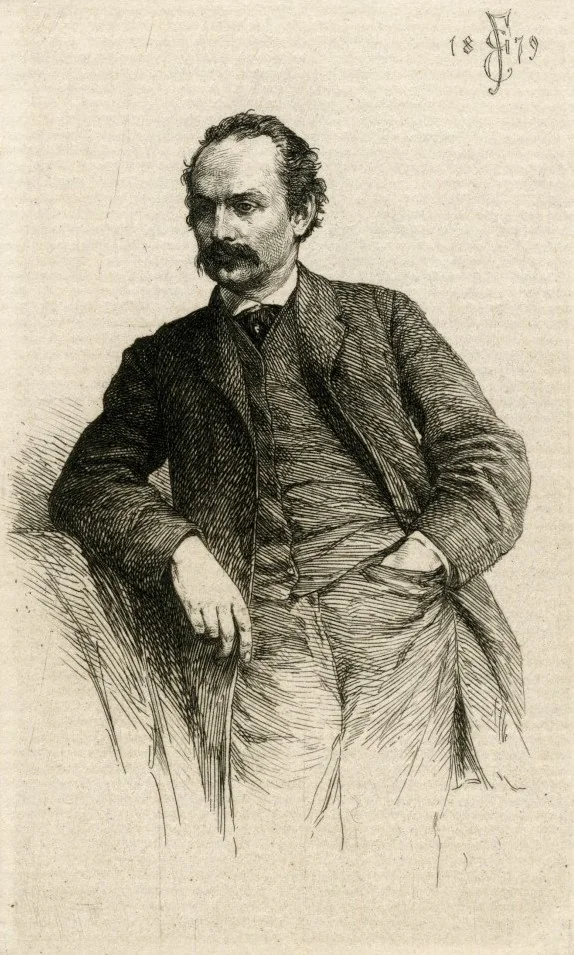
Image from Wikipedia
Image from Wikipedia
Hugo Harrer – the realistic view of architecture, ruins, and landscape
A painter between architecture, nature study, and Roman longing
Hugo Paul Harrer was part of that generation of German artists in the 19th century who found their way into modernity not through academic routine, but through observation, self-study, and an uncompromising view of reality. Born in 1836 in Eberswalde and passing away in Rome in 1876, he developed into a landscape and architectural painter of the Düsseldorf School, whose work was marked by realistic precision and atmospheric depth. His paintings combine architectural structure, nature study, and the allure of decaying places into a distinctive style that continues to resonate today.
Harrer initially began an architectural education but soon turned to painting, developing as an artist without attending an art academy. It is precisely this biographical independence that makes him interesting: he worked not from within the system but from precise observation. In Nuremberg, Munich, and later especially in Rome, he found the motifs that shaped his development – cityscapes, ruins, street scenes, and Italian coastal landscapes, which he rendered with great fidelity to nature.
Biographical background and artistic self-discovery
The biography of Hugo Harrer is an example of an artistic autonomy that was anything but self-evident in the 19th century. According to the German Biography, he was initially destined for architecture but switched to painting early on and continued to educate himself as a self-taught artist. Instead of systematic academic training, private study in the ateliers of friends, careful observation of nature, and a growing sense of pictorial order were central to his path.
This background explains much about the direction of his oeuvre. Harrer did not seek virtuoso effects for their own sake but aimed for a credible representation of spaces, materials, and lighting conditions. Thus, his development progressed towards a sober modern realism that showed things as he saw them. This is precisely where the strength of his art lies: in a stance of accuracy that never feels dry but is supported by quiet tension.
Nuremberg, Munich, and the step into Roman painting
Among his early artistic stops was Nuremberg, whose picturesque architecture undoubtedly inspired him to create his first works. Here, it already became evident what would later characterize Harrer's work: an interest in architectural structures, angles, edges, and façades, in places where history remains visible. In his work, architecture does not merely appear as a motif but as a carrier of atmosphere and memory.
An important impulse came from Munich, where the then-new, groundbreaking realistic painting style of Carl Theodor von Piloty captivated him. This encounter opened Harrer's eyes to a style of painting that combines observation, narrative, and technical precision. When he went to Rome in 1862 due to a chest ailment, his art gained a new focus: there, he produced nature studies that stood out for their truthfulness and fidelity, solidifying his reputation.
Rome as an artistic center and workshop of observation
Rome became for Harrer not just a place of residence but an artistic workshop and a space of intellectual resonance. There, he closely aligned himself with Ludwig Passini and worked with great discipline. He primarily painted architectural pictures with figures, along with smaller genre scenes, continuously gathering new study material on excursions. His stay in Rome offered him the opportunity to develop motifs not from memory but directly from observation.
The German Biography emphasizes that he sent several larger paintings to German art exhibitions from Rome each year. This points to an artist who did not work in isolation but actively engaged his position in the art scene. His paintings combined topographical accuracy with the poetic impact of decaying spaces, street scenes, and coastal landscapes. It is precisely this blend that imparted a distinctive tension between document and mood in his work.
The style: modern realism with a sense of ruins, angles, and atmosphere
Harrer was characterized historically as "a thoroughly modern realist." This formulation captures the essence of his style: he aimed to depict objects exactly as he perceived them and placed great importance on the manner of pictorial representation. For him, realism does not emerge as mere depiction but as a concentrated form of observation, where composition, light, and surface effect converge.
He frequently chose painterly angles in decaying ruins as motifs. Such places serve a dual function in his work: they convey historical substance while also embodying the quiet melancholy of transition, decay, and time. In his architectural and landscape paintings, space becomes a carrier of mood, nature stands in contrast to human construction, and the figures fit precisely within this tension.
The Düsseldorf School and Harrer's place in the 19th century
As a representative of the Düsseldorf School, Harrer finds himself in an environment known for detailed compositions, narrative motifs, and a high technical discipline. His work integrates into this tradition while simultaneously following a quieter, observational path. He sought neither monumental theatrical effect nor dramatic presence, but the credible representation of places shaped by light, perspective, and materiality.
His life journey illustrates how profoundly German painting in the 19th century thrived on mobility and international exchange. Nuremberg, Munich, Düsseldorf, and Rome create an artistic map for Harrer, where influences, studies, and work phases condense. Thus emerged a body of work that is not defined by fashionable programs but by permanence, precision, and the dignity of seeing.
Work, reception, and art-historical classification
The source situation regarding Harrer shows that he remains primarily traceable through art-historical reference works, the Allgemeine Deutsche Biographie, and the Deutsche Biographie. This does not detract from his significance but rather marks the typical position of many solid masters of the 19th century, whose contribution lies less in the myth of great genius than in the reliability of their work. Such artists uphold the visual memory of an era.
His images of street scenes, ruins, and Italian coastal landscapes depict an artist who mastered the act of observation and developed a calm, convincing visual language from it. From an art-historical perspective, Harrer acts as a link between academic tradition and realistic modernity. Those who view his works encounter a painting that is neither spectacular nor arbitrary, but rather relies on truthfulness, structure, and atmosphere.
Current relevance of a historical artist
Hugo Harrer was not an artist of the market but one of vision. This is precisely what makes his art interesting even today, as it shows how intensely a single gaze at architecture, landscape, and decay can be. In a present full of visual over-stimulation, his work possesses the quality of deceleration: it demands attention but rewards it with clarity and quiet depth.
While there are naturally no current projects or new publications, continued art-historical engagement with Harrer remains important. His paintings reference a time when precise observation of the world was considered an artistic stance and realism was a matter of integrity. Engaging with Harrer reveals a painter whose restraint is his strength and whose work is enduring as a result.
Conclusion: Why Hugo Harrer remains intriguing today
Hugo Harrer fascinates through the connection of self-teaching, realistic rigor, and a poetic gaze at decaying places. He left no loud programs behind, but rather paintings that narrate with quiet confidence how space, light, and memory intertwine. This is precisely where his lasting quality lies: he shows how powerful a painting can be when it approaches reality with patience and precision.
Anyone interested in German painting of the 19th century, architectural painting, and the quiet realism of the Düsseldorf School should certainly discover Hugo Harrer. His works invite viewers to look closer and take the subtle tones of art history seriously. A visit to his paintings is not a spectacular event but a rewarding encounter with an artist who masterfully understood the beauty of observation.
Official channels of Hugo Harrer:
- Instagram: No official profile found
- Facebook: No official profile found
- YouTube: No official profile found
- Spotify: No official profile found
- TikTok: No official profile found
Sources:
- German Biography – Harrer, Hugo
- Wikipedia – Hugo Harrer
- Wikipedia – List of Painters of the Düsseldorf School
- Wikipedia – Harrer (disambiguation)
- Wikipedia: Image and text source