
Quatuor Hermès
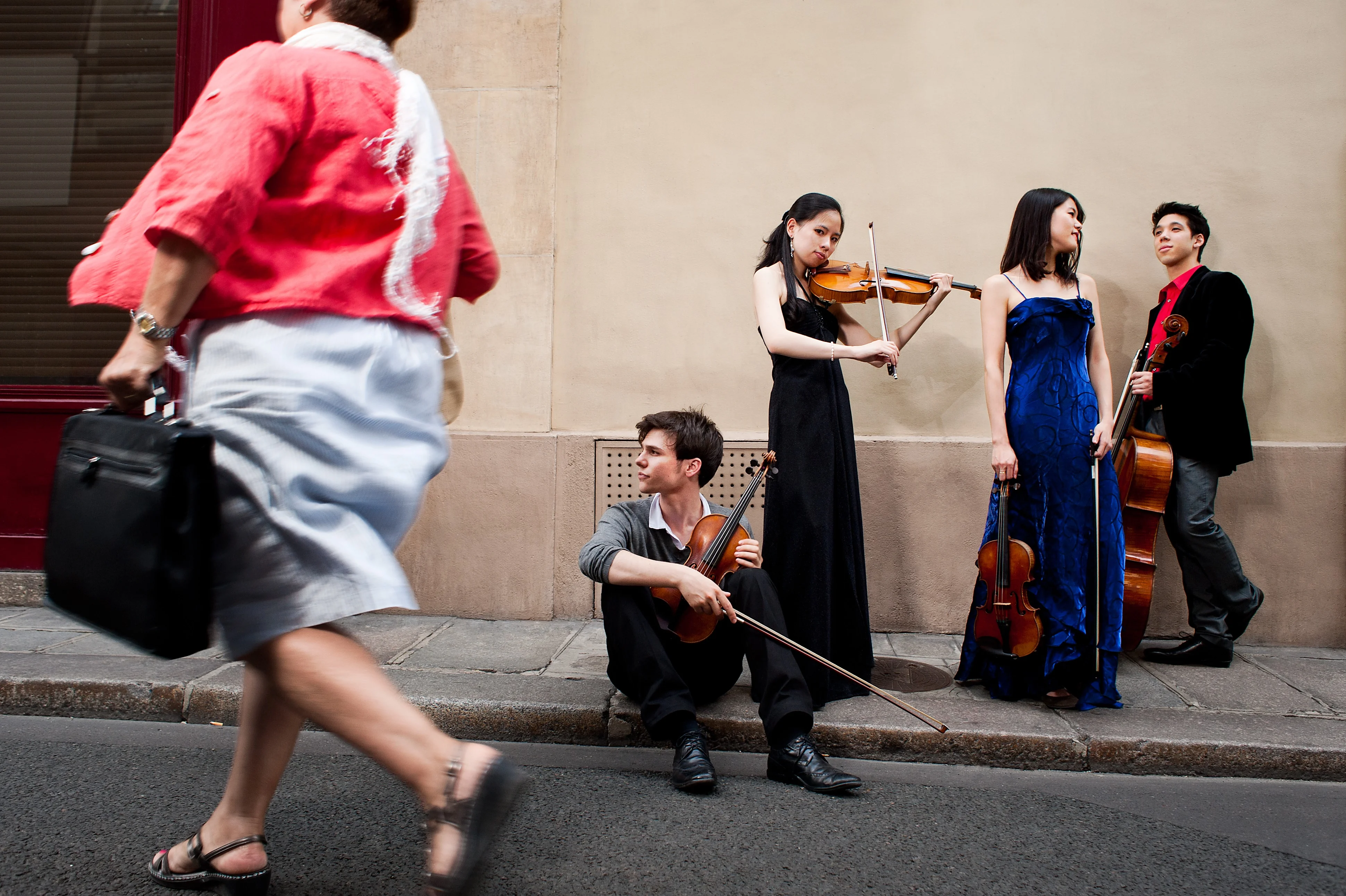
Image from Wikipedia
Image from Wikipedia
Quatuor Hermès: French Chamber Music with Passion, Precision, and Global Brilliance
A string quartet that blends classical tradition with contemporary stage energy
Quatuor Hermès is one of the most distinguished string quartets of its generation. Founded in 2008 at the Conservatoire national supérieur de musique et de danse in Lyon, the ensemble quickly evolved into an internationally sought-after address for chamber music with a clear profile, cultivated sound language, and compelling stage presence. The name refers to Hermes, the messenger god of Greek mythology, and accurately describes the artistic stance of the quartet: serving as a mediator between compositional vision and the audience's sensitivity. ([en.quatuor-hermes.com](https://en.quatuor-hermes.com/bio-1))
From early on, the ensemble combined technical sovereignty with stylistic openness. The quartet's biographies and portraits feature prestigious venues such as Carnegie Hall in New York, Wigmore Hall in London, and the Forbidden City in Beijing; additionally, it has participated in festivals like La Folle Journée, Radio France Montpellier, Deauville, La Roque d’Anthéron, and Mecklenburg-Vorpommern. This international presence shaped a musical career that relies not only on competition successes but also on the sustainable work on sound, balance, and interpretative depth. ([en.quatuor-hermes.com](https://en.quatuor-hermes.com/bio-1))
The Beginnings in Lyon: Education, Precision, and a Clear Artistic Identity
The roots of Quatuor Hermès lie in Lyon, where the members came together in 2008 during their studies at the CNSMD. The ensemble deepened its musical development through close exchange with a significant chamber music environment, including members of the Ravel Quartet as well as the Ysaÿe and Artemis quartets. Eberhard Feltz and later Alfred Brendel also played important roles as influential mentors. These encounters shaped the quartet's approach: differentiated phrasing, transparent musical lines, and a consistent search for an organic dramaturgy in quartet playing. ([en.quatuor-hermes.com](https://en.quatuor-hermes.com/bio-1))
Training in the context of a high-profile French chamber music tradition sharpened the awareness of form and sound architecture. In a string quartet, considered the kingly discipline of classical music, each voice demands individual responsibility while simultaneously requiring absolute ensemble coherence. Quatuor Hermès has early on utilized this tension as an artistic strength, forming a distinctive ensemble identity from it. ([en.quatuor-hermes.com](https://en.quatuor-hermes.com/bio-1))
The Breakthrough: Competitions, Awards, and International Recognition
The rise of the quartet was accompanied by significant competition successes. Outstanding awards include the first prize at the Concours de Genève as well as the first prize at the Young Concert Artists Auditions in New York. Additional honors include the Nordmetall Ensemble Prize in 2013 and being named the “Révélation Musicale de l’Année” at the 2014/15 Critics' Awards. Such prizes are more than trophies in the chamber music sphere: they mark the transitions from a promising young formation to an internationally recognized top ensemble. ([en.quatuor-hermes.com](https://en.quatuor-hermes.com/bio-1))
Institutionally, Quatuor Hermès also gained significance early on. From 2012 to 2016, the ensemble was based at the Queen Elisabeth Music Chapel in Brussels; since 2019, it has been associated with the Singer-Polignac Foundation in Paris. Support from the Banque Populaire Foundation underscores the value the quartet occupies in the French music landscape. This structure of support, residencies, and international concert activities has sustainably stabilized its artistic development. ([en.quatuor-hermes.com](https://en.quatuor-hermes.com/bio-1))
Discography: From Schumann to Schubert, from French Modernism to New Programs
The discography of Quatuor Hermès reflects an ensemble that does not merely manage repertoire but engages with it vibrantly. The connection with the label La Dolce Volta is particularly strong, with the quartet recording the complete Schumann quartets and an album featuring works by Ravel, Debussy, and Dutilleux. Their recording of the Schubert quartets Rosamunde and Death and the Maiden received the Choc Classica and a Radio-Classique trophy in 2022. These recordings mark the quartet as an ensemble that combines romantic substance, sonic sophistication, and analytical clarity. ([en.quatuor-hermes.com](https://en.quatuor-hermes.com/bio-1))
The official discography also includes releases of works by Schumann, Brahms, Janáček, as well as Haydn and Beethoven. In 2026, a new album titled Echoes of Vienna was released, referencing Mozart, Zemlinsky, and Webern, thereby expanding the quartet's musical horizon towards Viennese Modernism. Recent releases demonstrate how consistently the ensemble explores stylistic lines between classical form, late romantic expressiveness, and modern condensation. ([en.quatuor-hermes.com](https://en.quatuor-hermes.com/discographie))
Interpretation Style: Sound Culture, Expressive Tension, and Chamber Music Intelligence
Critics repeatedly highlight the connection of determination and depth in Quatuor Hermès. The Guardian described the quartet's interpretation of Schumann as thoughtful, vivacious, and individually colored, particularly praising the fidelity to Schumann's expressive impulsiveness and insatiable lyricism. Such reactions show that the ensemble does not merely play cleanly, but rather brings out musical characters with distinct contours. ([theguardian.com](https://www.theguardian.com/music/2014/oct/23/quatuor-hermes-schumann-string-quartets-op-41-cd-review?utm_source=openai))
Other portraits also emphasize the quartet's special energy. Press and festival texts speak of care, sensuality, precision, and a strong sense of community. Quatuor Hermès understands the string quartet as an organic conversation: each voice contributes, contradicts, supports, and shapes the overall picture. This blend of intellectual discipline and emotional directness provides the interpretations with their tension. ([ladepeche.fr](https://www.ladepeche.fr/2023/11/29/quatuor-hermes-un-concert-a-ne-pas-manquer-aux-dimanches-musicaux-11609201.php?utm_source=openai))
Repertoire, Collaborations, and Stylistic Openness
A defining characteristic of Quatuor Hermès is its openness to different repertoires. The ensemble not only works within the core canon of quartet literature but also regularly collaborates with renowned soloists, including Yo-Yo Ma, Kim Kashkashian, Anne Gastinel, Nicholas Angelich, Pavel Kolesnikov, and Gregor Sigl. This collaboration expands their interpretive radius and strengthens the dialogical quality of music-making. ([en.quatuor-hermes.com](https://en.quatuor-hermes.com/bio-1))
Since 2018, the quartet has also been developing new formats outside the classic four-member ensemble. Under the name Le Pari des Bretelles, the members perform alongside accordionist Félicien Brut and double bassist Édouard Macarez; the first recording of this project was released in 2019. Such expansions illustrate an artistic curiosity that considers repertoire not as a boundary but as a starting point. ([en.quatuor-hermes.com](https://en.quatuor-hermes.com/bio-1))
Cultural Influence and Reception: An Ensemble with Authority in European Chamber Music
Quatuor Hermès has quickly established remarkable authority in classical music. The combination of competition successes, international concert activities, prestigious residencies, and an award-winning discography makes the ensemble a staple in European chamber music. Particularly, the work with French, German-Romantic, and more modern repertoires has garnered the quartet a profile recognized in critiques as well as by a broad concert audience. ([en.quatuor-hermes.com](https://en.quatuor-hermes.com/bio-1))
Its cultural influence extends beyond mere concert life. The ensemble represents a generation of musicians who do not treat tradition in a museum-like manner but rather revitalize it in the here and now. This embodies the sustainable significance of the quartet: in the interplay of historical depth, sonic nobility, and the ability to make each work an immediate experience. ([en.quatuor-hermes.com](https://en.quatuor-hermes.com/bio-1))
Conclusion: Why Quatuor Hermès Remains So Exciting Today
Quatuor Hermès combines virtuosity with maturity, energy with discipline, and loyalty to repertoire with interpretive imagination. Those who hear this ensemble experience chamber music as a concentrated dialogue, a breathing architecture, and a vibrant presence. Especially in a time when many quartets compete for attention, Quatuor Hermès impresses with substance, character, and a sonic handwriting that is immediately recognizable. ([en.quatuor-hermes.com](https://en.quatuor-hermes.com/bio-1))
Experiencing the quartet's music live reveals the unique tension between four independent voices that come together to form a homogeneous, radiant collective sound. This is precisely the fascination of this ensemble: in musical storytelling with utmost precision and great emotional presence. A concert by Quatuor Hermès is not merely a playback of repertoire but an intense chamber music event that should not be missed. ([en.quatuor-hermes.com](https://en.quatuor-hermes.com/bio-1))
Official Channels of Quatuor Hermès:
- Instagram: No official profile found
- Facebook: No official profile found
- YouTube: No official profile found
- Spotify: No official profile found
- TikTok: No official profile found
Sources:
- Quatuor Hermès – Official Website
- Quatuor Hermès – Bio
- Quatuor Hermès – Discography
- Quatuor Hermès – Contact / Management
- The Guardian – Quatuor Hermès: Schumann String Quartets, Op 41 CD review
- Arts-Scène Diffusion – Quatuor Hermès biography
- Philharmonie de Paris – Quatuor Hermès
- Fundação Calouste Gulbenkian – Quatuor Hermès
- ResMusica – Quatuor Hermès, Schubert review
- Presto Music – Echoes of Vienna
- Wikipedia: Image and text source