
Hugo Harrer
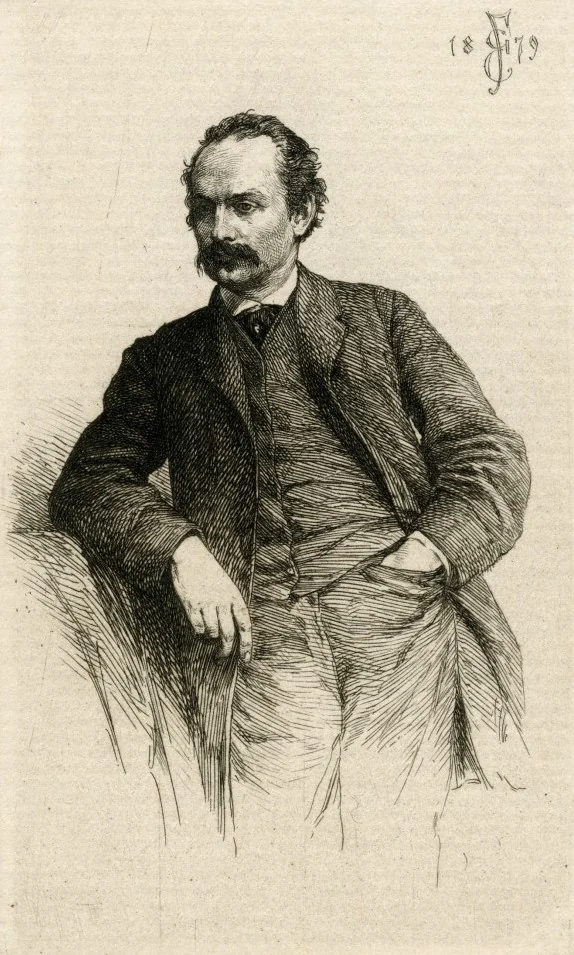
Image from Wikipedia
Image from Wikipedia
Hugo Harrer – Landscapes, Ruins, and the Perspective of a Modern Realist
A German-Roman Painter Between Architecture and Nature Study
Hugo Paul Harrer (February 6, 1836 in Eberswalde; December 10, 1876 in Rome) is among those artists of the Düsseldorf School whose work unfolds at the intersection of landscape and architectural painting. Initially embarking on an architectural education, he evolved into a self-taught painter, developing an early visual language based on precise observation of nature, urban depictions, and atmospheric accuracy. His biography reflects the journey of an artist who did not choose the academic path but carved out an independent position through study, travel, and personal observation. (de.wikipedia.org)
Early Years and the Path to Painting
Harrer was born in 1836 and was initially set to become an architect. However, he soon abandoned this plan and turned to painting without ever studying permanently at an art academy. The formative foundations of his artistic development were laid through private studies, nature observation, and exchanges in the studios of friends. This mix of self-education and immediate experience granted his work a freshness that repeatedly manifests as a hallmark of modern realism in the 19th century. (de.wikipedia.org)
His first paintings were created in Nuremberg, where the picturesque architecture of the city particularly inspired him. Here, the core of his later work is already visible: architecture as a living visual order rather than a rigid motif, connecting with light, space, and atmosphere. Nuremberg thus became the starting point of an artistic career marked by relocations, study trips, and a keen eye for historical as well as urban scenes. (de.wikipedia.org)
Munich, Rome, and the Influence of Realism
After Nuremberg, Harrer moved to Munich, where he was fascinated by the then new, groundbreaking realistic painting style of Carl Theodor von Piloty. This connection to the Munich art scene marked an important development step, as his perception of scenic density, drawing accuracy, and compositional order sharpened here. The Munich phase was not a break with his previous work but a refinement of his sensitivity to the interplay of architecture, figure, and landscape. (de.wikipedia.org)
In 1861 or October 1862, Harrer went to Rome due to a chest ailment. There, he joined Ludwig Passini and painted studies from nature. His early Roman works attracted attention due to their truthfulness and fidelity. Rome became not just a place of stay, but also an artistic laboratory: here, Harrer collected motifs, light moods, and topographical impressions that later flowed into larger paintings and honed his international orientation toward Italian subjects. (de.wikipedia.org)
Düsseldorf and Membership in the Düsseldorf School
During the years 1867/1868, Harrer spent time in Düsseldorf and studied at the Art Academy in the landscape painting class of Oswald Achenbach. From 1868 to 1872, he was also a member of the Malkasten artists' association, an important institution in Düsseldorf's art scene. This phase further anchored him in the landscape painting of the Düsseldorf School, which emphasized careful observation of nature, atmospheric spaces, and a narrative yet formally controlled composition. (de.wikipedia.org)
Upon his return to Rome, Harrer continued working with studies and sketches, which he used as templates for oil paintings. From there, he submitted works to German art exhibitions, favoring motifs such as street scenes, ruins, and Italian coastal landscapes. The artist combined the romantic allure of historical places with a sober, modern perspective. It is precisely this connection of mood and precision that makes his place within Düsseldorf painting interesting to this day. (de.wikipedia.org)
Style and Artistic Signature
The German Biography expressly describes Harrer as "a thoroughly modern realist." This characterization captures the essence of his art: he aimed to depict things as he saw them, placing great importance on the mode of pictorial representation. His paintings are characterized by a controlled perception that aims not for effect but for accuracy. In this regard, Harrer differs from purely decorative landscape painters and approaches an artistic stance that equates observation and composition. (deutsche-biographie.de)
He preferred to depict picturesque angles in decaying ruins. These scenes were complemented by architectural images with figures, small genre paintings, and Italian coastal views. The painter's gaze links topography with atmosphere: buildings become carriers of time, ruins serve as symbols of past history, and coastal landscapes manifest as images of light and expansiveness. Thus, Harrer's work thrives on a tension between documentary precision and poetic effect. (deutsche-biographie.de)
Selected Works and Art Historical Relevance
Among the surviving works are Alte Hanse (1868), View of the Amalfi Coast at Sunset (1871), At the Theater of Marcellus in Rome (1876), Theater of Marcellus in Rome (1876), and A Jewish Street Vendor in a Street in Siena. This selection already shows the range of his interests: northern German historical landscapes, southern Italian coasts, ancient monuments, and urban scenes create a thematic field that relies on travel, observation, and compositional discipline. (de.wikipedia.org)
Particularly significant is the recurring engagement with Rome. The Theater of Marcellus, for instance, reflects the fascination with ancient architecture and its lasting presence in the modern cityscape. Harrer utilized such motifs not merely as picturesque embellishments but as visual ordering systems where light, ruin, and everyday life intersect. This creates a body of work that art historically mediates between view-like accuracy and realistic mood representation. (de.wikipedia.org)
Aftermath, Source Situation, and Art Historical Classification
Harrer died in 1876 in Rome and was buried in the Protestant cemetery. The source situation already indicates that his biography is partly preserved in contradictory accounts: his birthplace is sometimes cited as Eberswalde, sometimes Hirschberg in Silesia; the date of death also appears inconsistently in literature. These ambiguities make him a typical figure in art historical research, requiring careful weighing of established observations and historical transmission. (de.wikipedia.org)
Despite his rather slim presence, now mainly visible in museums and auction contexts, Harrer remains an interesting representative of 19th-century German painting. His work illustrates how strongly the Düsseldorf School was shaped by travel, nature studies, and international experiences. Those interested in realistic architectural views, Roman vedutas, and the poetic side of realism will find in Hugo Harrer an artist with a clear signature and remarkable consistency. (de.wikipedia.org)
Conclusion: Hugo Harrer combines the precise gaze of a realist with the atmosphere of travel and urban landscape. His paintings turn architecture into narrative space, ruins into witnesses of time, and coasts into landscapes of light. That is where his tension lies: in the quiet intensity of a painter who captured the observed with utmost accuracy and simultaneously tangible pictorial poetry. Anyone passionate about the Düsseldorf School and 19th-century art should discover Harrer as a distinctive voice. (de.wikipedia.org)
Official Channels of Hugo Harrer:
- Instagram: No official profile found
- Facebook: No official profile found
- YouTube: No official profile found
- Spotify: No official profile found
- TikTok: No official profile found