
Hugo Harrer
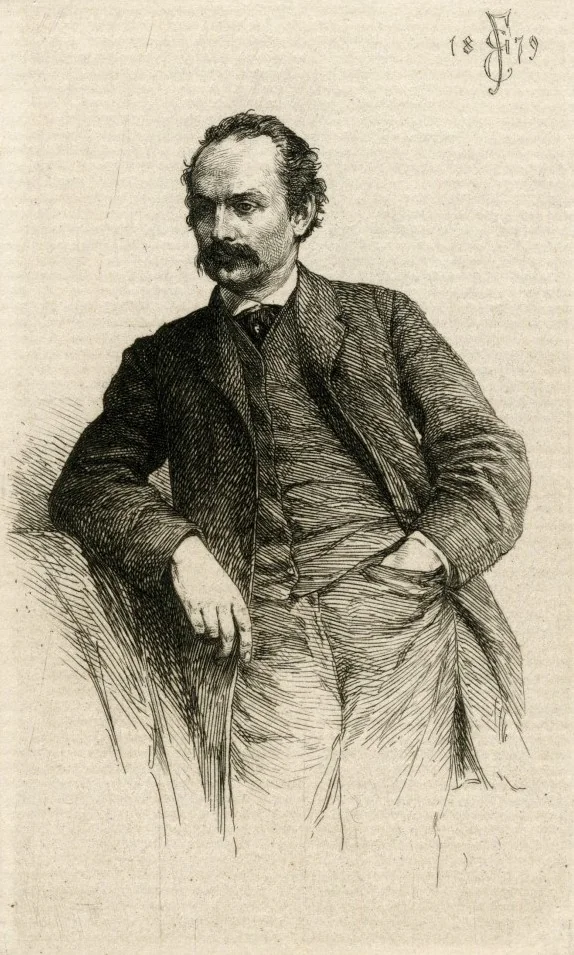
Image from Wikipedia
Image from Wikipedia
Hugo Harrer – the Silent Precision of a Landscape and Architectural Painter of the Düsseldorf School
An Artist Between Nature Observation, Italian Light Poetry, and Realistic Accuracy
Hugo Paul Harrer is among those German painters of the 19th century whose work asserts itself not through loud self-promotion, but through artistic consistency, precise observation of nature, and a clear visual language. Born on February 6, 1836, and died on December 10, 1876, in Rome, the artist gained recognition as a landscape and architectural painter of the Düsseldorf School. His career path ranged from an initial architectural education to self-taught studies, leading to paintings that capture street scenes, ruins, and Italian coastal landscapes with remarkable accuracy. (de.wikipedia.org)
Biographical Beginnings: From Architectural Plans to Painting
Harrer initially began an architectural education, but early on, his interest shifted towards the visual arts. Instead of pursuing an academic route, he chose to learn freely: private studies in the studios of friends, careful observation of nature, and ongoing work on his own style shaped his development. This early independence makes his biography particularly interesting, as it does not present him merely as a pupil of a single master, but as an artist who shaped his style in direct dialogue with place, light, and subject matter. (de.wikipedia.org)
His first paintings were created in Nuremberg, where its architecture strongly inspired him and sparked early attempts at architectural painting. He then moved to Munich, where he was captivated by the realistic painting style of Carl Theodor von Piloty. Here, a tension emerged that would influence Harrer's work until the end: the connection between architectural structure and painterly truthfulness. In 19th-century German art, this was a demanding synthesis that relied not on effects, but on precision and atmosphere. (de.wikipedia.org)
Rome as an Artistic Turning Point
In 1862, Harrer traveled to Rome due to a chest ailment, where his career significantly intensified. There, he joined Ludwig Passini and worked intensively from nature. The Roman period became a turning point for him, both biographically and artistically: studies in front of nature, architectural motifs, and the unique atmosphere of the city provided him with a wealth of observations from which he later developed oil paintings. His works gained attention for their great truthfulness and fidelity. (deutsche-biographie.de)
In both Berlin and Düsseldorf, Harrer represented a painting style oriented towards visible reality. The Deutsche Biographie explicitly describes him as a “modern realist” who sought to depict objects as he saw them. This is central to his artistic profile: Harrer wanted no idealized stage, but a credible visual world where light, space, and architectural details are organized with sober care. (deutsche-biographie.de)
Düsseldorf and the Classification in the Düsseldorf School
Between 1867 and 1868, Harrer stayed in Düsseldorf, studying in the landscape painter class of Oswald Achenbach at the Art Academy. From 1868 to 1872, he was a member of the Düsseldorf Künstlerverein Malkasten, an important center of the Rhine art scene. The Düsseldorf School was internationally networked in the 19th century and significant for landscape, genre, and architectural painting; particularly the combination of academic training, travel experience, and realistic observation provided painters like Harrer with a productive framework. (de.wikipedia.org)
Harrer's affiliation with the Düsseldorf School is also explained by his thematic closeness to its visual interests. The school was known for its export effect, its openness to international influences, and its strong anchoring in landscape and genre painting. Harrer's street scenes, ruins, and Italian coastal motifs fit into this context, as they provide not just travel impressions but develop a composed, atmospherically precise view of space. (de.wikipedia.org)
Motif World and Works: Architecture, Ruins, Coasts, and Everyday Observation
The preserved works demonstrate how consistently Harrer selected his themes. Among these are Old Hanse from 1868, View of the Amalfi Coast at Sunset from 1871, At the Theater of Marcellus in Rome from 1876, The Theater of Marcellus in Rome from 1876, and A Jewish Street Vendor on a Street in Siena. These titles refer to an art that mediates between city views, historical spaces, and European everyday observation. (de.wikipedia.org)
Particularly characteristic is Harrer’s view of places as cultural repositories. Ruins and street scenes are not merely documented by him but understood as pictorial spaces with historical depth. His Italian coastal landscapes and Roman architectural views combine topographical accuracy with a quiet, contemplative effect. Here lies the strength of his oeuvre: the motifs do not appear monumentalized, but observed, organized, and constructed with a fine sense for light conditions and perspective stability. (de.wikipedia.org)
Style, Technique, and Artistic Development
Stylistically, Harrer moved towards a clear realism. Starting his education outside an art academy and later studying in Düsseldorf with Oswald Achenbach indicates a development between autonomy and integration into the academic art world. The Deutsche Biographie emphasizes that he never worked permanently in a master’s studio, but educated himself through his own study and nature observation. This form of artistic self-discipline significantly shaped his work. (deutsche-biographie.de)
The balance between architecture and atmosphere is essential for his compositions. Harrer is interested in lines, spatial axes, and architectural structures, yet these never remain cold. Rather, they merge with weather, light, and figurative staffage to create images that build a quiet narrative tension. Especially as an architectural painter, he unfolds a special quality: he makes spaces legible without overloading them and endows landscapes and city views with a quiet poetic concentration. (deutsche-biographie.de)
Reception, Classification, and Cultural Value
Harrer was not a major star in art history, but his work is valuable for understanding the Düsseldorf School. He exemplifies a generation of painters who combined travel, on-site drawing, and the connection between realism and romantic motifs into a distinctive visual language. The exhibition activity of his oil paintings mentioned in sources indicates that he actively participated in the art discourse of his time. (de.wikipedia.org)
His art-historical significance lies in how he condensed the European urban and landscape experience of the 19th century into a calm, objective style. In an era where many artists fluctuated between historical pathos, academic convention, and realistic innovation, Harrer opted for accuracy, observation, and formal clarity. As a result, his work remains a prime example of concentrated, unpretentious painting with high documentary and aesthetic value. (deutsche-biographie.de)
Conclusion: A Quiet Master of Precise Visual Truth
Hugo Harrer fascinates with his blend of independence, discipline, and stylistic clarity. He belongs to the artists who do not work with grand manifesto effects, but with precise perception, good composition, and a sensitive treatment of space and subject matter. Those who want to understand the Düsseldorf School will discover in Harrer a painter who shaped architecture, landscape, and Italian life with realistic calm into an unmistakable visual language. (de.wikipedia.org)
It is precisely this quiet consistency that makes him intriguing: Harrer shows how powerful art can be when it focuses on precision rather than loudness. His work deserves rediscovery, as it makes the poetic side of realism visible and expands the perspective on the 19th century. Anyone interested in the Düsseldorf School, landscape painting, and architectural views should definitely get to know this artist better and experience his works in museums or collections with open attention. (de.wikipedia.org)
Official Channels of Hugo Harrer:
- Instagram: no official profile found
- Facebook: no official profile found
- YouTube: no official profile found
- Spotify: no official profile found
- TikTok: no official profile found