
Hugo Harrer
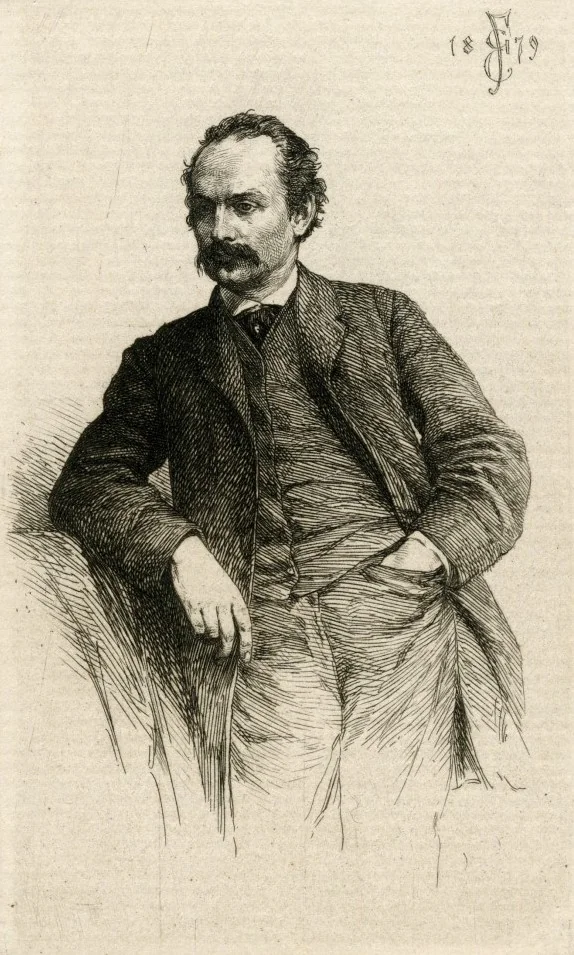
Image from Wikipedia
Image from Wikipedia
Hugo Harrer: The Quiet Realist of the Düsseldorf School between Ruin, Coast, and Rome
A German painter who distilled architecture, nature, and atmosphere into poetic precision
Hugo Paul Harrer (1836–1876) is one of those 19th-century artists whose work unfolds not through loud self-promotion, but through quiet perseverance and craftsmanship. The German landscape and architectural painter of the Düsseldorf School developed his visual language through self-teaching, meticulous observation of nature, and a pronounced sensitivity to architectural spaces. His career spans from Eberswalde or, according to another tradition, Hirschberg in Silesia, to Nuremberg, Munich, Düsseldorf, and Rome, culminating in the German art exhibitions of his day. (de.wikipedia.org)
When observing Harrer, one sees not an academic careerist but an artist who defined himself through motifs, light, and compositional order. His paintings revolve around street scenes, ruins, Italian coastal landscapes, and architectural views, which he captured with great fidelity and realistic clarity. This combination of precision and atmosphere continues to make his name relevant today for art lovers, collectors, and museum enthusiasts. (de.wikipedia.org)
Biographical Beginnings: Between Desire for Architecture and Artistic Self-Discovery
Harrer began training as an architect but turned to painting early on, teaching himself the craft. In addition to his own studies, he visited the studios of friends, sharpening his eye for composition, drawing structure, and painterly effect. His first paintings were created in Nuremberg, where the city's architecture inspired him to undertake early attempts at architectural painting. (de.wikipedia.org)
This phase is crucial for his entire oeuvre, as it reveals the origin of his visual world: houses, squares, masonry, and historical traces became not just a backdrop but the actual subject. Nuremberg not only provided him with motifs but also instilled in him a consciousness for the drama of urban spaces. It is here that the realism, which would characterize his later Roman and Italian works, began to take shape. (de.wikipedia.org)
Munich, Piloty, and the Shift to Realistic Painting
After Nuremberg, Harrer moved to Munich to draw inspiration from the painting of Carl Theodor von Piloty. Contemporary descriptions emphasize that he was captivated by Piloty's then-new and revolutionary realistic painting style. This moved Harrer into the orbit of an artistic conception that aimed not merely to decorate but to make visible: precisely observed reality, carried by compositional control. (de.wikipedia.org)
However, his path remained independent. He did not attend an art academy as a regular student and did not work permanently in a master's studio, but developed through observation, practice, and interaction with fellow artists. This independence continues to shape the painter's profile today: Harrer appears less as a representative of a school in the strict sense, but rather as a realist with a distinctly personal touch. (deutsche-biographie.de)
Rome as an Artistic Center: Nature Studies, Ruins, and Italian Motifs
In 1861, or according to another dating, in October 1862, Harrer moved to Rome for health reasons. There, he joined Ludwig Passini and produced nature studies that garnered attention for their great truthfulness and fidelity. Rome became not only a place of residence but an artistic laboratory: Harrer gathered impressions, created sketches, and built a repertoire of motifs that would nourish his later oil paintings. (de.wikipedia.org)
The Italian capital and its surroundings offered him an inexhaustible stage for architectural painting, ruins romance, and atmospheric street scenes. Sources mention motifs such as the Theater of Marcellus, street vendors in Siena, coastal views of Amalfi, and Mediterranean landscapes. Harrer combined these visual contents with a sober observational ability that did not diminish the poetic character of his works but rather enabled it. (de.wikipedia.org)
Düsseldorf and Joining the Düsseldorf School
Between 1867 and 1868, Harrer stayed in Düsseldorf and studied in the landscape painting class of Oswald Achenbach at the Kunstakademie. From 1868 to 1872, he was a member of the Düsseldorf artists' association Malkasten. This phase clearly places him within the network of the Düsseldorf School, whose international influence in the 19th century extended far beyond the Rhine. (de.wikipedia.org)
The Düsseldorf period strengthened his connection between landscape, architecture, and atmospheric staging. At the same time, Harrer remained open to Italian impressions and contributed further studies and sketches to German art exhibitions after his return to Rome. He navigated between two artistic centers without fully dissolving into either. (de.wikipedia.org)
Work and Themes: Of Ruins, Streets, and Coasts
The catalog of Harrer's works, as far as it is accessible in available sources, shows a clear thematic concentration. Titles include Old Hanse (1868), View of the Coast of Amalfi at Sunset (1871), At the Theater of Marcellus in Rome (1876), Theater of Marcellus in Rome (1876), and A Jewish Street Vendor in a Street in Siena. These titles attest to his sense of architecture, figures, and observed everyday scenes. (de.wikipedia.org)
Artnet also points out several auction results, including recurring coastal and ruin motifs such as Amalfi, the Temple of Minerva in Rome, or the Gulf of Naples. This indicates that Harrer's works are not only present in museums but also on the art market. For collectors and art historians, this continuity is a sign of the ongoing appeal of his Italian-influenced thematic world. (artnet.de)
Critical Reception and Artistic Signature
The German biography describes Harrer specifically as a "modern realist," who aimed to depict things as he saw them. This characterization strikes at the core of his work: he sought accuracy, fidelity to the object, and a convincing painterly form. The impact of his early Roman studies was regarded as remarkable precisely because of this true-to-life observation. (deutsche-biographie.de)
Even in later reception, this balance remains important. Harrer is not an artist of spectacular effects but one of subtle density. His paintings thrive on architectural order, perspective clarity, and an attitude that does not romanticize nature and city but depicts them precisely. This is where his art historical value within the Düsseldorf School lies. (de.wikipedia.org)
Current Projects, Publications, and Contemporary Presence
Since Hugo Harrer lived in the 19th century and died in 1876, there are no current albums, singles, or modern projects in a musical sense. His contemporary presence is reflected in museum, database, and auction contexts, where his works are documented and traded. For contemporary reception, catalogs of works, proof of collections, and art historical databases are particularly relevant. (de.wikipedia.org)
This quiet yet durable visibility speaks to the sustainability of his oeuvre. Today, those searching for Harrer find not a media overpresence but a solid art historical trail that runs through catalogs, reference works, and auction entries. This makes him an intriguing case for all who wish to discover art beyond the loud canon. (deutsche-biographie.de)
Cultural Influence and Art Historical Classification
Harrer exemplifies a generation of artists who worked between academic tradition, realistic observation, and international mobility. His stops in Nuremberg, Munich, Düsseldorf, and Rome show how closely intertwined motifs, education paths, and networks were in the 19th century. As a landscape and architectural painter of the Düsseldorf School, he connects German painting tradition with Italian pictorial poetry. (de.wikipedia.org)
His cultural influence lies less in monumental fame than in the quality of the interplay between space, light, and object. Especially in ruins, street scenes, and coastal landscapes, a controlled visual architecture emerges, keeping his works interesting for art history. Harrer is, therefore, a representative of that quiet mastery that only reveals its full strength upon careful examination. (de.wikipedia.org)
Conclusion: A Painter of Precise Atmosphere and Attentive Gaze
Hugo Harrer fascinates because he made the transition from a desire for architecture to painting not as a rupture but as a refinement of his gaze. His biography tells of self-study, travel, illness, Italian experiences, and a consistently realistic approach to motifs oscillating between city, ruin, and landscape. Those who view his works discover an artist who united order and mood in an unusually clear way. (de.wikipedia.org)
This mixture of technical rigor, atmospheric density, and historical imagery continues to keep Harrer compelling today. His works invite viewers to look closely, read spaces, and appreciate the quiet power of realistic painting anew. Those who have the opportunity to encounter his paintings in collections, exhibitions, or auction contexts should not only look at them but experience them intensely. (de.wikipedia.org)
Official Channels of Hugo Harrer:
- Instagram: No official profile found
- Facebook: No official profile found
- YouTube: No official profile found
- Spotify: No official profile found
- TikTok: No official profile found
Sources:
- Wikipedia - Hugo Harrer
- Deutsche Biographie - Harrer, Hugo
- Artnet - Hugo Paul Harrer Auction Results
- Wikipedia: Image and Text Source