
Hugo Harrer
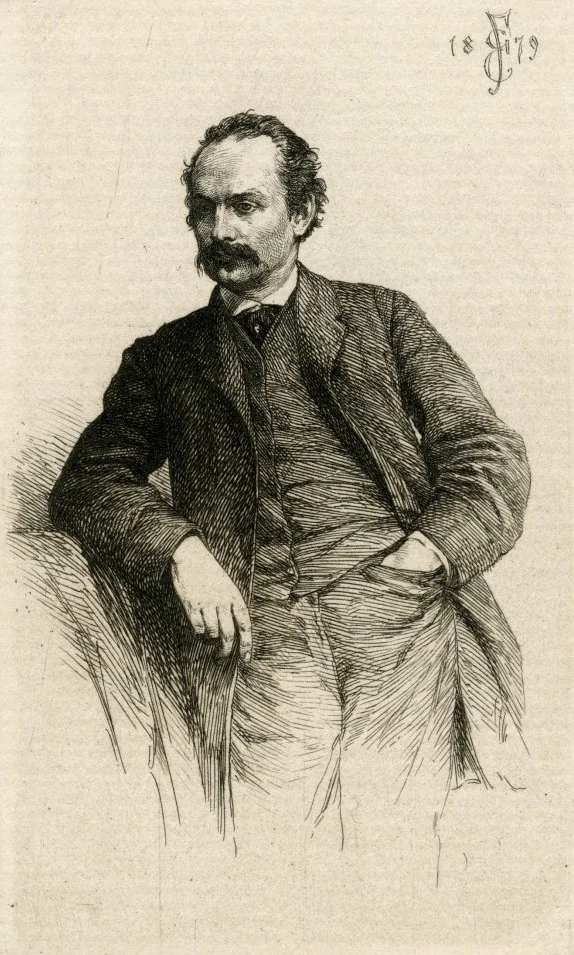
Image from Wikipedia
Image from Wikipedia
Hugo Harrer – Landscapes, Ruins, and the Quiet Power of the Düsseldorf School
A German Painter Between Architecture, Nature Observation, and Realism
Hugo Paul Harrer is among those 19th-century artists whose work is defined not by loud self-promotion but by precise observation, drawing discipline, and a fine sensitivity to atmosphere. Born on February 6, 1836, in Eberswalde and died on December 10, 1876, in Rome, he evolved from an aspiring architect to a landscape and architectural painter of the Düsseldorf School. His career took him from Nuremberg through Munich and Düsseldorf to Rome, where he found the motifs that would shape his oeuvre: ruins, street spaces, coastlines, and architectural corners with narrative depth. (de.wikipedia.org)
From Architecture Student to Self-Taught Painter
Harrer's path into art did not begin in an academic setting but in a practice he developed himself. Although he had started an architectural education, he quickly turned to painting as a self-taught artist and supplemented his private studies in the studios of friends through careful observation of nature. His first paintings were created in Nuremberg, where the city's architecture inspired him to early attempts at architectural painting. Even here, the connection between spatial awareness, linear perspective, and atmospheric accuracy, which would characterize his later work, was already apparent. (de.wikipedia.org)
His time in Munich brought him into contact with the then-new realistic painting style of Carl Theodor von Piloty, which profoundly impressed him. This phase is significant for Harrer's artistic development because it sharpened his view of contemporary life and distanced him from mere views of landscapes. Instead of idealized backdrops, he sought credible situations, living light, and a pictorial space that arises from observation and compositional order. His painting thus became a form of controlled representation of reality. (de.wikipedia.org)
Rome as a Workshop: Studies, Ruins, and Italian Coastlines
In 1861 or October 1862, Harrer moved to Rome for health reasons, where he joined Ludwig Passini and began outdoor studies. Rome became not only a place of residence for him but also a productive workshop where he collected motifs and transformed them into oil paintings. The city, with its ruins, street scenes, and historically significant architectural forms, offered him an inexhaustible world of motifs, which he translated with great precision into his visual language. (de.wikipedia.org)
Particularly characteristic are the painterly depictions of decaying ruins, small genre scenes, and Italian coastal landscapes. Harrer worked with a stock of sketches and studies that he collected during travels and excursions to be used later for oil paintings. This working method shows a blend of immediate observation and careful composition, typical of many representatives of the Düsseldorf School. The gaze remains objective, yet the effect of his images lives from the quiet charm of the aging, weathered, and spatially rich. (de.wikipedia.org)
Düsseldorf, Malkasten, and the Classification in the Düsseldorf School
In 1867 and 1868, Harrer stayed in Düsseldorf and studied at the Art Academy in Oswald Achenbach's landscape class. From 1868 to 1872, he was a member of the artists' association Malkasten, one of the central networks of the Düsseldorf art scene. This engagement marked his belonging to an environment where landscape, architecture, and precise drawing were held in high regard. Harrer thus navigated the tension between academic training and independent observation. (de.wikipedia.org)
The Düsseldorf School shaped an internationally influential landscape and genre painting in the 19th century, characterized by compositional clarity, careful detail, and a keen interest in spatial effect. Harrer fits into this tradition without being subsumed by it. His works seem less aimed at representative monumentality and more at quiet accuracy. It is precisely this quality that gives them lasting value: they combine nature study, architectural understanding, and realistic painting into a distinct artistic profile. (de.wikipedia.org)
Important Works and Thematic Focuses
Among the preserved works are Alte Hanse from 1868, View of the Amalfi Coast at Sunset from 1871, as well as At the Marcellus Theater in Rome and Theater of Marcellus in Rome from 1876. A painting titled A Jewish Street Vendor in a Street in Siena is also mentioned. These titles refer to Harrer's preferred pictorial worlds: urban spaces, historical architecture, Italian topographies, and scenes with a narrative subtext. (de.wikipedia.org)
His canon of motifs is closely linked to the perspective of an architectural artist. Harrer was interested in buildings not merely as backdrops but as carriers of history, light, and social space. In his depictions of ruins and streets, composition and observation come together in a type of image that offers the viewer tranquility, distance, and at the same time a quiet discovering. It is precisely the concentration on marginal zones, passages, and "painterly corners" that makes his works so characteristic. (deutsche-biographie.de)
Realistic Attitude and Painterly Precision
The Deutsche Biographie describes Harrer as a "thoroughly modern realist" who wanted to depict objects exactly as he saw them. This finding captures the essence of his work very precisely. Harrer placed great value on the manner of painterly representation, focusing on the quality of surface, light, and material presence. His realism is not cold documentary but rather a controlled, artistically thought-out form of fidelity to reality. (deutsche-biographie.de)
Immediate observation of nature remained particularly important to him. Even where architecture dominates, the image does not feel static but is permeated by air, time, and perspective. The early studies in Rome are said to have attracted attention due to their great truthfulness; this reaction indicates how strongly Harrer stood out among his contemporaries for his accuracy and seriousness. His work thus gains a quiet authority that is especially visible today in the sum of his consistent visual language. (deutsche-biographie.de)
Final Years in Rome and Posthumous Classification
After his stay in Düsseldorf, Harrer returned to Rome, from where he undertook extensive study trips and submitted larger paintings to German art exhibitions. Rome remained the central place of his work until his death and was also the place of his final resting; he was buried in the Protestant Cemetery in Rome. Sources also mention a small discrepancy with the biography of Rudolf Bergau, which states that the birthplace is also recorded as Hirschberg in Silesia, and that the date of death may differ in an older account. However, it remains clear in the history of his work that Harrer belongs to the realistically oriented painters of the Düsseldorf School. (de.wikipedia.org)
His posthumous fame derives less from broad popularity than from his art historical placement and museum preservation. The aforementioned works and references in literature anchor him within the network of 19th-century German and Italian art. Harrer thus represents a painting that observes precisely but never appears dry and perceives architecture as emotional and historical material. This very connection makes him interesting to this day. (de.wikipedia.org)
Conclusion: Why Hugo Harrer Remains Interesting
Hugo Harrer is an artist of quiet intensity. His paintings are alive with nature studies, architectural sensitivity, and a realistic attitude that neither exaggerates nor simplifies. Anyone interested in the Düsseldorf School, the Italian veduta, and the precise view of the 19th century will find a remarkable discovery in Harrer's work. His legacy invites a renewed consideration of the connection between space, history, and atmosphere. (de.wikipedia.org)
Especially in a time of rapid images, it is worthwhile to look at a painter who made patience, observation, and compositional clarity an art form. Hugo Harrer shows how strongly an artist can resonate when he does not chase after things but captures them with calm, precision, and stylistic consistency. His works deserve attention because they not only document but also transform the moment into a lasting pictorial order. (de.wikipedia.org)
Official Channels of Hugo Harrer:
- Instagram: no official profile found
- Facebook: no official profile found
- YouTube: no official profile found
- Spotify: no official profile found
- TikTok: no official profile found