
Gospel
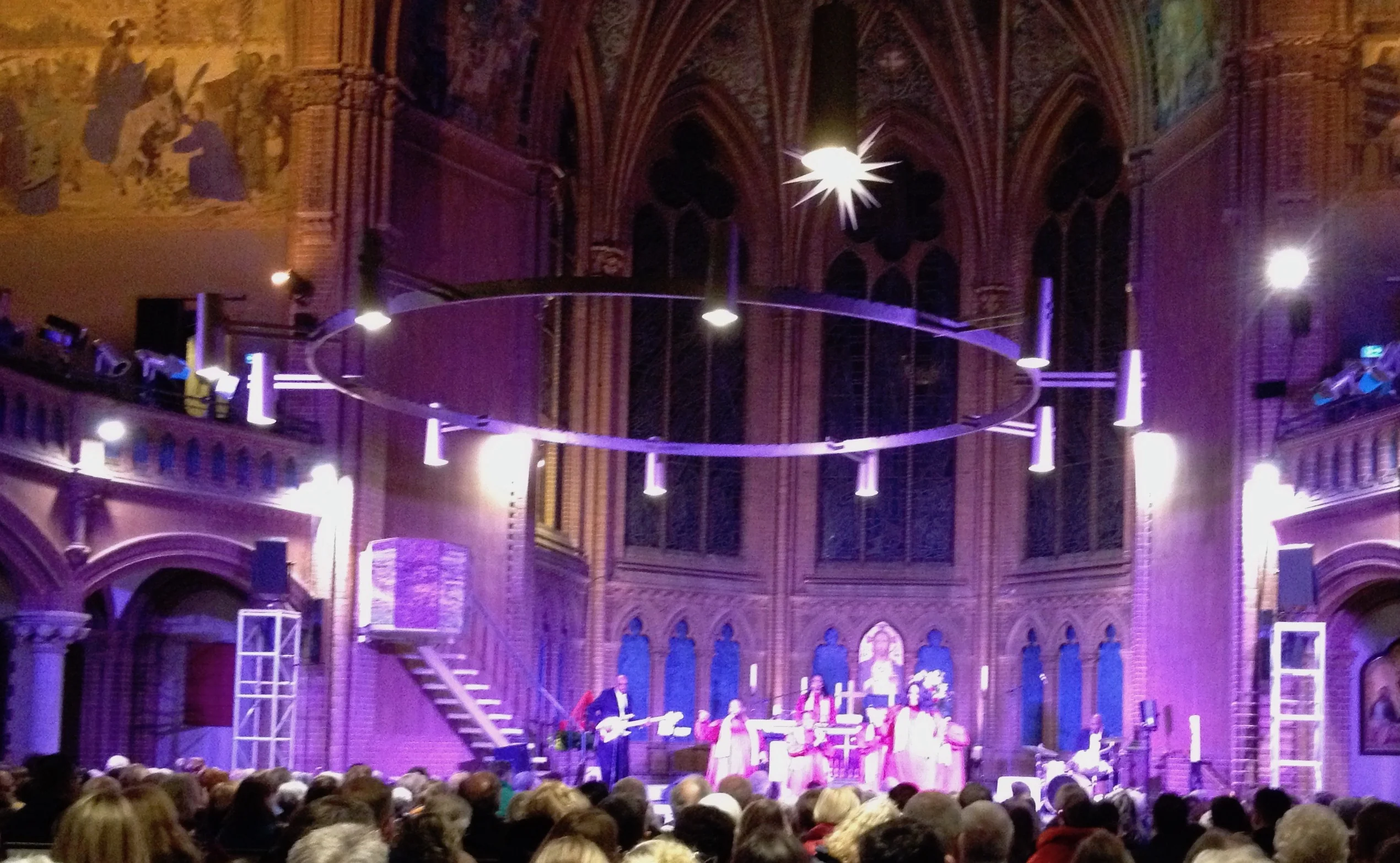
Image from Wikipedia
Image from Wikipedia
Gospel: The Sounding Power of Faith, Community, and Musical Renewal
Gospel – One of the Most Defining Religious Sound Languages in African American Music History
Gospel is much more than just a music style: it is a cultural expression, a spiritual practice, and a historically evolved sound system that has emerged from African American communities. In German usage, Gospel refers to a Christian Afro-American style that developed in the early 20th century from Spirituals, as well as elements of Blues and Jazz. In a broader sense, the term also encompasses Christian English-language music in Europe, including parts of Christian pop music. ([loc.gov](https://www.loc.gov/collections/songs-of-america/articles-and-essays/musical-styles/ritual-and-worship/african-american-gospel?utm_source=openai))
Those who understand Gospel hear not only melodies, harmonies, and rhythmic tension but also history: migration, resistance, hope, church community, and musical self-assertion. It is this connection between religious message and artistic intensity that makes Gospel one of the most influential traditions in modern music. The development of the genre can be seen as a bridge between sacred tradition and popular contemporary culture. ([loc.gov](https://www.loc.gov/collections/songs-of-america/articles-and-essays/musical-styles/ritual-and-worship/african-american-gospel?utm_source=openai))
Biographical Roots: A New Sound Emerging from Spirituals, Blues, and Jazz
The history of Gospel is intimately connected to the African American experience. Research and historical overviews describe how the style condensed in the 1930s from several sources: from hymn-like forms, from rural solo Gospel songs as a counterpart to Country Blues, and from the passionate worship practices of the Holiness and Pentecostal movements. This blend produced a new form of religious music that was emotionally direct, rhythmically freer, and vocally more expressive than many older church songs. ([loc.gov](https://www.loc.gov/collections/songs-of-america/articles-and-essays/musical-styles/ritual-and-worship/african-american-gospel?utm_source=openai))
Important impulses also came from the compositional tradition of Charles Albert Tindley, whose hymns incorporated elements of Spirituals, accompaniment, improvisation, and blues-like intervals. This development marked a crucial step: Gospel was not only sung but consciously shaped, arranged, and disseminated. As a result, a music emerged that gained its own aesthetic authority both in the congregation and on stage. ([loc.gov](https://www.loc.gov/collections/songs-of-america/articles-and-essays/musical-styles/ritual-and-worship/african-american-gospel?utm_source=openai))
The Artistic Development: From Hymn to Style-Defining Performance
Gospel is a music of vibrant interpretation. Call-and-response structures, rich choral work, improvisational gestures, and the combination of solo and ensemble continue to shape the genre to this day. These elements made Gospel connected to Jazz, Blues, Rhythm and Blues, Soul, and later also to Pop and contemporary worship forms. Thus, it became a stylistic nexus of African American popular music. ([encyclopedia.com](https://www.encyclopedia.com/literature-and-arts/performing-arts/music-history/african-music?utm_source=openai))
Historical representations also emphasize that Gospel is not just a repertoire of songs but also a special form of performance. The genre thrives on intensity, repetition, tension-building, and a voice that testifies rather than merely entertains. This connection between musical form and spiritual message explains why Gospel unfolds a strong emotional impact across generations in churches, concert halls, and on recordings. ([encyclopedia.com](https://www.encyclopedia.com/history/encyclopedias-almanacs-transcripts-and-maps/music-united-states?utm_source=openai))
Discography in a Broad Sense: Songs, Songbooks, Recordings, and Chart Presence
In Gospel, one does not speak of a classic discography of a single artist but rather of a broad corpus of songs, songbooks, choral works, and recordings. An early printed reference point is the publication of Philip Bliss's Gospel Songs in 1874, which made the term visible in a musical context. Later, songbooks, church recordings, quartet singing, choral productions, and live recordings helped to document and disseminate the style. ([en.wikipedia.org](https://en.wikipedia.org/wiki/Gospel_music?utm_source=openai))
In the present, Gospel remains relevant on the charts: official charts continue to list Christian and Gospel albums, demonstrating the genre's enduring market presence. The Official Charts document a separate Christian & Gospel Albums Chart, which will be showcased until July 2026. This indicates that Gospel not only has historical significance but continues to form a clearly recognizable category in the music market today. ([officialcharts.com](https://www.officialcharts.com/charts/christian-and-gospel-albums-chart/?utm_source=openai))
Critical Reception: Between Church Tradition, Cultural Recognition, and Pop Impact
The reception of Gospel has never been static. Historical sources note that the style initially encountered resistance because it shifted the boundaries between sacred tradition and popular expression. However, it is precisely this tension that made Gospel a defining form of the 20th century. It connected black sacred folk music with urban styles, thus contributing to a sustainable change in American music culture. ([academic.oup.com](https://academic.oup.com/reference/62284/reference-article-abstract/552003678?utm_source=openai))
Cultural recognition is also evident in institutional signs: in 2008, the U.S. Congress explicitly honored Gospel Music with a resolution designating September as Gospel Music Heritage Month. Such official honors underscore how deeply the genre is rooted in the cultural history of the United States. Gospel is thus not only a musical style but also a socially recognized cultural heritage. ([congress.gov](https://www.congress.gov/bill/110th-congress/senate-resolution/595?utm_source=openai))
Musical Language: Arrangement, Harmony, and Emotional Dramaturgy
Musically, Gospel thrives on a special balance between structure and ecstasy. Characteristic features include strong vocal dynamics, repeated refrains, modulated crescendos, and an arrangement that often places the choir as the collective voice of the congregation at the center. Harmony often incorporates blues-like tensions, while the rhythm generates immediate physical movement. ([loc.gov](https://www.loc.gov/collections/songs-of-america/articles-and-essays/musical-styles/ritual-and-worship/african-american-gospel?utm_source=openai))
Particularly in African American churches, this developed into an art form where production and interpretation are inseparably linked. Gospel is therefore both composition, performance, and social practice. Its power arises from the combination of musical precision and spiritual urgency, which manifests in every phrase, every response, and every vocal line. ([encyclopedia.com](https://www.encyclopedia.com/history/encyclopedias-almanacs-transcripts-and-maps/music-united-states?utm_source=openai))
Cultural Influence: From Church to Mainstream
The influence of Gospel extends far beyond the genre itself. Historical and musicological sources emphasize that Gospel has shaped the development of Jazz, Blues, R&B, Soul, and even Country. Many central features of modern popular music – such as emotional lead singing, choral density, and call-and-response-based communication – have been decisively molded by Gospel. ([encyclopedia.com](https://www.encyclopedia.com/literature-and-arts/performing-arts/music-history/african-music?utm_source=openai))
In Europe, the term has also expanded and today partly represents Christian English-language music as well as forms of Christian pop music. This conceptual broadening shows how adaptable Gospel has become while not denying its origins. Between tradition, transcendence, and contemporary production, Gospel remains a music that creates identity and crosses boundaries. ([loc.gov](https://www.loc.gov/collections/songs-of-america/articles-and-essays/musical-styles/ritual-and-worship/african-american-gospel?utm_source=openai))
Current Developments: Gospel in the 21st Century
Even in the 2020s, Gospel remains a vibrant field with new productions, crossover projects, and spiritually motivated releases. Official label announcements show that the term Gospel continues to be present in current album concepts, collaborations, and cross-genre works. Thus, Gospel remains not just a preservation of tradition but also a space for artistic renewal. ([bluenote.com](https://www.bluenote.com/artist/joel-ross/?utm_source=openai))
This present is important for contextualization: Gospel has never been reduced to a museum of the past. Instead, the genre continues to evolve along new voices, new production methods, and new listening habits. This remarkable durability lies in its ability to remain closely connected to faith while also being open to the present. ([officialcharts.com](https://www.officialcharts.com/charts/christian-and-gospel-albums-chart/?utm_source=openai))
Conclusion: Why Gospel Continues to Fascinate Today
Gospel is one of the great musical testimonies of African American history. The genre connects faith, community, artistic creation, and cultural self-assertion in a way that still resonates today. Its strength lies in emotional directness, in the choral singing power of the community, and in the ability to transform pain into hope. ([loc.gov](https://www.loc.gov/collections/songs-of-america/articles-and-essays/musical-styles/ritual-and-worship/african-american-gospel?utm_source=openai))
Those who experience Gospel live immediately understand why this music has moved people for over a century. The blend of rhythmic energy, vocal dedication, and spiritual intensity creates moments that go far beyond an ordinary concert experience. Gospel remains an invitation to not just listen to music but to experience it existentially. ([philadelphiaencyclopedia.org](https://philadelphiaencyclopedia.org/essays/gospel-music-african-american/?utm_source=openai))
Official Channels of Gospel:
- Instagram: No official profile found
- Facebook: No official profile found
- YouTube: No official profile found
- Spotify: No official profile found
- TikTok: No official profile found
Sources:
Upcoming Events
Summer Serenade in Cottbus
Summer Serenade: Joyful Concert
Summer Serenade at St. Nikolai Church
SINGING IN MY SOUL – Anniversary Concert of the Gospel Choir St. Lukas
Singing in my soul - Anniversary Concert of the Gospel Choir St. Lukas, Munich
Singing in my soul - Anniversary Concert of the Gospel Choir St. Lukas, Munich
Lord reign in me

Gospel Choir Braunschweig with Guests from the USA
PraiSing Gospel Christmas