Zero Waste & Green Events: Celebrate Sustainably in Cottbus
Zero Waste & Green Events: How Cottbus Will Celebrate Sustainably in the Future
In the coming years, Cottbus wants to show that large festivals, culture, and conferences can succeed with less waste, lower emissions, and fair procurement. This guide compiles practical building blocks for organizers and visitors – with a focus on future events.
From After-Work Beer to Green Event: Cottbus in Transition
Cottbus plans to gradually make its event landscape more sustainable: from city festivals and open-air cinemas to conferences and concerts. The key is not to treat sustainability as a one-off measure, but as a repeatable process – with clear goals, responsibilities, and transparent criteria.
In the coming seasons, organizers in Cottbus will likely rely more often on standardized sustainability approaches, such as guidelines, checklists, or multi-level programs that bundle concrete measures in areas like mobility, energy, waste, and social responsibility. This can turn individual green ideas into a reliable standard for future events.
Green Events: Six Building Blocks for Sustainable Events
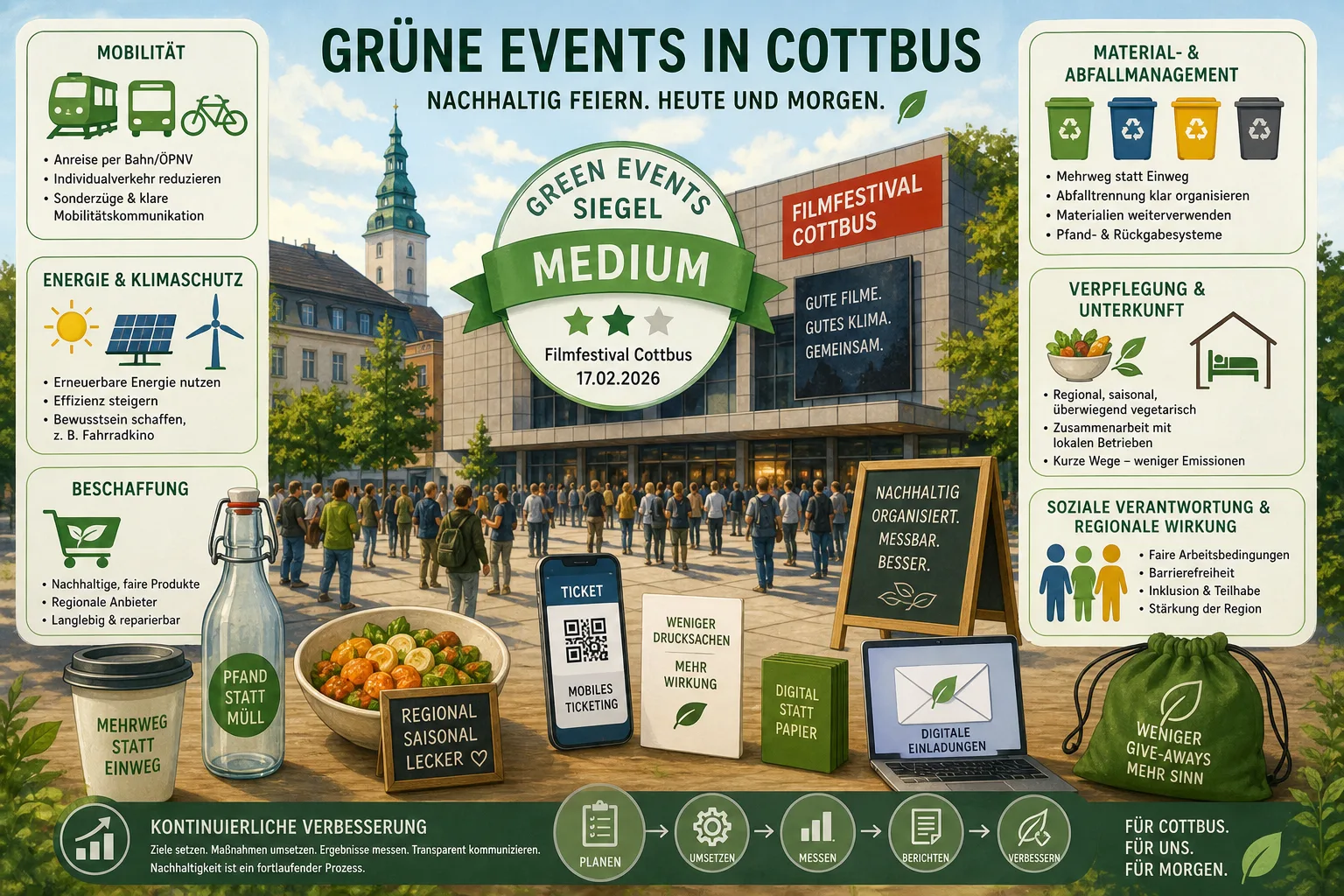
For planning future green events, a structure along central fields of action has proven effective. These six building blocks help to systematically prioritize, document, and improve measures from edition to edition:
- Mobility – Arrival and departure of guests, teams, and artists
- Energy & Climate Protection – Power supply, efficiency, emission reduction
- Procurement – Products, services, supply chains, standards
- Material and Waste Management – Avoidance, reusable systems, separation, cycles
- Catering & Accommodation – Catering, drinks, food waste, overnight stays
- Social Responsibility & Regional Impact – Accessibility, fairness, local value creation
This structure fits established sustainability logics such as the waste hierarchy (prevention before reuse before recycling) and management approaches that focus on continuous improvement. This will be crucial for upcoming events in Cottbus: less symbolism, more measurable routines.
Zero Waste in Cottbus: Less Waste, More Experience
Zero Waste will be understood at future events in Cottbus primarily as a direction: avoiding waste, closing material cycles, and separating the remaining waste as cleanly as possible. For visitors, this can even be more pleasant – fewer overflowing bins, cleaner areas, and a more coherent overall experience.
Concrete Measures Suitable for Upcoming Events
- Reusable instead of disposable: Cups, dishes, and cutlery in a deposit/return system reduce waste volumes and cleaning effort on site.
- Plan water and beverage logistics smarter: Where possible, use refill and dispensing concepts (instead of many disposable bottles) and communicate transparently.
- Make waste separation visible: Uniform, well-signposted collection points with clear pictograms improve sorting quality.
- Minimize printed materials: Provide programs, site maps, and information preferably digitally; print only selectively and in reduced quantities.
- Critically review promotional materials: Giveaways only if they are durable, useful, and meaningful; otherwise, omit them.
Preventing Food Waste – Before Anything Is Left Over
Especially at city festivals, markets, and festivals, food losses often occur due to incorrect quantity planning and lack of processes at the end of the day. For upcoming events in Cottbus, these levers are particularly effective:
- Calculate needs realistically: Include portion sizes, peak times, and weather risks in planning.
- Flexible portioning: Offer small and large portion options to reduce over-purchasing.
- Define leftover strategy in advance: Set clear rules for storage, redistribution, and disposal – including responsibilities.
Mobility and Energy: The Silent Climate Factors of Events
Mobility: Arrival as the Biggest Lever
For the climate impact of upcoming events, the arrival and departure of guests will often be more decisive than stage or lighting technology. That’s why it pays off in Cottbus to plan so that the sustainable option becomes the easiest option:
- Actively promote public transport and trains: Communicate travel information, accessible routes, departure times after the event, and clear walking routes from the train station.
- Prioritize bicycles & walking: Provide good parking facilities and safe routes around the site.
- Reduce car traffic: Design parking information, carpooling options, and, if necessary, shuttle solutions so that congestion and search traffic decrease.
Energy: Source Renewably, Use Efficiently
For future events in Cottbus, two goals can be combined: Source electricity as much as possible from renewable sources and reduce consumption. In practice, these work particularly well:
- Efficient technology: LED lighting, time- and zone-based control, and energy-saving auxiliary devices.
- Avoid peak loads: Technical planning that reduces unnecessary peak performance (e.g., coordinated switch-on times).
- Make energy visible: Participatory formats such as a planned bicycle cinema or energy info points can involve guests and create understanding.
Regional Cuisine, Digital Tickets: Enjoying Sustainably in Cottbus
Catering with Regional Impact
At upcoming festivals and city festivals in Cottbus, catering can fulfill several goals at once: enjoyment, short delivery routes, better planning, and less waste. Proven approaches are:
- Buy regional & seasonal: Shorter transport routes and better traceability of origin.
- More plant-based options: A wide range of vegetarian/vegan options usually reduces the environmental impact per portion.
- Reusable in serving: Consistently use reusable systems for drinks and food service.
Digitization: Less Paper, Better Accessibility
Digital tickets, online programs, and well-structured event websites can reduce paper consumption and at the same time improve accessibility (e.g., through plain language, scalable font sizes, and easily accessible information on entrances, sanitary facilities, and retreat areas). For future Cottbus events: The clearer the information, the easier it is for guests to travel sustainably and participate.
Certification, Seals, Continuous Improvement: What Cottbus Can Achieve Next
So that sustainability at future events does not depend on the commitment of individuals, a management approach with clear criteria and regular review helps. Internationally, for example, ISO 20121 is established as a standard for sustainable event management. Even without formal certification, its principles can serve as a guideline: set goals, define responsibilities, assess risks, document measures, and improve after each event.
A Realistic Roadmap for Upcoming Events
- Create a foundation: Reusable systems, waste separation, digital communication, minimum standards in procurement.
- Increase impact: Mobility concept, energy efficiency, regional partnerships in catering and services.
- Strengthen transparency: Briefly report after the event (e.g., reusable quota, waste volumes, travel information) and announce improvements for the next edition.
This way, Cottbus can develop a clear profile in the coming years: celebrating with atmosphere – and at the same time with a plan that conserves resources, involves local businesses, and makes social standards visible.