Experience Startups & Innovation Events in Cottbus
Startups & Innovation Events in Cottbus (Outlook 2027): Formats, Opportunities, and How to Participate
7 min readLaura Müller
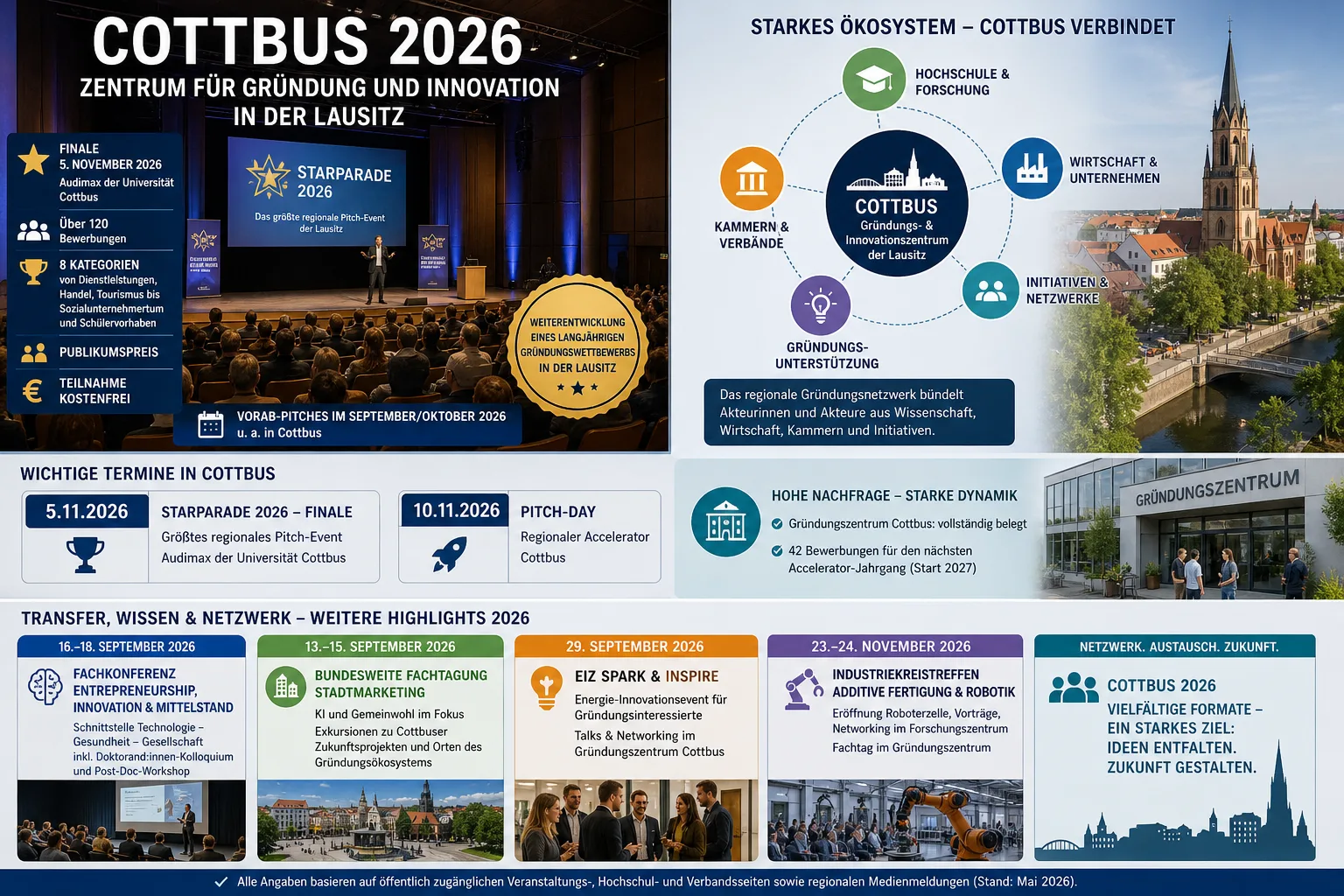
Cottbus is developing into a visible meeting point for founders, students, companies, and everyone who wants to experience innovation in practice during the structural transformation. For 2027, an event mix is emerging that ranges from pitch formats to accelerator programs to technology transfer meetups. This article bundles the most important event types, explains the typical process, and shows concrete next steps so that you can find suitable dates, apply, or participate as a visitor.
Target group: People interested in founding, startups, students, SMEs, investors, administration, citizens, and visitors.
Which Innovation and Startup Events You Can Expect in Cottbus in 2027
Even without "one" central flagship event, an ecosystem thrives on recurring formats that cover different phases of founding: idea generation, validation, prototyping, market entry, and growth. In Cottbus, these event types are particularly relevant in 2027:
- Pitch events (short presentations in front of a jury and audience, often with feedback and prizes)
- Accelerator and incubation programs (multi-week cohorts with coaching, mentoring, and demo day)
- Technology transfer formats (specialist meetups, lab tours, industry talks, workshops)
- Conferences on entrepreneurship & urban development (panels, keynotes, practical and scientific contributions)
- Community meetups (after-work, founders’ breakfast, thematic regulars’ tables)
The most reliable way to find current dates is to check the official event calendars of the university, regional startup and transfer offices, and economic development agencies. This way, you avoid outdated dates and receive the valid participation conditions.
Pitch Events in Cottbus: Stage, Feedback, and a Quick Reality Check
Pitch formats are particularly valuable in 2027 if you want to test an idea early: you receive condensed feedback, meet potential co-founders or pilot customers, and practice explaining your project clearly. In Cottbus, pitch evenings are typically structured as follows:
Typical Process of a Pitch Format
- Call for Applications: Apply with a short description, problem, solution, target group, team, and status (idea/prototype/market).
- Preparation phase: Pitch training, storyline, live demo (if available), Q&A simulation.
- Pitch stage: 3–7 minutes pitch, followed by Q&A.
- Feedback & networking: Conversations with jury, mentors, and audience.
- Optional: Audience voting: If provided, audience response is included alongside the jury rating.
How to Increase Your Chances of a Convincing Application
- Demonstrable need: Outline how you validated the problem and target group (interviews, tests, waiting list, pilot partners).
- Concrete benefit: Metrics are good – but also a clear "before/after" effect.
- Implementation capability: Team roles, timeline, and access to resources (e.g., lab, data, industry contacts).
- Openly name risks: Regulation, data protection, IP/patents, dependencies – and how you deal with them.
Accelerator & Incubation 2027: How Ideas Gain Momentum in a Few Weeks
Accelerator and incubation programs are suitable for 2027 if you not only want to "get on stage" but also make structured progress: with milestones, mentors, and access to network partners. In the region, such programs are often implemented in cooperation between the university, startup services, transfer actors, and business partners.
What a Good Early-Stage Program Should Provide
- Business model & validation: Target group, value proposition, pricing logic, go-to-market.
- Legal & IP: Legal form, contracts, trademark/patent research, licensing models.
- Financing: Funding logic (e.g., startup grants), investor readiness, planning runway and unit economics.
- Sales & partnerships: Pilot projects, references, industry access.
- Demo day: Final presentation in front of stakeholders (companies, funding agencies, investors).
If your project originates from research or works closely with a university, it is also worth looking at programs and consulting services in 2027 that explicitly support spin-offs from science and transfer. For technology- and knowledge-based startups, clear IP and exploitation paths are often critical to success.
Hands-On Technology 2027: Transfer Meetups, Lab Tours, and Industry Formats
Many innovations arise where research, companies, and startups work together on concrete questions: automation, robotics, additive manufacturing, data applications, energy and mobility solutions, or digital city services. Transfer events in Cottbus are particularly useful in 2027 if you:
- want to check as a company which technologies are suitable as pilots,
- as a startup are looking for an industrial use case or test environment,
- as a student want to identify topics for your thesis, internship, or startup.
How to Recognize Practice-Oriented Transfer Events
- Use-case focus instead of pure theory: concrete problems and solution paths.
- Demonstrations: Showcases, test stands, lab tours, or live demos.
- Matchmaking: Moderated discussions and slots for 1:1 exchange.
- Follow-up structure: Clear path to pilot project, workshop series, or working group.
Entrepreneurship & Urban Development 2027: When Innovation Is Translated into Everyday City Life
In 2027, it will be particularly relevant for Cottbus how innovation has an impact beyond founder teams: in urban development, public services, community projects, and new service offerings. Specialist conferences and public dialogue formats are suitable bridge formats for this. They bring administration, business, science, and civil society to the table and create spaces for:
- digital city services (e.g., user-centered processes, data literacy, accessibility),
- responsible AI applications (data protection, transparency, benefit orientation),
- energy and climate protection solutions with a view to acceptance and feasibility,
- health & care innovations with high sensitivity to safety, evidence, and regulation.
If you want to participate as a visitor in 2027, look for formats with open program parts (keynotes, panels, trade fair/expo areas). If you want to participate as a project team, check submission deadlines for practical sessions, posters, or pilot ideas.
How to Find the Right Dates in 2027 (Without Detours)
Since events can change at short notice, the best strategy is a combination of official sources and direct network contact. For Cottbus, these approaches are typically suitable in 2027:
- University and transfer websites: Dates for pitch nights, transfer workshops, lectures, and startup-related consultations.
- Economic development & regional networks: Information on cluster and industry meetings, funding info events, and cooperation formats.
- Chambers & associations: SME-related events, consultation days, information formats.
- Funding programs: Webinars, roadshows, calls, and consulting services related to startup funding.
Practical tip: Make a short list of your goals (e.g., "pilot customer", "co-founder", "check funding eligibility", "technology contact"). With this list, you select events not by buzzwords, but by concrete benefit.
Responsibility & Diligence: What Teams Should Pay Attention to in 2027
In innovation contexts, the closer a topic is to health, finance, security, or personal data, the more important are evidence, transparency, and compliance. For 2027, these principles are particularly relevant in practice:
- Data protection & security: Clarify legal bases, data flows, and protective measures early on.
- No overpromising: Formulate benefits as verifiable hypotheses, not as guaranteed effects.
- Traceability: Document tests, feedback, decisions, and assumptions.
- Fairness & accessibility: Consider accessibility and low-discrimination processes.
This article serves as orientation and does not replace legal, tax, or funding advice. For concrete projects, you should use qualified advice and the official guidelines of the respective programs.