Which running formats you can expect in Cottbus
Under the term "sports events & running events in Cottbus," several formats appear in practice. For your planning in the coming months, these categories help:
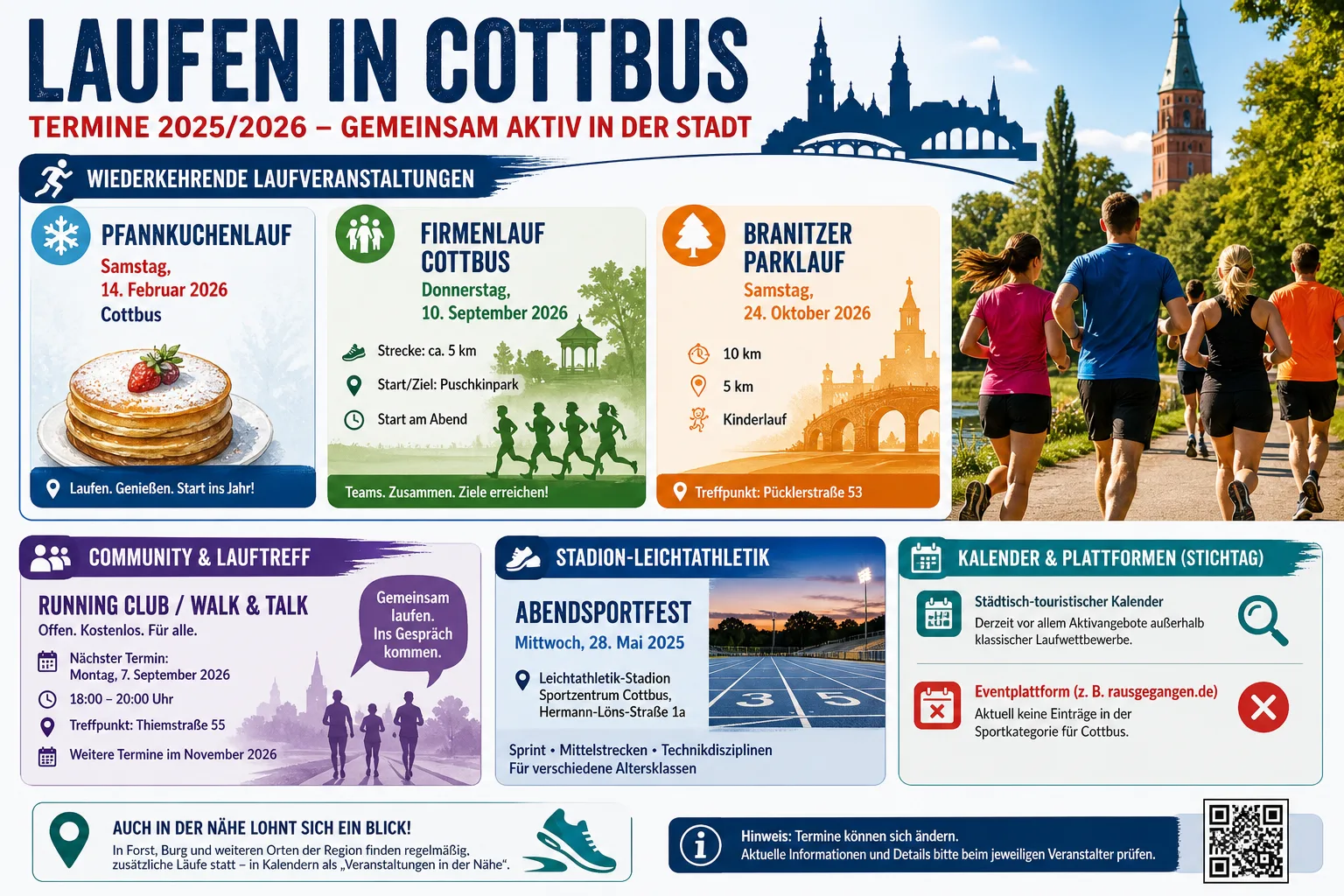
In themed runs, the community aspect is in the foreground: relaxed pace, many first-timers, often additional program points around the running theme. If you want to (re)start or are looking for a low-threshold event, such dates are often the right choice.
Suitable for: Beginners, occasional runners, familiesTypical distances: short laps, often several optionsWhat to clarify beforehand: Registration deadline, starting waves, timing (if relevant)
Team events like company runs are ideal when motivation comes from community: training groups at work, fixed team names, joint arrival, and a straightforward, comparatively short competition. A distance of about five kilometers is common so that different fitness levels can participate.
Suitable for: Teams from companies/institutions, running groups, returneesTypical requirements: Team registration, possibly relay or group scoringPractical tip: Plan early who will run together and who will "just" finish vs. who will set the pace.
Park runs combine a clear competition structure with a scenic loop. There are often several distances (e.g., 5 km and 10 km) as well as children's runs. This is especially practical for families: adults can run one distance while children start in their own groups.
Suitable for: Beginners to ambitious hobby runners, familiesWhat to plan for: Weather-appropriate clothing, non-slip running shoes (depending on the surface)
Stadium formats differ significantly from road and park runs: clear track laps, precise distances (e.g., 800 m, 1500 m, 3000 m), often several age groups, and a process with announcements, bib number checks, and exact timing. This is especially exciting if you want to gain competition routine or test your pace on a defined course.
Suitable for: Sports club members, ambitious runners, youthTypical features: Spike rules, registration times, track allocation
If you (still) don't want a competition, open running meetups are the best bridge: You move in a group, switch between easy running and brisk walking as needed, and get tips on pace, technique, and load management along the way. Especially for newcomers, this reduces uncertainty and increases the chance of sticking with it.
Suitable for: Beginners, anyone looking for social motivationClarify in advance: Meeting point/time, performance groups, whether registration is required
How to find reliable dates and current route information
For the coming season: The most reliable information always comes from the official communication of the respective organizers. Public calendars are helpful but do not necessarily cover all running and sports dates or are not always up to date.
For your planning, it is best to use this order:
Official event page/registration portal of the event (dates, routes, participation conditions, liability, data protection).Club pages (announcement, registration classes, schedule, contact).Municipal/regional event calendars (good overview, but always double-check details).Social media channels of the organizers (updates on weather, route changes, start documents).
Also plan for the fact that running events may be adjusted for safety or permit reasons. The decisive factor is therefore the last official notice shortly before the event.
Planning & training up to the start: practical roadmap
Choose a goal: finish, improve time, or "first 5 km"
First, decide what you want to get out of the event. This prevents overwhelm and makes your preparation measurable:
Finish & fun: You train regularly but without hard sessions. Perfect for themed or team runs.First 5 km nonstop: You build up run/walk intervals and increase the running portions.Improve time: You combine easy endurance runs, tempo sections, and recovery.
Health & safety: increase realistically
A simple guideline: Increase volume and intensity gradually and allow yourself rest days. If you have taken a long break, have pre-existing health conditions, or notice symptoms during exertion (e.g., chest pain, dizziness, unusual shortness of breath), a medical check-up is advisable before more intensive training.
For general health orientation (and as motivation), the World Health Organization's physical activity recommendations can help set realistic weekly goals.
Equipment: better suitable than "high-end"
Running shoes: comfortable, sufficient cushioning/fit; break them in before the event.Clothing: weather-appropriate (layering principle), no experiments on race day.Start documents: secure attachment of the bib number (pins or band), if required.Drinks: for longer distances or heat, plan your hydration strategy early.
Realistic time planning: avoid the most common pitfalls
In practice, a good event day rarely fails because of the run itself, but because of organization. Therefore, plan:
Arrival buffer: extra time for parking/public transport and closed areas.Pick up start documents: check time window and location, possibly possible the day before.Warm-up: 10–15 minutes of easy jogging plus mobilization (especially in cool weather).Start block/wave: sort yourself realistically (fair for you and others).
Checklist for event day
Before the start: light warm-up, last toilet visit, check bib number/chip (if available).During the run: start at a consciously controlled pace; for 5 km: don't "overdo" the first 500 m.After finishing: jog or walk, drink something, put on dry clothes (especially in wind/cold).If you run as a team: arrange a meeting point after finishing, as mobile network and crowds may vary.
Tips for visitors
If you are traveling to Cottbus for a running event, make the city "runnable":
Arrive early: You avoid stress and can check out route sections or entrances/exits on site (without disturbing the event).Easy exploration run the day before: 20–30 minutes of easy movement helps many to acclimatize.Plan for the weather: In autumn and winter, wind- and cold-proof layers are crucial; in warm weather, sun protection is important.Respect rules: Observe official barriers and route instructions to keep the event safe.
This way, the running event becomes not only a sports appointment but also an active city visit with minimal organizational effort.
Note: This article is for information purposes and does not replace medical advice. In case of health complaints or uncertainties: seek medical clarification.
Last reviewed: 2026-10-21