Interreligious Events & Cultural Festivals in Cottbus
Interreligious Events & Cultural Festivals in Cottbus (Outlook from Late Summer 2026)
What interreligious formats, cultural festivals, and meeting spaces can be expected in Cottbus in the coming months and in 2027? This overview bundles typical highlights (from city festivals to church nights to festival formats), classifies them, and shows where you can find reliable dates.
Cottbus City Festival (expected 2027): Culture, Diversity, Sorbian/Wendish Perspectives
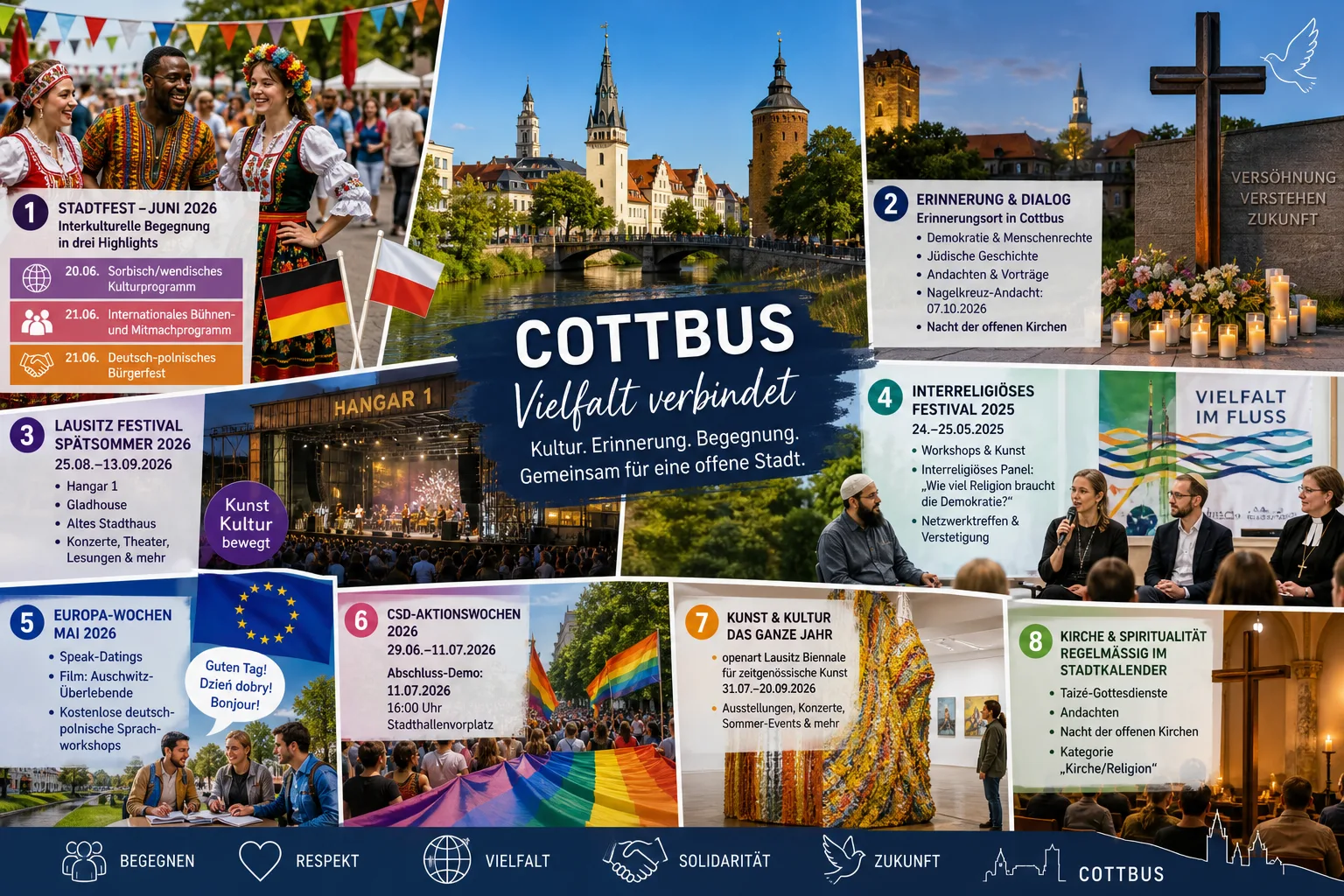
For 2027, as is common in many cities, a large city festival is expected again in Cottbus in the summer. Such city festivals typically combine stage programs, hands-on activities, club life, and culinary stands in the city center, creating a low-threshold framework for encounters.
What visitors can expect to experience
- International Program: Concerts, choirs, dance, and neighborhood initiatives, often complemented by information stands from local organizations.
- Dialogue in Passing: Especially where culture and community work come together (e.g., stage moderation, club presentations, hands-on activities), spontaneous conversations about origin, everyday life, and coexistence often arise.
- Regional Identity: In Lusatia, cultural diversity also includes the Sorbian/Wendish perspective. When it appears in the supporting program, it is usually an invitation to consciously consider regional history and the present.
If you want to use the city festival specifically as a "meeting format": Plan not only to attend a concert, but also allow time for information stands, short tours, or workshops, which are often offered in the afternoon.
Remembrance, Democracy & Spirituality: Memorial Formats and Church Events (from Autumn 2026/2027)
In Cottbus, several types of events are likely in the coming months and in 2027 that combine remembrance work, civil society learning, and spiritual forms. Depending on the organizer, this can look very different: from historical-political education to silent devotions to cultural evening formats in church spaces.
Typical formats you can look for in the calendar
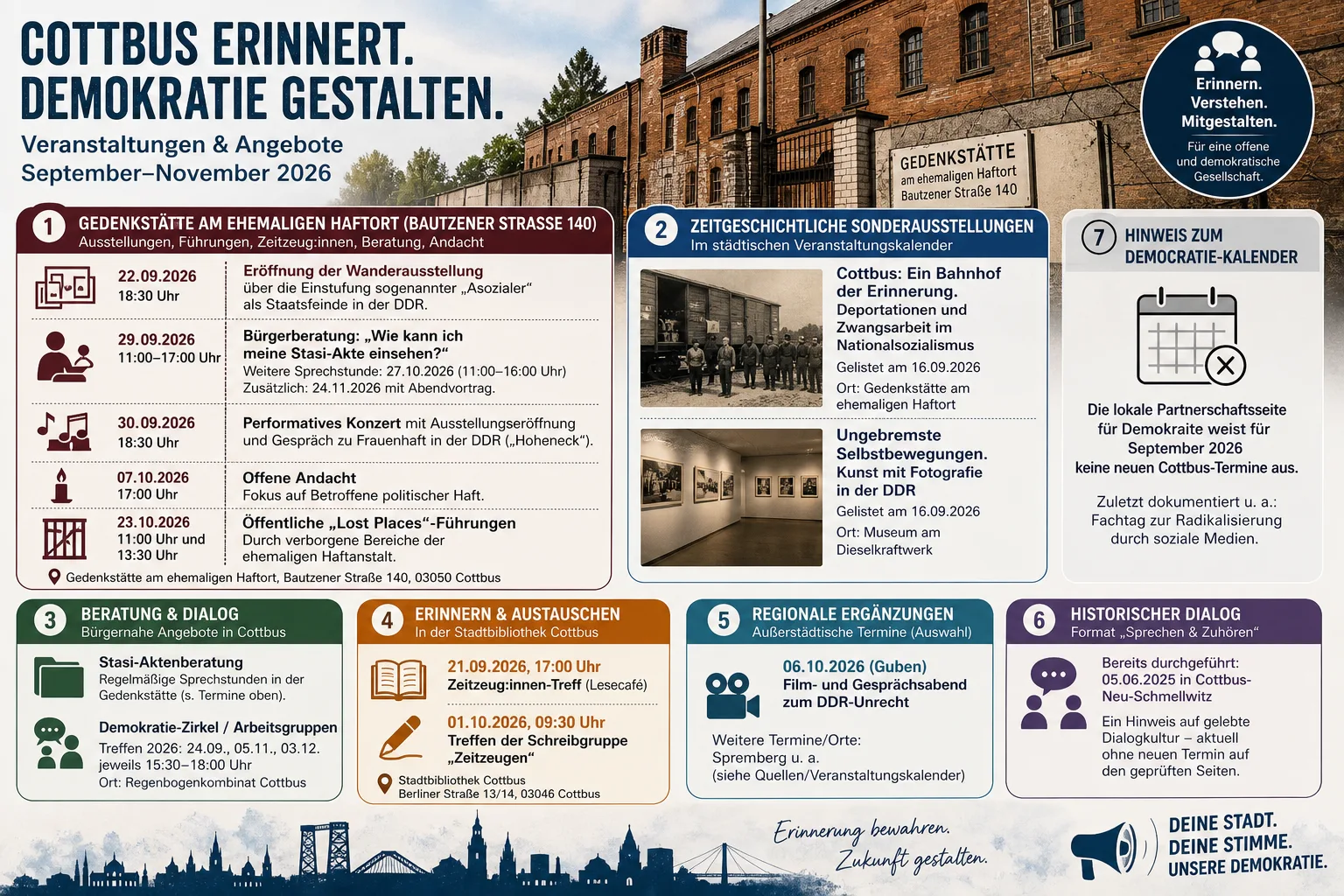
- Memorial and learning events: Guided tours, lectures, readings, and discussion evenings that focus on historical experiences and democratic responsibility.
- Music & opening spaces: Church spaces are often opened for concerts, installations, or themed evenings—often with a short introduction to the significance of the place.
- Silent formats: Candle moments, meditative music, short texts, and times without a program (deliberately as a "breathing pause" in the evening schedule).
If you are participating for the first time: Many venues communicate in advance whether it is more of a cultural evening, a dialogue format, or a liturgical offering. This helps to set expectations appropriately.
Interreligious Festival and Workshop Formats: What You Can Expect in the Future
Interreligious exchange does not only take place on panels. For Cottbus, formats that combine art, bodywork, music, and conversation are also conceivable in the future. In announcements, pay particular attention to terms such as "workshop," "lab," "creative," "encounter," or "interreligious."
Why creative formats often work particularly well
- Low-threshold entry: A workshop (e.g., writing, drawing, dance, music) allows participation without prior knowledge of religion or theology.
- Experience instead of debate: When people first create together, the subsequent conversation is often more respectful and concrete.
- Polyphony becomes visible: Different religious or ideological backgrounds can stand side by side without having to be "resolved."
Practical tip: If a program announces a "panel" or a "fishbowl," this is usually an indication of an interactive conversation format in which the audience plays an active role.
Europe Weeks, CSD & Cultural Series: Diversity in Urban Space (2027)
Even without an explicitly religious focus, citywide theme weeks and festival series shape the image of diversity. For 2027, the following types of events are particularly realistic, which you can note in your calendar:
Europe-oriented theme weeks (typically in spring)
Europe Weeks often combine language, film, discussion, and civil society encounters. In Cottbus—due to the regional location and everyday relevance—multilingual offerings and exchange formats can be expected.
- Language encounters (e.g., short tandem formats)
- Film evenings with discussion
- Workshops on European remembrance culture and the present
CSD-related action weeks (typically in late spring/summer)
Queer visibility often arises in action weeks through readings, information stands, panels, and a larger closing event. In some cities, religious or church groups also participate with their own discussion offerings (e.g., "Faith & Diversity"), while other actors deliberately remain secular. Both can be meaningful side by side.
Art and cultural series (typically in late summer/autumn)
For the second half of 2027, more bundled cultural programs are likely again, in which venues (e.g., cultural centers, off-locations, temporary exhibition spaces) combine concerts, theater, installations, and discussions. Thematically, structural change, identity, and coexistence are often the focus in Lusatia—topics that can be well combined with dialogue formats.
Regular Offers: Church/Religion, Music, Conversation, and Open Spaces (from Autumn 2026)
In addition to major highlights, it is worth looking at recurring dates that are particularly plannable from autumn 2026 and in 2027. In the event calendar, you will often find such offers under categories like "Church/Religion," "Concert," "Reading," or "Education."
Recurring formats you can look for
- Music in churches: Choir evenings, organ or chamber concerts, themed programs with short introductions.
- Meditative services: Formats with singing, silence, and reduced liturgy (often announced as "meditative," "Taizé-inspired," or "evening prayer").
- Discussion evenings: Ethics, coexistence, worldviews, intercultural questions—often with moderated discussion.
- Open meetups: Neighborhood evenings, cultural salons, open doors on certain weekdays.
If you want to get involved, recurring offers are usually the best entry point: You get to know people over several dates, instead of just having "event contacts."
Practical Tips: Arriving, Participating Respectfully, Planning with Accessibility in Mind
Participate Respectfully (Interreligious & Cultural)
- Questions are welcome, judgments are not necessary: In dialogue formats, curiosity is usually expressly desired; missionary or derogatory comments, on the other hand, are rare.
- Observe clothing & photo rules: For spiritual parts, there may be notes on appropriate clothing or photo/film bans.
- Choose language sensitively: In conversations about faith, identity, or discrimination, it helps to speak from the "I" perspective ("I experience...", "I know...").
Plan with accessibility in mind
- Arrival: Check in the announcement whether a venue is easily accessible by public transport and whether there are notes on parking options.
- Accessibility: Look for information on wheelchair accessibility, induction loops, plain language, or companion regulations.
- Admission times: For concerts/performances, it is worth arriving early if you need a quiet place or certain sightlines.
Sources & Further Links
- City of Cottbus/Chóśebuz (official website) — Starting point for administration, cultural information, and links to official offers (accessed 2026-08-12)
- Cottbus (Overview, Background) — Context on the city, region, and cultural environment; please check details against official organizer pages (accessed 2026-08-12)