Events in Cottbus: Democracy & Contemporary History
Events on Democracy & Contemporary History in Cottbus (Preview)
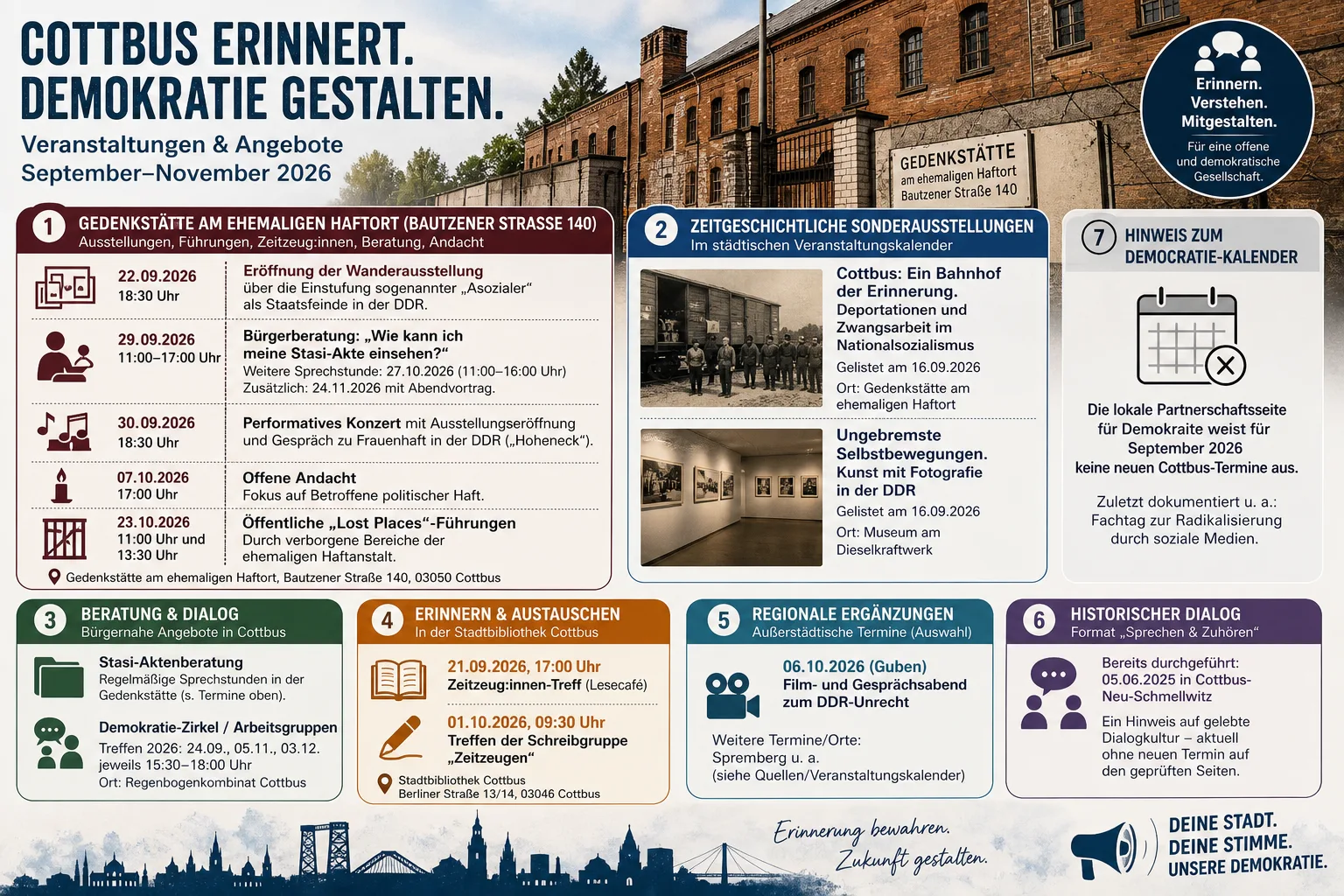
Cottbus also offers a wide range of opportunities in the coming months to engage with democracy, experiences of dictatorship, and the culture of remembrance: in memorial and museum formats, in library talks, at film evenings, as well as in counseling services for processing personal GDR biographies. This overview helps you find suitable upcoming events and participate well-prepared.
Exhibitions with Contemporary History Reference: Topics You Can Expect in the Future
In Cottbus and the region, museums, memorial sites, and cultural centers regularly announce exhibitions that anchor contemporary history locally and at the same time open up European perspectives. Which exhibition is currently running changes—but the following focal points can often be found in upcoming programs:
- National Socialism & Local Traces: Exhibitions about persecution, forced labor, deportations, and the role of infrastructure (e.g., railway facilities) in the system of Nazi violence.
- GDR Society, Control, and Everyday Life: Formats on state security, imprisonment, opposition, adaptation, and biographical ruptures.
- Art, Photography, and Cultural Policy: Exhibitions that relate creative forms of expression to censorship, funding structures, and scope for action in dictatorships.
- Marginalization & Stigmatization: Projects about groups affected by state or social exclusion—and what this means for today's questions of democracy and equality.
If you would like to visit exhibitions, pay particular attention to accompanying programs in the future: Curator-led tours, lectures, workshops, and educational offers usually provide the greatest added value compared to a simple tour.
Performative Formats: Readings, Music, and Scenic Approaches
A trend in political education in Cottbus is also artistic event formats that not only explain history but make it tangible—for example, through readings, concerts, theater, or multimedia projects. Such formats are often combined with short inputs, moderated discussions, or audience exchanges.
Why these formats can (in the future) be particularly effective
- More Access: In addition to facts, they appeal to emotions, memory, and empathy.
- Conversation Starters: They make it easier to get into difficult topics such as imprisonment, fear, betrayal, or civil courage.
- Bridge to the Present: Democratic values, human rights, and current conflicts are often reflected—without party-political appropriation.
For planning: Find out in advance about duration, age restrictions (especially for sensitive content), and whether registration is required.
Stasi Files & Processing: Consultations and Office Hours
Anyone who would like to deal with their own GDR biography or family history in the future will regularly find consultation offers in the region that explain how to submit applications and what rights those affected have. Such office hours are particularly helpful if you are unsure which office is responsible or what access to files can mean emotionally.
Typical topics in future consultations
- What ways there are to access files and what requirements apply
- How to classify files and which terms/abbreviations are common
- What support is available if access is stressful
- How data protection and the personal rights of third parties are taken into account
Reliable introductory information is provided by the Stasi Records Archive in the Federal Archives as well as regional contact points, which explain office hours and procedures on their websites.
City Library, Contemporary Witness Formats, and Film Discussions
Even beyond classic memorial site formats, events are announced in Cottbus in the future that discuss the history of democracy in a way that is close to everyday life—often in libraries and cultural venues. These include discussion rounds, readings, writing and memory workshops, as well as film evenings with subsequent discussion.
Which formats you will often find in upcoming programs
- Readings & Discussions: Authors or experts classify topics such as dictatorship, upheaval, migration, or civil society.
- Memory Workshops: Moderated group formats in which biographical storytelling is practiced and classified.
- Film & Discussion: Documentary or feature films as a starting point for moderated discussions about interpretation, sources, perspectives, and responsibility.
For film discussions, it is worthwhile to pay attention in advance to notes on language, trigger content, and discussion format (panel, audience discussion, expert Q&A).
How to Plan Your Visit: Concrete Steps
- Check official calendars: Look for current announcements (dates, registration, admission, accessibility) on the websites of the memorial, museums, and the city library.
- Set a goal: Would you prefer a guided tour, an exhibition, a debate, or a consultation format? A clear goal makes selection easier.
- Start with company: If this is your first visit, choose a public tour or a moderated format—this lowers the entry threshold and increases understanding.
- Prepare questions: Write down 3–5 questions in advance (e.g., about local traces, sources, biographies, terms). This makes exchange formats more fruitful.
- Plan for sensitive content: For topics such as imprisonment and violence, it can help to schedule time for rest or a conversation afterwards.
Note on up-to-dateness: Programs can change at short notice. For concrete dates, locations, and access conditions, rely on the respective official event pages.