Discover the Tech Meetup & Hackathon Scene in Cottbus
Tech Meetups & Hackathons in Cottbus (Outlook 2026/2027): Which Digital Events Are Coming Up Next?
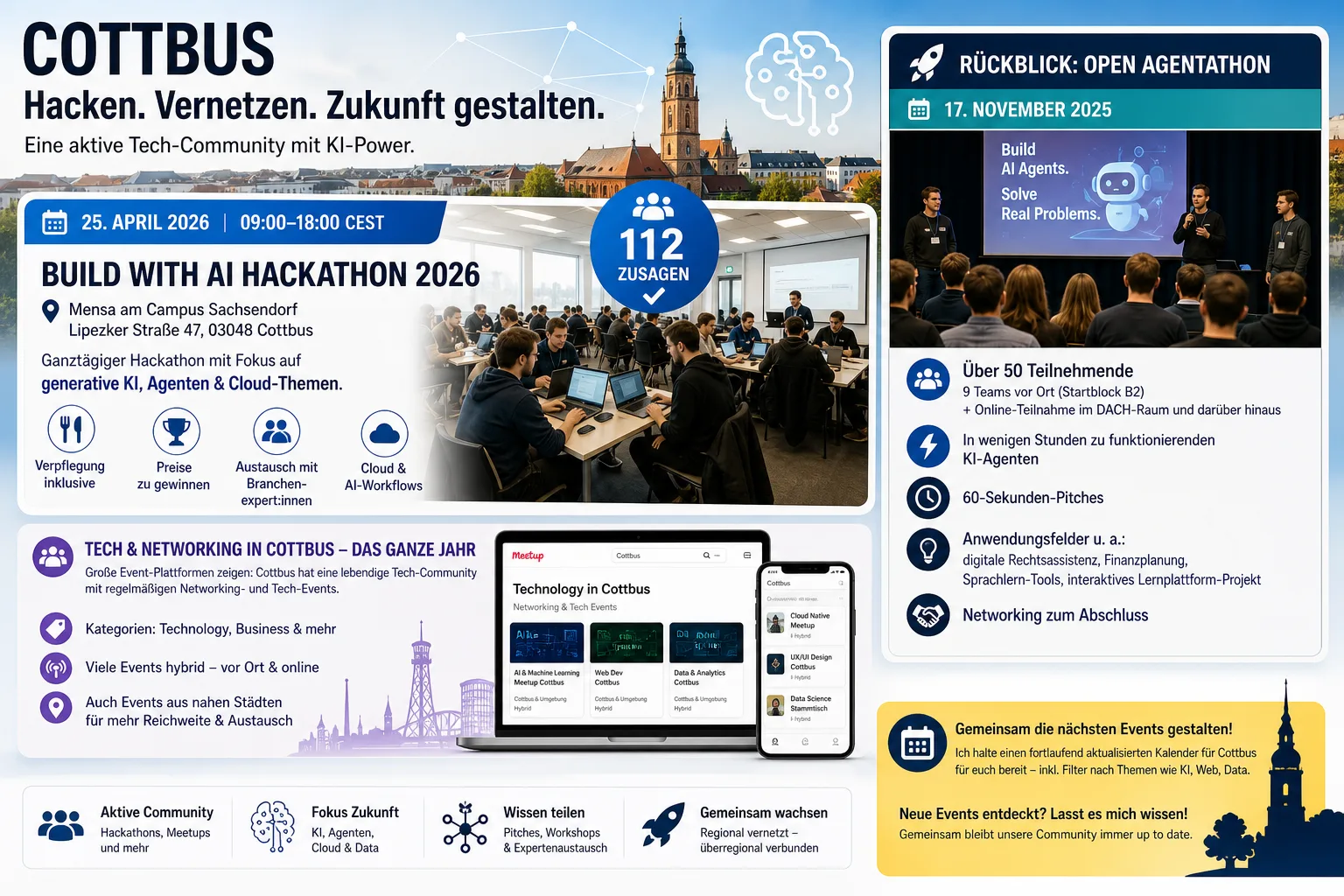
If you visit, study, or work in Cottbus in the coming months, you can also get to know the city through its tech events: meetups, workshops, and hackathons around software, data, cloud, and AI. This article is intended as a preview and guide—with a clear focus on future events and how you can prepare well.
Which Tech Meetups You Can Expect Soon in Cottbus
In Cottbus, recurring tech formats aimed at students, founders, professionals, and the curious are expected to be announced in the near future. Typical for the upcoming meetup series will likely be these focus areas:
- Software & Web: Frontend/Backend, APIs, Testing, Developer Tooling
- Data & AI: Prompting, Data Quality, Evaluation, Productive AI Applications
- Cloud & DevOps: Containers, Deployment, Monitoring, Security Basics
- Product & Business: MVP, User Research, Go-to-Market, Funding
Many of these events will in the future be announced as after-work meetups, hands-on sessions, or hybrid formats. In practice, this means you will often have the choice to network on-site or join remotely.
How to Reliably Find Upcoming Meetups
If you don't want to miss anything in the future, these sources will prove especially useful:
- Event platforms with categories like “Technology” and “Business” (e.g., Meetup or Eventbrite)
- University and innovation sites (announcements, newsletters, event calendars)
- LinkedIn (local groups, event pages, posts from organizers)
For planning upcoming visits to Cottbus, it is worth checking the event calendars already one to two weeks before your stay, as many meetups are published at short notice.
Hackathons in Cottbus: What Will Typically Happen at the Next Formats
At the next hackathons announced in Cottbus or nearby, it will likely again be about rapid prototyping, teamwork, and applicable ideas. The formats will often be designed for a day or a weekend and will generally pursue three goals:
- Learning under time pressure: try out new tools in practice instead of just talking about them
- Interdisciplinary teams: bring together code, design, product thinking, and storytelling
- Result orientation: a working demo booth at the end (even if not “perfect” yet)
This Is What the Process at the Next Hackathons Will Most Likely Look Like
- Kick-off: rules, topics, evaluation criteria, and possibly short tech impulses
- Team formation: pitches for ideas, matching by skills and interests
- Build phase: implementation of the prototype, short check-ins, mentoring
- Demo & Pitch: presentation, Q&A, feedback, possibly prizes
What You Should Pay Attention to at Future AI/Cloud Hackathons
If the upcoming hackathons (as is often the case now) use AI tools, APIs, or cloud services, these points will be especially important:
- Data protection: only use data that you are legally allowed to use (do not enter sensitive personal data into external tools).
- Security: never check secrets (API keys) into repos; assign minimal permissions; clean separation of test and demo environments.
- Transparency: clearly state in the pitch which parts are AI-generated and what risks/limitations exist.
AI & Agent Challenges: Why Short Pitches Will Play a Big Role in the Future
For upcoming competitions around “agents” (i.e., AI-powered systems that perform tasks semi-automatically), formats that demand convincing results in a short time will likely prevail. This is because “agents” can quickly seem complex—and short pitches help make the essentials visible.
What Will Work Well in Agent Pitches in the Future
- Clear task: “What problem does the agent solve—for whom—in what context?”
- Understandable process: Inputs → processing steps → output (preferably as a simple flow chart in the pitch deck)
- Controls: What guardrails prevent incorrect or risky actions?
- Measurability: What criteria show that the agent really helps (e.g., time savings, error rate, user feedback)?
At future events in Cottbus, projects that handle data, security, and transparency responsibly will likely be much better received—both by juries and potential partners.
How to Get Started at Upcoming Events (Even Without Pro-Level Skills)
You won't have to be “perfect” for upcoming meetups and hackathons in Cottbus. What you should bring is more a mix of curiosity, openness, and a small, realistic goal. For getting started, these three paths will be particularly suitable:
1) Meetups as Door Openers
An upcoming meetup will be the easiest entry point for many: you can listen, ask questions, make contacts. If there will be a Q&A round, prepare two to three questions that really concern you (e.g., tool choice, entry paths, learning resources).
2) Workshops for Structured Learning
If workshops on AI, data, or web development are announced in the next few months, they will be particularly suitable for systematically building up basics. When choosing, pay attention to whether the event requires prior knowledge and whether you need a practical exercise environment (laptop, accounts, software).
3) Hackathons for Team and Project Practice
At the next hackathon, it will make sense to start with a small scope: better a clear mini use case with a clean demo than a huge concept without a working result. If you don't program, you can still make a decisive contribution in the future—for example through:
- Product & Story: problem definition, target group, pitch logic
- Design: simple UI, click dummy, user guidance
- Research: sources, data situation, risk assessment, legal/ethical boundaries
- Testing: test cases, error reproduction, demo safety
Practical Checklist for Your Next Meetup or Hackathon
Before the Event (in the future)
- Read event description: goal, format, requirements, location/online link, code of conduct.
- Prepare laptop: updates, charger, possibly hotspot plan.
- Check accounts: GitHub/GitLab, cloud provider, collaboration tools (only if really needed).
- Have a mini-intro ready: “Who am I, what am I looking for, what do I want to work on?”
During the Event (in the future)
- Keep scope small: think demo-first.
- Document decisions: short notes on assumptions, data sources, risks.
- Pay attention to security: do not share secrets, do not enter sensitive data into tools.
After the Event (in the future)
- Follow-ups within 48 hours: contact people, share repo/slides.
- Set next step: a date for a short review call or a meetup for further work.
- Collect lessons learned: what worked, what should be different next time?
Sources & Further Links
- Meetup — Platform for finding and organizing meetups (accessed 2026-07-29)
- Eventbrite — Event search and ticketing, often used for tech workshops and conferences (accessed 2026-07-29)
- OWASP — Best practices for application security, relevant for hackathon prototypes (accessed 2026-07-29)
- NIST AI Risk Management Framework (AI RMF) — Guidance on risks and responsible AI use (accessed 2026-07-29)
- EUR-Lex — Official access to EU law (including regulations that may be relevant for AI compliance) (accessed 2026-07-29)