Cottbus Libraries & Literature – Culture for Eye & Ear
Libraries & Literary Houses in Cottbus – Culture for Ear & Eye (Outlook)
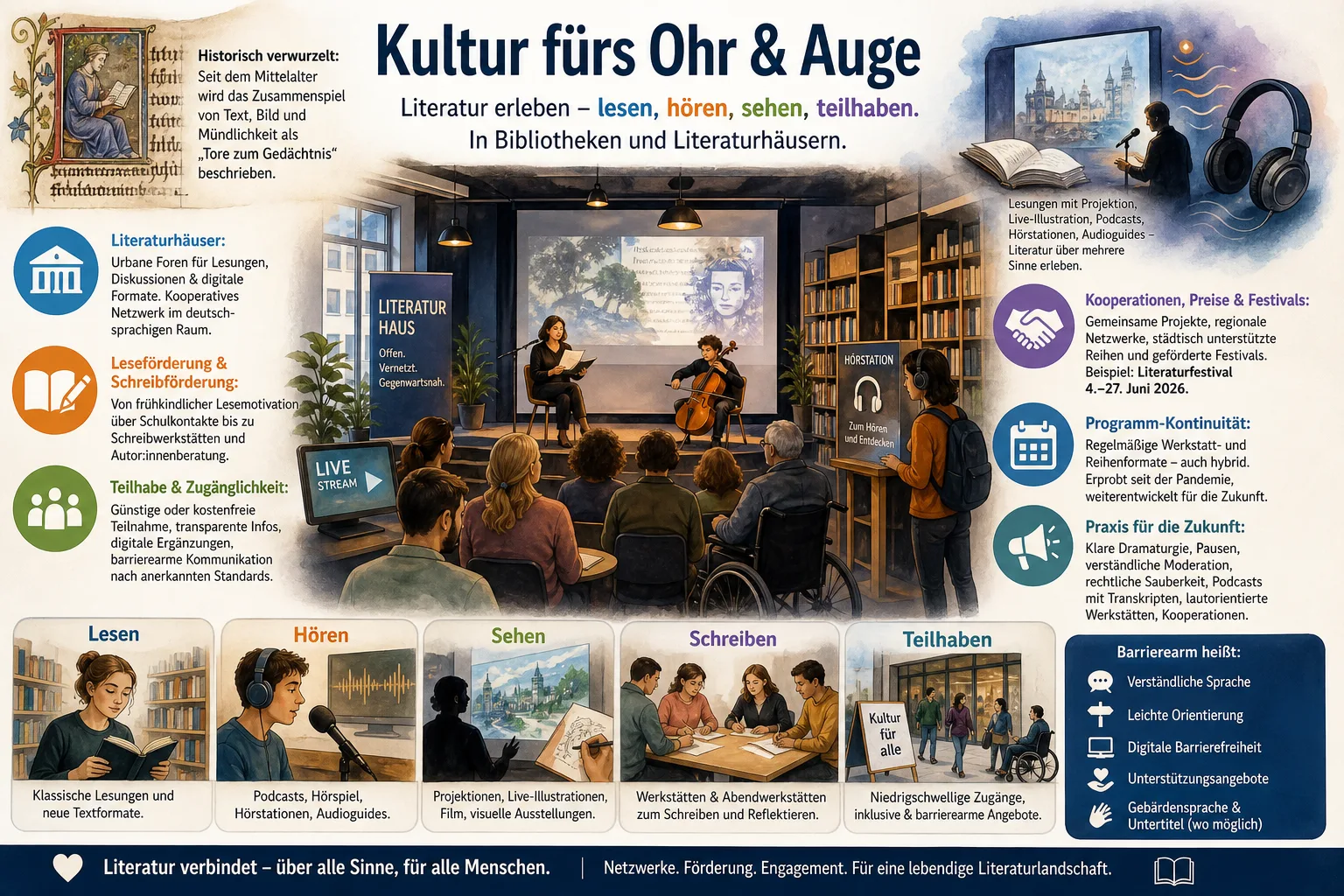
How might a city feel if stories in the future are not only read, but also heard and seen? In Cottbus, literary offerings are expected to be designed even more as sensory experiences in the coming months and years: with readings, visual elements (e.g., projections or live illustration), listening stations, accompanying exhibitions, and digital formats such as the podcast. This article summarizes which program ideas can be expected, which quality criteria (e.g., accessibility) count, and how visitors can find suitable formats.
Literary Houses as Forums of Urban Society
Literary houses and literary organizers in Cottbus can act as open forums in upcoming programs: as places where literature addresses, sharpens, and makes social questions discussable. This is especially successful when readings do not take place "at a distance," but are combined with moderated discussions and audience involvement.
Program Components That May Be Especially Relevant in the Future
- Reading + Discussion: Author appearances with moderated discussion, audience questions, and thematic deep dives.
- Literature & Performance: Formats in which text is combined with music, film, or spoken-word elements.
- Hybrid Participation: Events can be offered both on-site and digitally in parallel, so that more people can participate.
For Cottbus, this can mean: more opportunities to talk about urban development, identity, Sorbian/Wendish perspectives, education, or climate through literary voices—without requiring specialist knowledge.
Reading Promotion, Writing Workshop & Podcast: How Literature Comes Alive
A strong literary scene is likely to emerge where reading promotion, writing workshop formats, and digital offerings are conceived together. In Cottbus, these components can be particularly effective in the future if they are planned to be age-appropriate, inclusive, and recurring.
Reading Promotion: Entry Through Curiosity Instead of Performance Pressure
- Early Experiences: Reading aloud, picture book hours, and interactive formats can show children that stories are something sensory and playful.
- School Cooperations: Class formats can strengthen research skills, text comprehension, and conversational ability—ideally in connection with library visits.
- Family Formats: Shared reading, listening, storytelling, and creative activities can lower barriers and create routines.
Writing Workshops: From Impulse to One's Own Voice
Writing workshops can in the future be offered even more frequently as regular series: with short writing impulses, gentle feedback, methods for revision, and optional presentation formats (e.g., open mics, zine evenings, or workshop readings). It is important to communicate clearly whether the offer is suitable for beginners and what the framework conditions are (duration, group size, required prior knowledge).
Podcast & Audio: Reach That Lasts
Podcast formats can serve as a "second stage" in the future—for people who cannot attend on-site or want to listen to content again. To ensure audio offerings remain truly inclusive, operators can also provide short content summaries, chapter markers, and (where possible) transcripts.
Participation, Accessibility & Fair Access
If libraries and literary houses in Cottbus are to reach even more people in the future, participation and accessibility will become central quality features—not as an add-on, but as a planning basis.
What Visitors Can Typically Expect in Low-Barrier Programs
- Clear Information: clear times, location details, ticketing, durations, and target group information.
- Visual Readability: easily scalable font, contrasts, clear program structure—online as well as in print.
- Hearing Support: depending on the room and budget, e.g., induction loops, good microphones, or quiet acoustic zones.
- Digital Accessibility: easy-to-use websites, low-barrier PDF files, and clear player controls for audio/video.
- Fair Pricing: Discounts, group options, or free offers can significantly facilitate participation.
For guidance on digital accessibility, institutions can orient themselves to recognized standards such as the WCAG. International and national professional positions provide additional guidelines for the role of libraries as public, inclusive places.
Cooperations, Festivals, Exhibitions: Cottbus in the Literary Network
Literature is especially effective when local actors cooperate. For Cottbus, network formats in which libraries, schools, cultural initiatives, university actors, and regional partners develop joint series may be particularly interesting in upcoming programs.
Formats Well Suited for Cooperation
- Thematic Series with Local Reference: Evenings that open up urban questions literarily (e.g., change, work, environment, belonging) and invite different perspectives.
- Workshop Networks: Writing and media workshops with final formats such as a public reading, a small exhibition, or an audio premiere.
- Festival Components: Programs that combine readings with music, discussion, film, and exhibition formats—so that "ear & eye" are addressed equally.
To ensure such formats are sustainable in the long term, transparent curation, reliable time slots in the annual calendar, and clear communication to different target groups (families, young people, students, professionals, seniors) are helpful.
Outlook: How Cottbus Can Shape Its Literary Future
For the coming years, three development directions are emerging that Cottbus can actively shape—if resources, partners, and program work are consistently brought together:
- Analog + Digital as Standard: Events can more frequently have a digital "echo" in the future—as a podcast, recording, or supplementary material.
- Multilingualism: Program parts in several languages (e.g., bilingual readings or multilingual introductory texts) can reflect the city's diversity and reach new target groups.
- Accessibility from the Start: Accessibility can be treated more consistently as part of planning, budgeting, and communication in the future—so that participation becomes reliable.
Anyone who wants to experience "culture for ear & eye" in Cottbus in the future will likely find what they are looking for especially in such formats: a reading with live illustration, an audio play night with curated listening stations, a writing workshop with a closing evening, or an exhibition that brings together texts, images, and audio. Practical tip: check program calendars regularly, subscribe to newsletters, and ask early about accessibility questions (e.g., seat selection, hearing support, or digital access).
Note: This article provides editorial guidance on possible and typical literary formats. Specific dates, prices, and accessibility features depend on the respective organizer and should be checked in the current program before attending.