Career Events & Job Fairs in Cottbus – Career & Advice
Career Events & Job Fairs in Cottbus: Your Local Springboard
What it's about: This guide shows you what types of career events, job fairs, and advisory services you can expect in Cottbus, how to prepare strategically, and how to find reputable, up-to-date dates—without relying on outdated information.
Career Center & Job Boards: The Central Starting Point
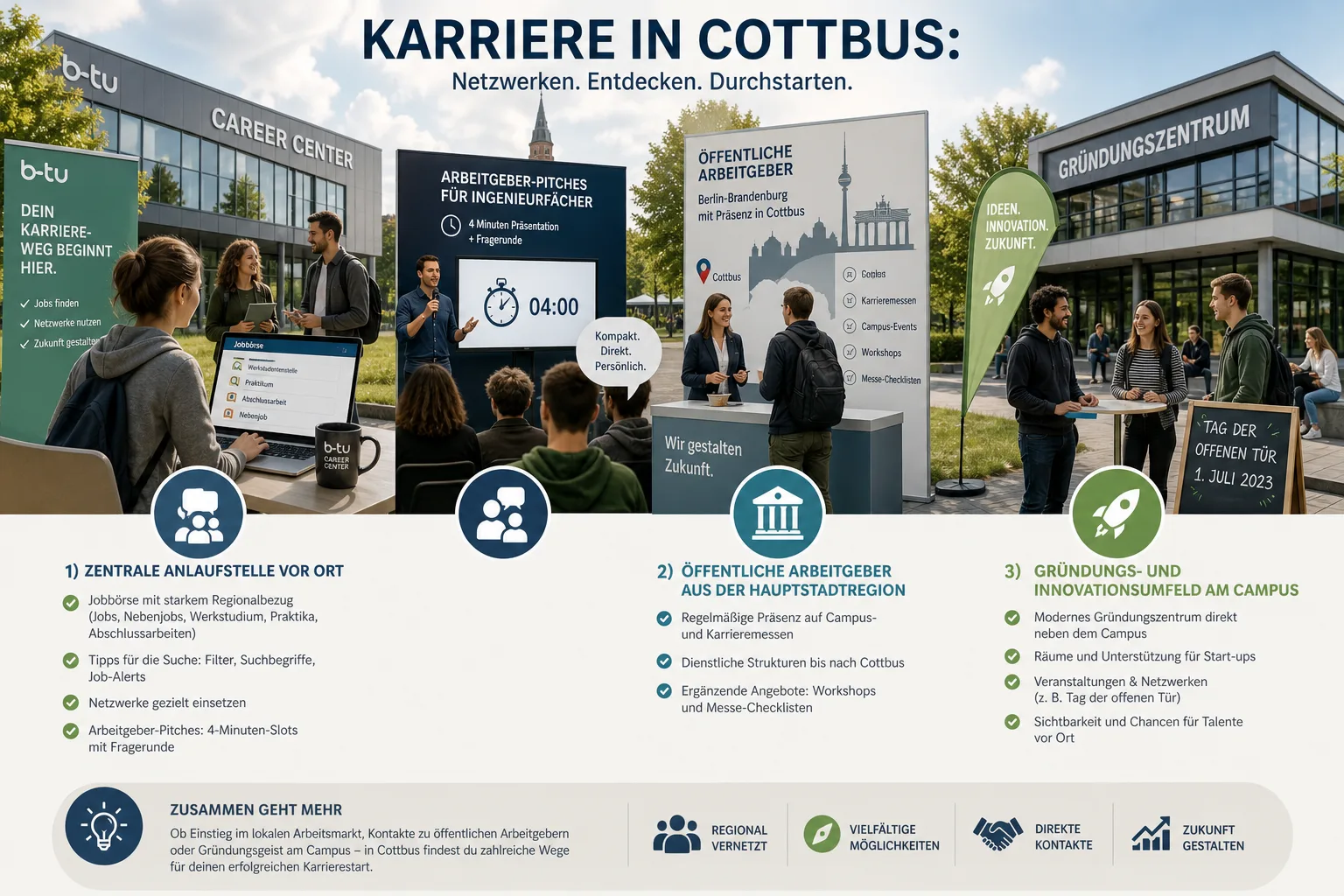
If you are studying in Cottbus or orienting yourself to university offerings, the Career Center (or the university's central career service structure) is usually the most reliable starting point for upcoming dates, employer contacts, and application support. Here, job boards, advisory services, and event announcements are usually bundled.
What Opportunities You Typically Find Through Job Boards
- Working student positions and part-time jobs
- Internships and practical phases
- Entry-level positions for graduates
- Theses in cooperation with companies (if offered)
- Academic-related activities at chairs or institutes (depending on the university)
How to Use the Job Board Not Just “Passively”
- Set up search profiles (e.g., industry, location/hybrid, hours).
- Activate notifications if the platform offers it.
- Create a short list of 5–10 target employers and regularly monitor their postings.
- Use advisory services to sharpen your CV and a short profile so you can present yourself clearly at events in 30–60 seconds.
Job Fairs, Employer Pitches & Networking Formats
In Cottbus, you can expect various event formats in the coming semesters and quarters—from classic exhibition stands to compact short presentations. Such dates are often published via university websites, event platforms, or through the career channels of participating employers.
Typical Formats You Can Plan For
- Job fairs/recruiting days: Many conversations in a short time; ideal if you want to compare several options.
- Employer pitches (short presentations): Short slots (e.g., a few minutes) plus Q&A; good for quickly getting a feel for tasks and culture.
- Workshops & application formats: CV checks, interview training, LinkedIn/XING optimization (depending on the offer).
- Networking evenings: Less formal, often more effective for internships, working student jobs, and thesis topics.
What You Should Specifically Say (and Ask) at the Event
To turn small talk into a next step, a clear “mini-pitch” helps:
- Who am I? Degree program/focus or professional focus in one sentence.
- What am I looking for? Internship/working student/entry-level role/project—with timeframe and scope.
- Why do I fit? 1–2 specific skills or projects (e.g., tool, method, lab/project work).
Good questions for employers include: “What tasks would I have in the first 8–12 weeks?”, “What does onboarding look like?”, “Which profiles are currently most urgently needed in the team?” or “Which documents help you to quickly assess me?”
Public Service & Capital Region as a Career Factor
Cottbus is within reach of the capital region—and as a result, public employers and institutions from Brandenburg or the surrounding area are often present at career formats. This can be attractive for you if you are looking for plannable career paths, structured entry points, or socially relevant tasks.
What You Should Clarify in Advance (So You Find Suitable Options)
- Direction: Administration, IT/digitalization, technology, infrastructure, education, research—depending on the posting.
- Process: Some entry points require fixed deadlines, online tests, or structured selection interviews.
- Documents: Completeness, proof, and formal criteria often count more than in some private companies.
At events, you can specifically ask about the next sensible step—for example, “Are there suitable internships or student jobs that serve as entry channels?” or “What are the typical posting periods with you?”
Founding, Innovation & Alternative Career Paths
In addition to classic employers, you can probably also find formats in Cottbus around founding, innovation, and transfer—such as information events, open advisory hours, or networking formats from start-up centers and innovation hubs in the university environment.
Why This Is Also Relevant for Non-Founders
- Internships and working student roles in young teams often offer steep learning curves.
- Project and thesis work can be closer to real product or customer topics.
- You strengthen skills like problem-solving, communication, and ownership—skills that employers regularly seek.
If you want to found, events are less about “the perfect idea” and more about next steps: problem, target group, first tests, team skills, funding and advisory offers. Good programs make transparent which requirements apply and how decisions are made.
How to Use Events Strategically (Preparation to Follow-up)
1) Preparation (1–3 Days Before)
- Define your goal: “I want 3 concrete contacts for internships” or “I want to find out which 2 industries suit me.”
- Documents ready: CV as PDF, a short profile (3–5 bullet points), and—if useful—project portfolio or GitHub/work samples.
- Employer list: 5 favorites + 5 “backup” stands so you don’t wander aimlessly.
- Note questions: 2 questions per target employer that are not answered on the website.
2) At the Event (Focus Instead of Collecting)
- Quality over quantity: Better 4 good conversations than 20 business cards without context.
- Notes immediately: After each conversation, 2–3 keywords (name, topic, next step).
- Concrete conclusion: “May I send you my profile?” / “Who is the right contact person?” / “Which posting should I use?”
3) Follow-up (Within 24–72 Hours)
- Thank you message referring to the conversation (1–2 sentences are enough).
- Apply to the appropriate posting or make an unsolicited contact if expressly desired.
- Follow-up only if a next step was agreed (e.g., documents, appointment, link).
How to Check Dates, Providers & Credibility
To ensure you only work with current and trustworthy information, you should always verify dates via primary sources. This is especially important because event pages change and external announcements are not always updated promptly.
Practical Checklist
- Check primary source: Is the event listed on the official university/career service page or with the organizer?
- Imprint & data protection: Reputable providers name those responsible, contact methods, and data protection information.
- Participating employers: Are companies/institutions named and linked?
- Contact channel: Are applications processed via official portals/email domains (no dubious forms without context)?
- Up-to-dateness: Are there notes like “updated on” or ongoing date maintenance?
If an event is subject to a fee, read the participation conditions carefully and clarify in advance what service you will actually receive (e.g., workshop, coaching, document check). Costs alone are not a disqualifier—but lack of transparency is.