Citizens' Assembly in Cottbus: Experience City Politics
Experience Citizens' Assemblies & City Politics in Cottbus: How You Can Participate in the Future
Anyone in Cottbus who wants to know how decisions are prepared in the future can use citizens' assemblies, public meetings, and dialogue formats. This guide shows which formats exist, how to prepare, and where to find reliable dates.
Formal Citizens' Assemblies: Official Exchange
How does it feel when a decision about your neighborhood is not made somewhere behind closed doors, but is discussed publicly? That is exactly what citizens' assemblies and related participation formats are for: You can listen, follow the agenda, ask questions, and experience how municipal considerations arise.
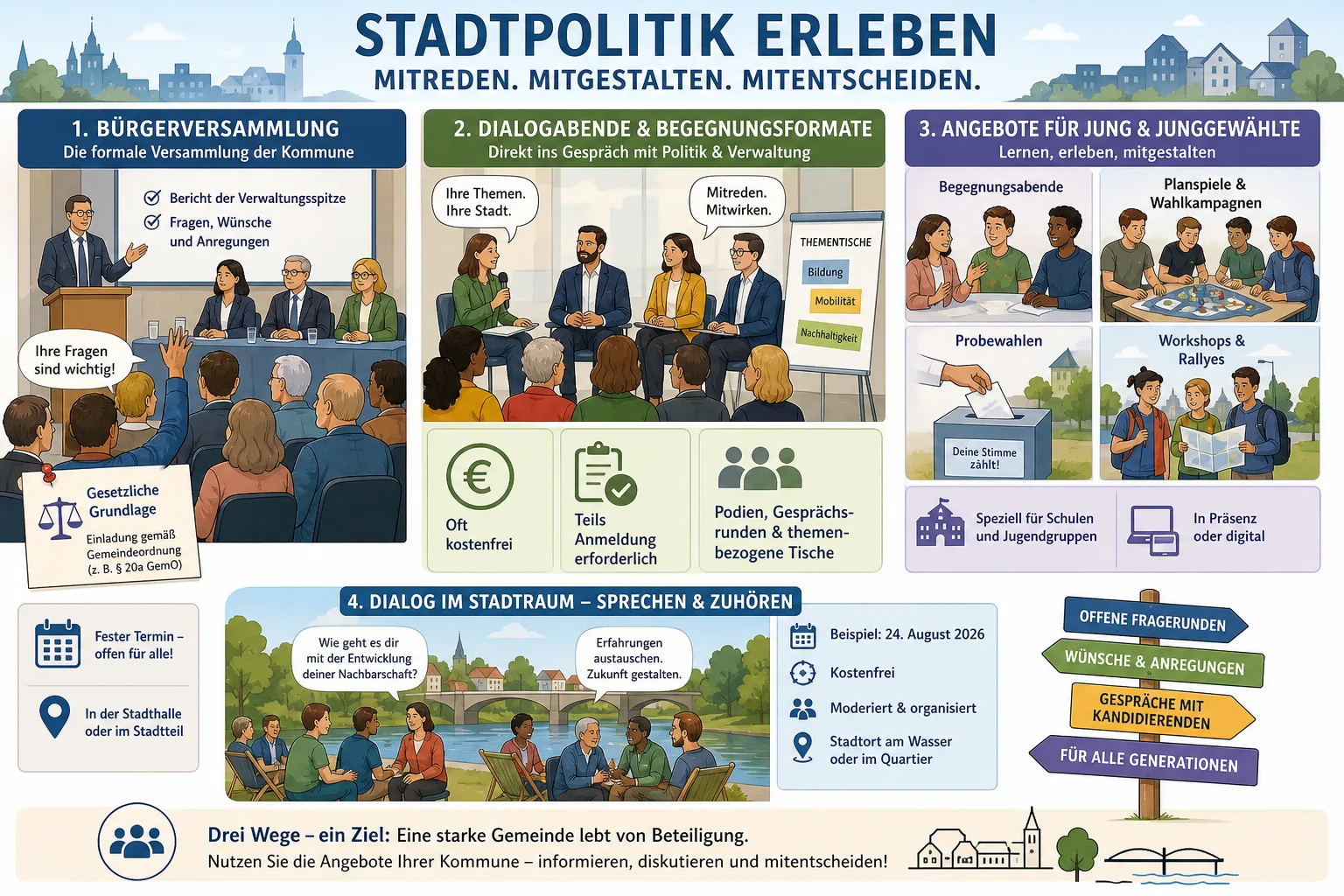
In Cottbus (as in many municipalities in Brandenburg), citizens' assemblies are a formal framework in which the administration and local politics inform and the public can ask questions. The specific design (e.g., procedure, speaking times, moderation) is usually explained in the invitation or rules of procedure.
Typical Procedure You Can Expect in the Future
- Welcome & Notes on the Procedure: At the beginning, it is explained how to request to speak and which topics will be addressed.
- Report/Classification by Administration or City Leadership: Current projects, plans, or statuses are often presented (e.g., urban development, mobility, education, safety, green spaces).
- Questions & Concerns from the Public: You can address specific points. Depending on the format, answers are given directly or provided later in writing.
Many of these events are free of charge. The core benefit is transparency: You learn what leeway exists, why certain steps are necessary (e.g., budget situation, legal requirements), and where your suggestions can actually have an impact.
Where to Find Dates & Agendas in the Future
To ensure you don't miss any important citizens' assembly, committee meeting, or city council meeting, it is worth establishing a fixed information workflow. For Cottbus, official publications are especially important.
- Official Website of the City of Cottbus: Invitations, meeting calendars, announcements, and often agendas/documents will be published there in the future.
- Council Information System / Meeting Service (if available): Many cities provide agendas, draft resolutions, and minutes through this. If Cottbus uses such a portal, it is the most reliable source for documents.
- Official Gazette/Official Announcements: Legally relevant invitations and announcements are often published via an official gazette or an official section.
Practical Tip: Set a monthly reminder in your calendar to check the meeting calendar and announcements. This way, you stay up to date even without social media or newsletters.
Dialogue Evenings & Local Political Events (Also Around Elections)
In addition to formal citizens' assemblies, there will be dialogue evenings, information events, and moderated discussion rounds in Cottbus and the region in the future. Especially in the run-up to elections (e.g., local elections), the number of such formats typically increases, as many actors seek direct exchange.
Formats You Will Frequently Encounter in the Future
- Panel Discussions: Several candidates or party representatives discuss publicly; afterwards, there are Q&A sessions.
- Themed Evenings: A focus (e.g., transport, housing, climate, safety, urban development) allows for in-depth questions.
- Neighborhood Forums: Discussions directly in the neighborhood – in community centers, schools, or cultural institutions – with reference to specific places and everyday routes.
Important for your orientation: Neutrally moderated formats will often be supported by actors in political education (e.g., state centers or civil society organizations). This helps to explain procedures clearly and structure debates fairly.
Formats for Young People & First-Time Voters
To enable young people to experience local democracy in practice, there will be an increased number of target group-specific formats in the future – often in cooperation with schools, youth clubs, or educational providers.
- Simulation Games: Participants simulate a meeting or an election campaign, negotiate motions, and experience how compromises are made.
- Local Political City Rallies: Stations at places where politics becomes visible (e.g., school routes, sports fields, public transport hubs) connect facts with everyday experience.
- Workshops with Administration/Local Politics: Collect questions, discuss priorities, clarify next steps – often with moderated small groups.
- Low-Threshold Discussion Evenings: Informal meetings lower barriers and encourage direct, understandable questions.
If you want to support young people as a parent, teacher, or club member, it helps to pay attention to neutrality, moderation, and clear rules – so that it really is about orientation and participation.
City Politics in Public Spaces: Speaking & Listening
In addition to events in halls, formats in public spaces will become increasingly important in the future: Conversations in squares, on promenades, or at mobile information stands bring politics to where people are anyway.
This Is How "Speaking & Listening" Formats Work in Practice
- Moderated Discussion Rounds: Moderation ensures speaking time, respectful rules, and topic focus.
- Short Information Impulses: Facts are briefly explained in advance (e.g., responsibilities, schedules, procedures) so that questions can be more targeted.
- Documentation: Concerns are collected and – depending on the organizer – published as a summary or list of topics.
The advantage: When participation is visible and accessible, the distance between administration, politics, and the neighborhood decreases – and topics such as transport, noise, safety, or green spaces can be discussed more concretely.
How to Prepare for Citizens' Assemblies & More
With just a few steps, you can get much more out of public events in the future – whether you are participating for the first time or regularly.
- Read the agenda in advance: This way you know when "your" topic is likely to come up.
- Formulate questions briefly and concretely: A clear question (Who is responsible? What deadline? What alternative?) increases the chance of a usable answer.
- Document examples: Note location, time, frequency (e.g., with traffic noise) and stick to verifiable observations.
- Clarify responsibilities: Some topics are not the city's responsibility (e.g., state or federal roads). If you know this early, you save time.
- Remain respectful but persistent: Good participation is objective, precise, and asks about the next step.
Why It Is Worth Experiencing City Politics in Cottbus
Local politics will soon decide very concretely about your everyday life: routes to school, cycling and walking, development plans, playgrounds, culture, order, cleanliness, or climate adaptation. Those who use public events gain twice: more understanding of processes and more influence through well-placed questions and suggestions.
If you regularly listen, ask questions, and check documents, abstract processes become tangible: What steps are next? What deadline is running? Who decides? This is exactly where effective citizen participation begins.
Sources
- Brandenburg Municipal Constitution (BbgKVerf) — Legal basis for municipal bodies, public access, and forms of participation in Brandenburg (accessed 2026-11-04)
- City of Cottbus/Chóśebuz (official website) — Official information, announcements, and municipal services (accessed 2026-11-04)
- Federal Agency for Civic Education (bpb) — Background knowledge on elections, democracy, and political procedures (accessed 2026-11-04)
- State Agency for Civic Education Brandenburg — Information and offers for civic education in Brandenburg (accessed 2026-11-04)